

Support CleanTechnica’s work through a Substack subscription, on Patreon, or on Stripe. Help us produce all of the high-quality, original content we publish week after week despite the challenges of content-scraping AI, antisocial media, inflation, and other hurdles.
RheEnergise deserves credit for something a lot of energy-storage startups never accomplish: it built the thing. At Cornwood in Devon, the company constructed upper and lower reservoirs, installed pumps, pipes and generating equipment, manufactured hundreds of cubic metres of its proprietary high-density fluid, pumped that fluid uphill and ran it back through a turbine. The demonstrator reached its 500 kW design power. Dense-fluid pumped hydro is therefore no longer an attractive rendering, a laboratory claim or an extrapolation from component testing. It is a working storage technology demonstration, albeit with only 15 minutes of storage and not grid connected.
That does not settle the more important commercial question. Pumped hydro earns its value by storing energy over time, not by briefly reaching its power rating. The final UK government demonstrator report says Cornwood was designed around four hours of operation at 500 kW, but difficulties producing enough acceptable high-density fluid reduced the available inventory and left the finished system with roughly 15 minutes of full-power discharge. The integrated system also measured 59% round-trip efficiency before parasitic loads that had not yet been measured. Those are entirely legitimate results for a first-of-a-kind demonstrator. They are also a reminder that proving a machine works and proving an energy-storage architecture scales economically are different milestones.
This is the short version of a deeper TFIE Strategy Briefing assessment. The interesting question is no longer whether RheEnergise can push a mineral-rich fluid uphill and recover electricity from it. Cornwood answered that. The question is what happens to costs, siting and competition when storage duration rises from a demonstrator to the multi-hour and multi-GWh scales where long-duration storage is supposed to matter.
The fundamental attraction of RheEnergise’s approach is easy to understand. Its fluid is about 2.5 times as dense as water, so the same gravitational energy can be obtained with less fluid volume or less elevation. That can mean smaller reservoirs or access to lower hills. RheEnergise has emphasized precisely that siting advantage, including in its response to my 2024 assessment, arguing that high-density hydro can open sites conventional pumped hydro cannot use economically. Density really does provide an engineering advantage. The problem is that density is not free.
Water is an unusually difficult storage medium to improve upon. It is cheap, chemically simple, stable and available by millions of tonnes without manufacturing a specialist commodity. It does not need to be milled, formulated, mixed, kept homogeneous or sourced from a mineral supply chain. Conventional closed-loop pumped hydro also has a much larger potential site resource than discussions of giant river dams tend to imply. Australian National University researchers identified roughly 616,000 prospective off-river closed-loop sites with around 23,000 TWh of theoretical storage potential. Most will never be built, but the surplus is so large that lack of technically plausible hills is not the constraint advocates of alternative gravity-storage systems sometimes assume. We do have this thing called transmission, after all.
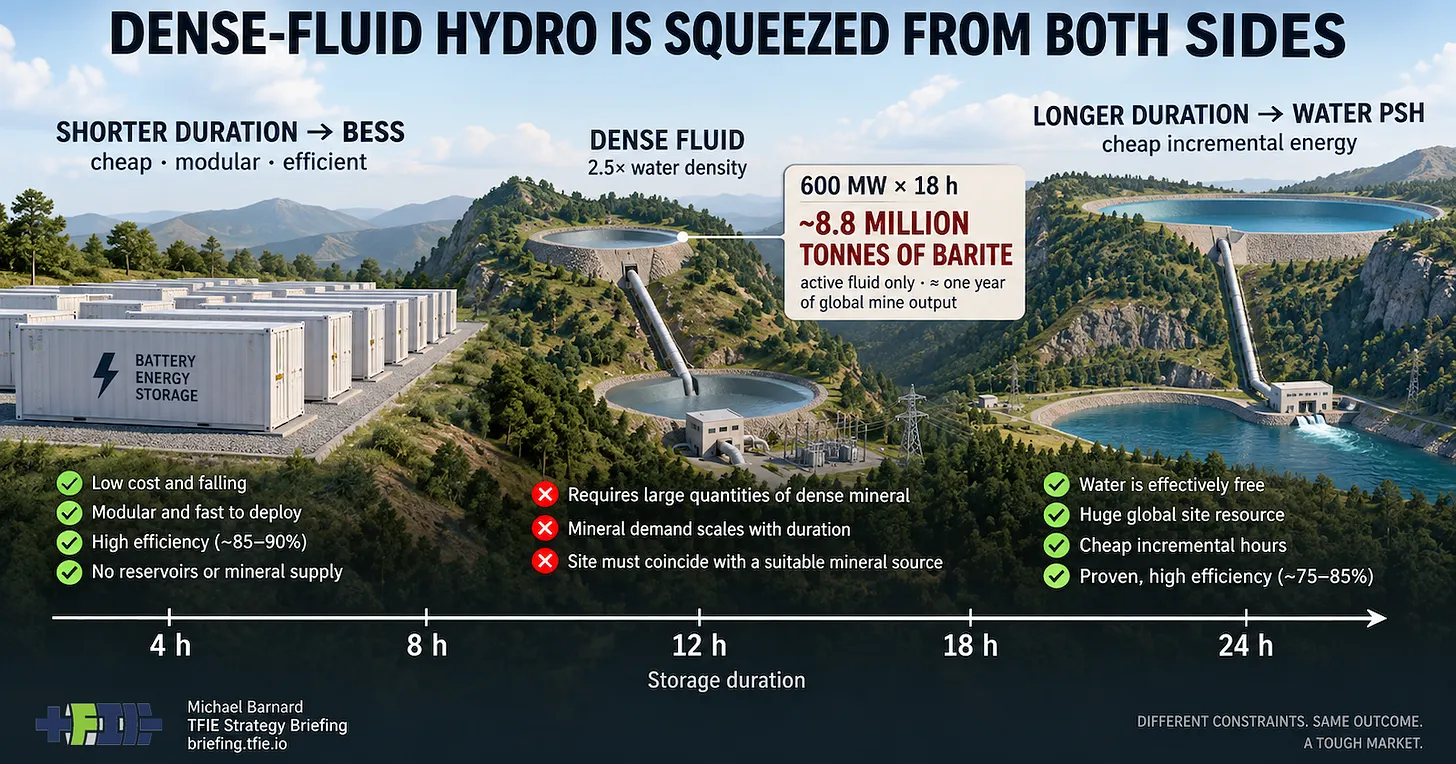
The difficulty for dense-fluid hydro emerges when stored energy increases. At fixed power and head, each additional hour of storage requires approximately proportionally more working fluid and therefore more weighting mineral. The example on the Briefing’s hero graphic is deliberately at a recognizably long-duration scale: 600 MW for 18 hours. Using the barite-rich formulation disclosed in RheEnergise’s patent as a screening case, the active fluid alone would require roughly 8.8 million tonnes of barite. For context, one storage project would be asking for mineral quantities comparable to current annual global mine production, before inactive inventory, processing losses or contingency stocks are considered.
RheEnergise is clearly aware that buying ordinary commercial barite by the millions of tonnes cannot be the scalable answer. Its work increasingly emphasizes mines and quarries where suitable dense material or waste streams might be available locally. That could produce worthwhile projects. A mine with disturbed land, a suitable hill, a constrained grid connection and a large nearby stockpile of benign material may be exactly the sort of place where an unconventional storage architecture earns its keep. But that solution changes rather than removes the siting constraint. Instead of requiring suitable topography, geology, reservoirs, transmission and permitting, the project now also requires an enormous nearby mineral source with the right density, chemistry, recovery yield, particle behaviour and processing economics.
Duration then creates an awkward competitive squeeze. Reducing storage to four, six or eight hours makes the mineral inventory much easier to imagine, but it moves dense-fluid hydro into the market where lithium-ion batteries are strongest and getting cheaper. BloombergNEF’s 2025 battery price survey put stationary-storage battery packs at about $70/kWh, down sharply in a year. Pack price is not installed BESS cost, but the direction matters because RheEnergise’s own early commercial focus is increasingly around 10–20 MW modules and roughly four to eight hours of duration. Its hardest mineral problem improves precisely as its battery competition gets stronger.
Moving toward 12, 18 or 24 hours weakens the battery comparison, but the mineral requirement grows almost linearly with stored energy. Those are also the durations where conventional pumped hydro’s almost-free working fluid becomes increasingly valuable. Water projects need larger reservoirs as duration rises, but the extra stored mass is water. Dense-fluid projects need more manufactured, qualified suspension. That is the duration trap: going shorter pushes RheEnergise toward batteries, while going longer magnifies its distinctive material constraint and strengthens the comparison with water.
Cornwood adds another useful reality check. The final demonstrator report describes months of troubleshooting and reformulating the fluid-production process, moisture sensitivity in barite feedstock, unexpectedly slow mixing and chemistry differences in replacement additives. None of those lessons means dense-fluid storage cannot work. Discovering them is exactly what a demonstrator is for. They do mean the working fluid should be treated as part of the engineered plant rather than as a passive substitute for water. The same applies to efficiency. RheEnergise models approximately 80% round-trip efficiency for commercial systems, and larger machinery may indeed perform better, but the measured integrated result at Cornwood is currently 59%.
That leaves room for a niche without supporting a broad storage winner. There might be projects beside mines or quarries where geography, grid needs, existing disturbed land and enormous quantities of cheap suitable material line up. If RheEnergise builds several of those successfully, they will be genuine commercial achievements, assuming that maintaining the mineral suspension doesn’t cost too much. What the current evidence does not yet show is a storage architecture capable of escaping the technologies on either side of it. Batteries keep strengthening at shorter durations. Conventional pumped hydro retains extremely cheap incremental energy at long durations. RheEnergise has now proved that dense-fluid pumped hydro can work. The scaling math suggests that working may be the easier part.
The full TFIE Strategy Briefing analysis works through the civil-engineering comparison, disclosed fluid chemistry, mineral-cost arithmetic, mine-waste siting constraint, duration scaling and the gap between measured demonstrator performance and commercial assumptions.
Sign up for CleanTechnica’s Weekly Substack for Zach and Scott’s in-depth analyses and high level summaries, sign up for our daily newsletter, and follow us on Google News!
Have a tip for CleanTechnica? Want to advertise? Want to suggest a guest for our CleanTech Talk podcast? Contact us here.
Sign up for our daily newsletter for 10–15 new cleantech stories a day. Or sign up for our weekly one on top stories of the week if daily is too frequent.

CleanTechnica uses affiliate links. See our policy here.
CleanTechnica’s Comment Policy