
Support CleanTechnica’s work through a Substack subscription, on Patreon, or on Stripe. Help us produce all of the high-quality, original content we publish week after week despite the challenges of content-scraping AI, antisocial media, inflation, and other hurdles.
Record Month — BEVs Reach 31% Market Share!
BEVs remain in high demand in Europe, with pure electrics reaching a record 31% share last month thanks to a record 422,000 fully electric passenger cars being registered in Europe, which is not only a 63%(!) increase year over year (YoY), but is also the fastest growth rate in over three years!
Overall, plugin vehicles were up 49% YoY, dragged down by plugin hybrids, which grew only 23%, to 167,000 units, which was also a new record high for plugin hybrids in Europe, thus placing September’s total plugin volume at a best ever 590,000 units and its share at 43% (31% for BEVs only).
With BEVs pulling the market upwards, the year-to-date share for BEVs is now at 25% (36% for PHEVs and BEVs combined), which is already higher than the 2025 final result (20% BEV share, 29% adding PHEVs). This is an encouraging sign if we want to be close to 100% PEV share by the mid-2030s.
Looking at other powertrains, while petrol (18% share in September, down 21% YoY) and diesel (4%, down 28% YoY) continue their downward trend into irrelevance, the main news is the fact that we could have already passed the point of peak HEV — in September, plugless hybrids still grew, albeit less (+5% YoY) than the overall market (+10%, to 1.4 million units).
More important than that, if we compare the 34% share earned by HEVs in September 2026 with the share they had 12 months ago (36% then), we might be witnessing the beginning of plugless hybrids’ downward slope. So … if 2026 is the year of peak HEVs, how far are we from peak PHEVs?



Looking at the best sellers in several size categories, the EV push is starting to get visible. While we are far from the EV domination we see in China, things are indeed evolving in Europe.
Before, the only EVs that we saw on the overall podiums were Teslas. Now, besides those two usual suspects, the 3rd placed model in the midsize category, the Mercedes GLC, is also heavily electrified, with 59% of all its sales coming from either its new BEV model (representing 44% of its total sales) or the PHEV versions (15% of sales), leaving the ICE versions representing just 41% of total sales.
The A-segment has the Renault Twingo as the 2nd placed model. Like in China before, expect this category to be quickly electrified. Firstly, the ICE competition is shrinking. Secondly, not only do we have the Renault Twingo already on the podium, but the new Dacia Spring is set to become a success, so expect it to join the Renault sibling on the podium. As a third musketeer, the VW ID.Up is set to land sometime next year, which is another strong bet from the German brand — and nothing shorter than a podium position would do.
And even if all these competitors cannot remove the eternal Fiat Panda from the podium … then the 2028 Fiat Koala and Citroen 2CV surely will. And let’s not forget the Chinese competition, namely the future second-generation Leapmotor city car, said to be developed together with the Koala and 2CV. Not counting others, by 2028, we will have half a dozen serious candidates for podium positions in the city car category.
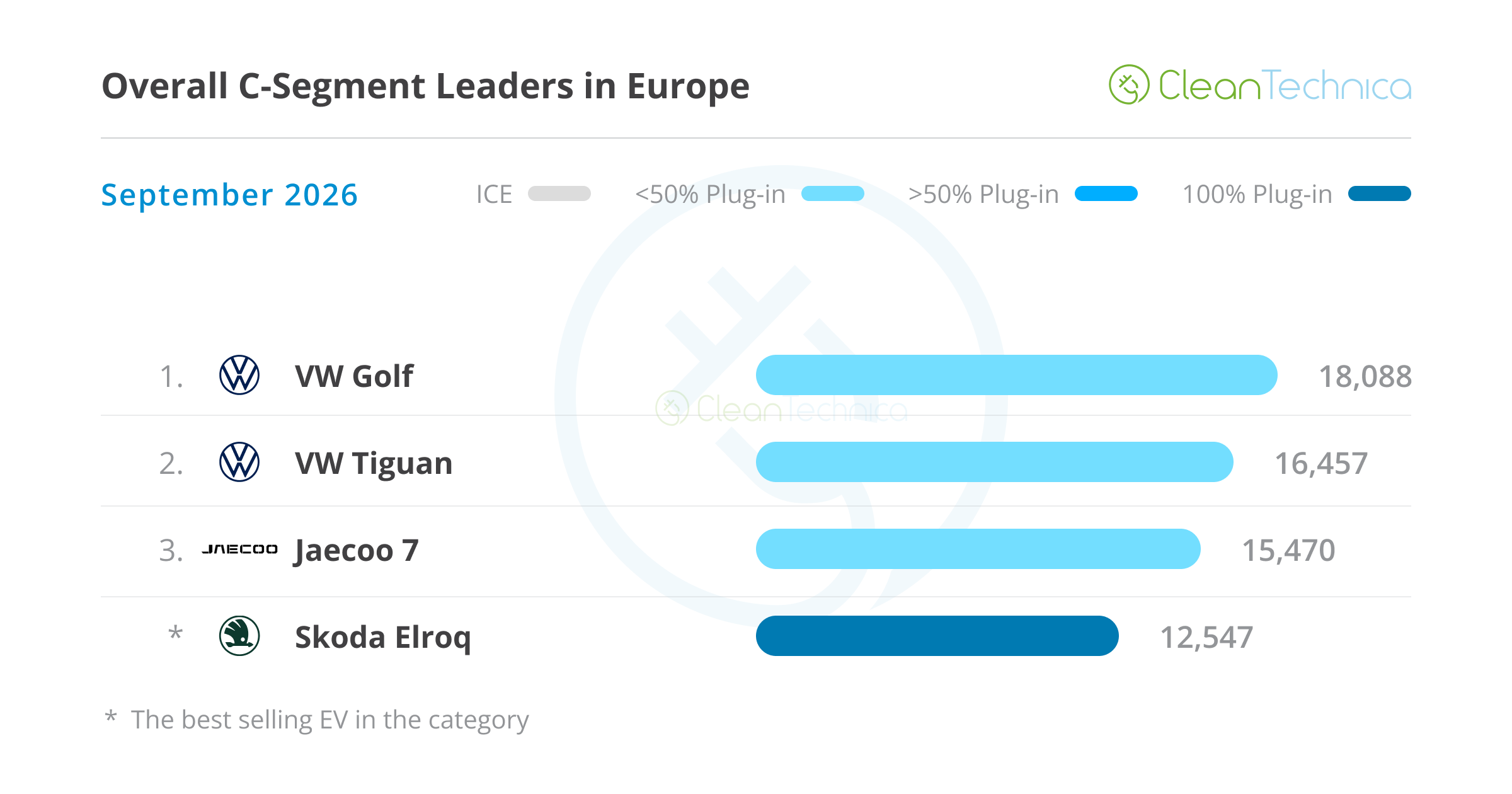
Looking at the other segments, the B-segment is still ICE-heavy, with none of the top 3 models having a plugin version, the C-segment is getting increasingly electrified (#1 VW Golf is 31% PHEV, #2 VW Tiguan is 32% PHEV, and #3 Jaecoo 7 is 47% PHEV).
In the full size category, electrification is also significant, with the #1 BMW 5 Series (including the BMW i5) having 74% of sales coming from either the BEV or the PHEV version; the #2 BMW X5 being 28% electrified (either with the BEV i5 or the PHEV version); and the #3 Range Rover Sport having 33% of its sales coming from the PHEV versions.
So, electrification in the D-segment is quite advanced, while the A, C, and E segments are showing good potential, with real progress being made. But the all-important B Segment is showing that it is in the laggard category.
(A note on the full size category and its importance on the European market: the best selling E-segment model was just #109 overall … which says a lot about the (in)significance of it in the larger scheme of things. True, margins are attractive, but it’s a faaar smaller market than its counterpart categories in the USA or China. The full size category represents 18% of the market in both China and the USA, while in Europe, it represents only 6%.)

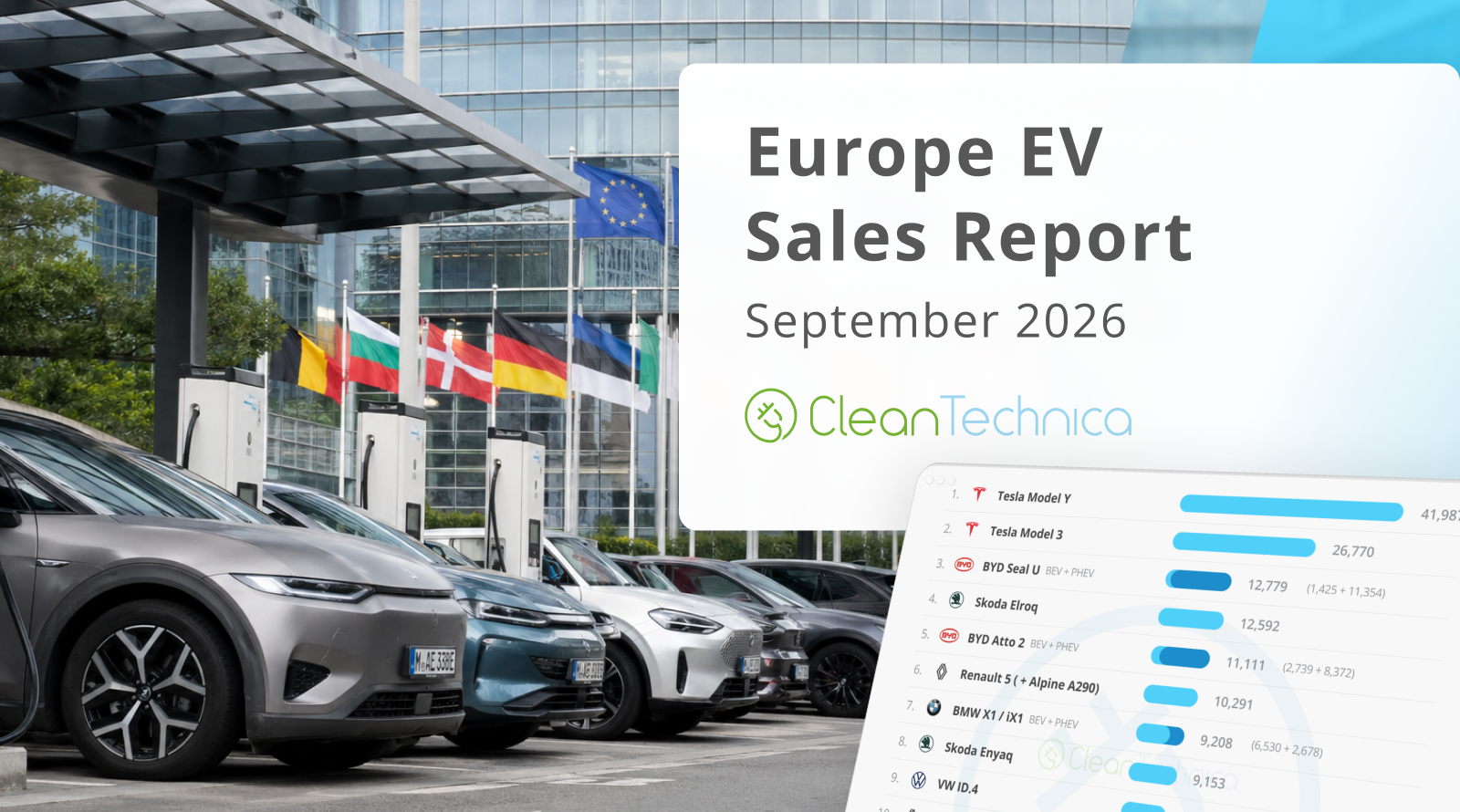
Looking at September’s best selling EV models, the big news this month was Tesla winning 1st and 2nd place, and by a large margin — so much so that the #1 plus #2 win extended into the overall market! Yes, you have read that right — for only the second time ever, the other time being in December 2022, Tesla placed the Model Y in 1st and the Model 3 in 2nd on the overall market! Notice, also, BYD placing two models in the top 5. Here’s a more detailed analysis of the top 5 EVs in September:
#1 Tesla Model Y — Tesla’s midsize crossover is back in the driver’s seat, thanks to an amazing 41,987 registrations in September, a 52% increase YoY, and its best result in four and a half years! The Berlin-made crossover was the overall #1 in Germany, France, Iceland, Ireland, Sweden, the Netherlands, Norway, Switzerland, Denmark, Finland, and … maybe a few more I might be forgetting. This was its second best performance ever in Europe, only behind the 46,512-unit score of March 2023. With Model Y prices starting at €40,000, and even after six years on the market, the crossover offers an appealing package and, together with its Model 3 sibling and a few Chinese models, is reviving a lost category on the European automotive market — the midsize mainstream market. Remember a time when the Ford Mondeo, Opel Vectra, and others sold at least as much as the models of the premium Germans? Well, it seems that with their prices now starting above 50,000 euros, that has created a hole in the market, where between 40,000 to 50,000 euros you can get a lot of great midsize models (both Teslas, the Xpeng G6, the Mazda 6e/CX-6e, the Deepal S07, the BYD Seal/Seal U, the Leapmotor C10, the Zeekr 7 GT, etc.), for a fair bit less money than the German brands. Currently, you buy one of these with your wallet/head, not your heart. And that’s exactly where the market is headed. People don’t care as much about badge, they care about value. That is exactly the kind of buyer that is now searching for EVs. These people don’t want a badge, they simply want to lower their costs by switching from ICEVs to BEVs.
#2 Tesla Model 3 — Tesla’s sedan was 2nd in September thanks to 26,770 registrations, an awesome surge of 120% YoY that allowed it to be 2nd in the overall European market. Benefiting from the same tailwinds as the Model Y (mass surge in EV demand, competitive pricing, and rapid production ramp-up), the 10-year-old sedan is racing to meet soaring demand, as proven by the current 3- to 4-month waiting list. Its demand surged because price-conscious buyers are in the market and its prices, starting around €35,000, place it, a midsize sedan, in competition with models one segment below, compact hatchbacks. As of this moment, it seems Tesla’s sedan will recover its podium position in 2026, and maybe even provide a gold plus silver win for Tesla at the end of the year … which is no mean feat for a 10-year-old model wearing a body type (sedan) not popular in Europe.
#3 BYD Seal U (BEV+PHEV) — The Chinese SUV remained in the top 5 and hit a record 12,779 registrations last month, meaning that while the BYD’s star is recovering in China, thanks to its new-generation Ultra body, the old generation is still able to win medals in Europe all by itself (a bit like when veteran football/soccer players leave top leagues and semi-retire in less competitive ones…). September’s 3rd place finish was much thanks to generous discounts, but still, with the model’s development costs now well behind it, BYD can afford to go into hard discount territory with this one.
#4 Skoda Elroq — The Elroq continues surfing the BEV wave, with the 12,592 registrations representing a record result. Looking ahead, the Czech crossover will have to face fierce internal competition, as the new, smaller, and more affordable Skoda Epiq crossover is about to land. Being simultaneously cheaper and more modern than the Elroq, will the Epiq become Skoda’s new best seller at the cost of the Elroq?
#5 BYD Atto 2 (BEV+PHEV) — The Chinese make has another hit on its hands, with the small crossover scoring 11,111 registrations, mostly thanks to the new PHEV version. Why so popular in Europe? Besides not having real competition in the small PHEV category, the top range version has a 18 kWh battery, providing a usable range (90 km/56 mi). Additionally, it has increasingly important vehicle-to-load (V2L) capability. With the recent Dolphin G PHEV small hatchback using the same powertrain, expect the Shenzhen make to have another representative on the European table soon, especially considering that the new hatchback will be made in Hungary.

Outside the top 5, there were a number of record scores to mention, as would be expected in a record month.
Starting with Mercedes, we have both its representatives, the CLA EV (15th place with 7,206 registrations) and the new Mercedes GLC EV (16th place, 7,099 units) scoring record results.
Regardless of what might happen to the GLC, I am now curious to see whether the Mercedes GLC will be able to surpass to the BMW iX3’s volumes. I mean, the three-pointed-star model’s specs are a degree below the Bimmer’s, but on the other hand, it looks like Mercedes is ramping up production faster than BMW, as one can see from the waiting lists of both models (5 to 6 months for the Mercedes, around 9 months for the BMW). An example of that is that Mercedes is working its Bremen factory 24/6 to make the GLC, while BMW only now added a second shift to its Debrecen plant.
Good news also in the Kia stable: Its star player, the EV3, scored a record high, 7,385 registrations, ending the month in 11th. Even better than that, the new EV2 small crossover (it’s basically a hatchback on stilts, but anyway … marketing oblige) continues to ramp up, now reaching a record 6,458 registrations. With production still in ramp-up mode and a sizeable waiting list, the EV2 looks destined to become the automaker’s best seller in Europe.
Renault’s new baby also shined, with the Twingo rising to 10th thanks to a record 7,776 registrations. How high will the cutesy French EV go? Will 10,000 units in a month be possible?
Despite Volvo’s headaches due to battery issues that are hurting the production ramp-up of the Volvo EX60, its smaller sibling, the EX30, has given the brand something to smile about — the small crossover had its best result in two years thanks to 7,245 registrations.
Finally, a reference has to be given to the Chinese models. Besides the record performance of the #3 BYD Seal U, three other made-in-China models hit top 20 positions and record scores — the Jaecoo 7 PHEV was 13th, with 7,262 units; the Geely Starray plugin hybrid crossover was 17th, with 6,888 units; and the Leapmotor B10 was 19th, with 6,262 units. All three models are compact crossovers. And together with the BYD models, they add up to five Chinese representatives in the top 20. Something to think about….
Outside the top 20, there were records galore, so I won’t mention all of them. Instead, I will mention this:
- BYD was the brand with the most record scores in relevant volumes — Seal (4,545); Sealion 07 (5,413); Dolphin G (3,813); and Atto 3 (3,347);
- Volkswagen Group had the Audi A3 PHEV, VW Golf PHEV, and VW ID.Buzz scoring record results, while production of the Cupra Raval (4,746 units) and VW ID.Polo (2,572) continued to ramp up;
- Besides the aforementioned EV3 and EV2, Kia saw two other models score record results — the EV5 (3,607) and PV5 (2,309 — MPVs will rise again!);
- Besides joining the top 20 with the Starray, Geely saw its E5 (EX5 in other markets) compact crossover score a record 2,936 registrations, while the E2 (euro-spec Xingyuan) had its first full sales month with 1,383 registrations. Expect this last one to rise fast and reach the table soon;
- Toyota also had two models in record mode (the C-HR+ and RAV4 PHEV), while fellow Japanese brand Nissan had its
Renault 5 rebadgeMicra hit a record 2,510 registrations.

Looking at the 2026 ranking, the big surprise was the four-position jump of the Tesla Model 3, into 2nd place.
It was to be expected that the Tesla sedan could climb onto the podium, thanks to September being a peak month for Tesla, but that it could surpass a 13,000-unit disadvantage over the (then) 2nd placed Skoda Elroq … now that was a surprise. And all of this is despite the Skoda Elroq posting a record month.
A podium position is now guaranteed for the veteran sedan, and we can even say that it is now the favorite for the 2026 runner-up spot, something few could have foreseen at the start of this year.
Just below the podium, another question is arising — will the Renault 5 be able to resist the advances of the BYD Seal U and Atto 2? As for the latter, the current distance allows Renault some peace of mind. When it comes to the former, … it will be difficult for the Renault 5 to stay ahead of the up and coming model, especially considering that the R5 has to share its factory line with several other models, like the R4, Nissan Micra, Renault Scenic, and Renault Megane, preventing it from ramping its production up further.
As for the remaining changes, the Skoda Enyaq was up one spot, to 8th, surpassing the soon-to-be-retiring VW ID.4. Will the new VW ID.Tiguan improve on the ID.4’s performance? The high point of the outgoing crossover was two 3rd place finishes, in 2022 and 2023. That’s a tall order for the new contender….
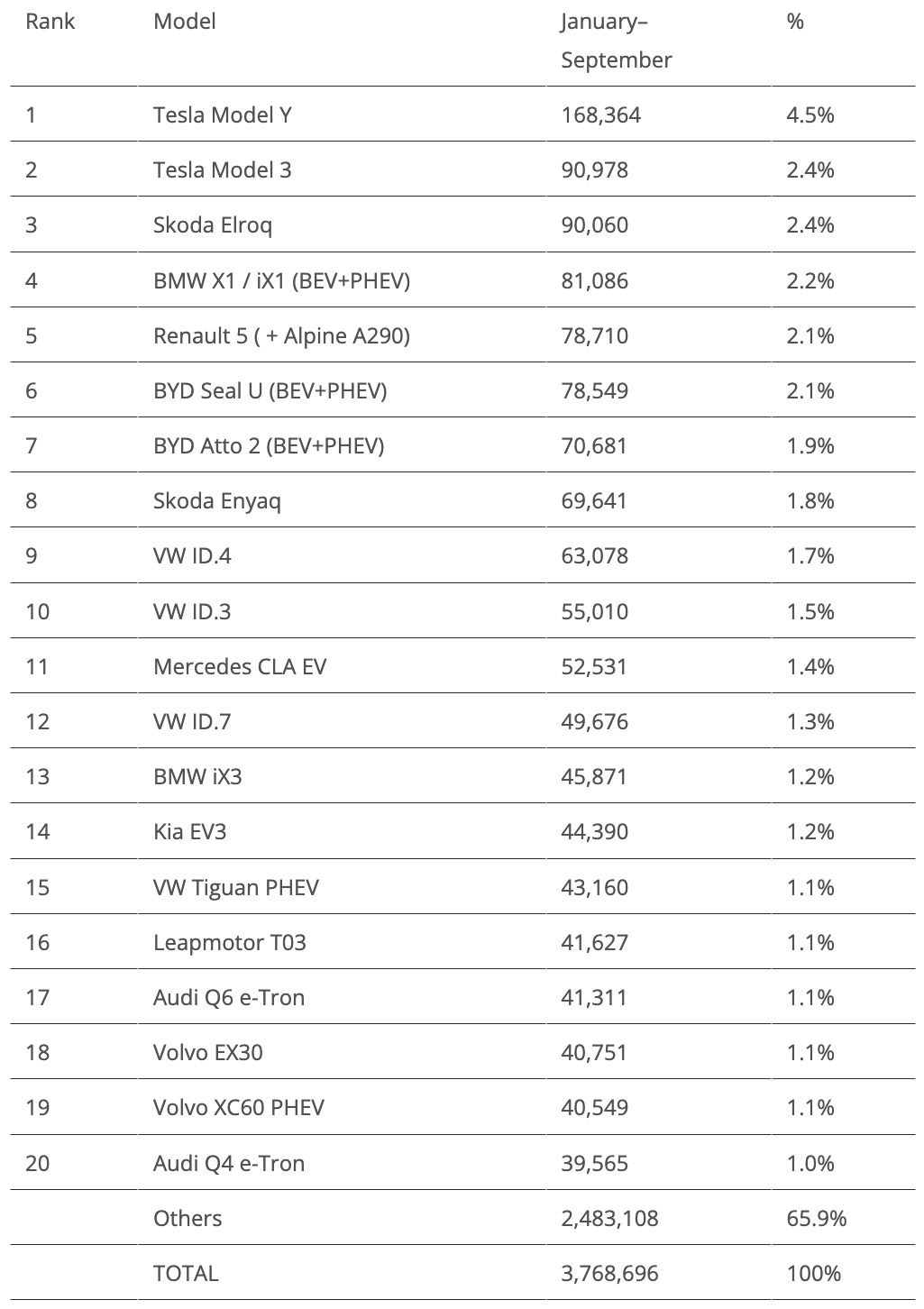
In the second half of the table, the Kia EV3 profited from its record score to jump two positions, into 14th, while the Audi Q6 e-tron and Volvo EX30 profited from their Volvo XC60 PHEV and Audi Q4 e-tron siblings’ horrible September performances to surpass them and reach the 17th and 18th positions, respectively.
Finally, a reference must be given to the deliveries of the #11 Mercedes CLA EV. It might not sound like much of a highlight, but the point here is that, historically, the CLA was a niche model for Mercedes, sandwiched between the poor man’s Mercedes A-Class and the more properly statutary Mercedes, the C-Class. As a consequence, the CLA’s overall sales in Europe were no more than 65,000 to 70,000 units per year, in a good year. With the BEV version of the CLA now above 52,000 units, and still three months to go, it won’t be hard for the CLA to beat the upper limit of the sales target this year.
Sure, neither the A-Class nor the C-Class (yet) have BEV versions to cast a shadow over the CLA, but it is a significant performance nevertheless, and with the CLA having a BEV station wagon version, that neither the A or C-classes will have, it sure looks like the CLA will continue to sell in significant numbers. Adding to its fortunes is the fact that it’s one of the most energy efficient EVs around, which allows it to post above-average range despite having average-sized batteries. Go, Mercedes CLA!
Having a quick look at the overall brand ranking, the highlights were the contrasting fortunes of Tesla (7th, up 71% YoY) and Ford (16th, down 18% YoY), as well as the usual rise and rise of the Chinese brands.
Two comments regarding the US automakers:
- Despite doing a rare #1 plus #2 win in the overall model ranking, Tesla was only 7th overall. Why? You might have the best two players in a basketball league, but if all the other teams play with a full lineup and your team only plays with two … it becomes hard to win the league.
- Why, Ford? Why, why, why?… Why did you have to cancel the Fiesta? Why did you have to cancel the Focus? These were staples of Ford Europe. They brought something different and attractive to the European market. Now, one looks at Ford’s lineup and … there’s a seven-year-old Puma, a bland Kuga, two rebadged Volkswagens, and … van-based MPVs. Not exactly exciting stuff…. Which was the opposite of what Ford used to represent in Europe. Sure, the quality could have been a bit sketchy, but it was good enough for the price, in a blue-collar kind of way. But, above all, Fords were exciting to look at, and even better to drive. Maybe the future Renault-based small EVs (new Fiesta and Puma?) will bring back the blue collar Fordness fun. The Renault platform at least has the right ingredients for that. Now, Ford, don’t f*** up this. It’s your future in Europe that is at stake. (end of rant)
BYD, also known as the Chinese Toyota, ended the month in 11th, with 49,340 units, up 102% YoY. That’s ahead of mainstream staples like Dacia (12th), but, above all, MG (13th). Yep, despite having a few years of advance and also selling ICE models, SAIC’s MG is now behind BYD in Europe.
But the strength of the Chinese automotive industry is the fact that it doesn’t rely on one major OEM, but rather the diversity it offers to European buyers — China has 15 brands in Europe’s top 50! Of them, the highlights are surging Jaecoo (#22, +157%), Omoda (#27, +111%), Leapmotor (#28, +324%), and Chery (#29, 688%).
(One could say that the overall European market is growing — +10% YoY — thanks to the rise of Chinese OEMs….)
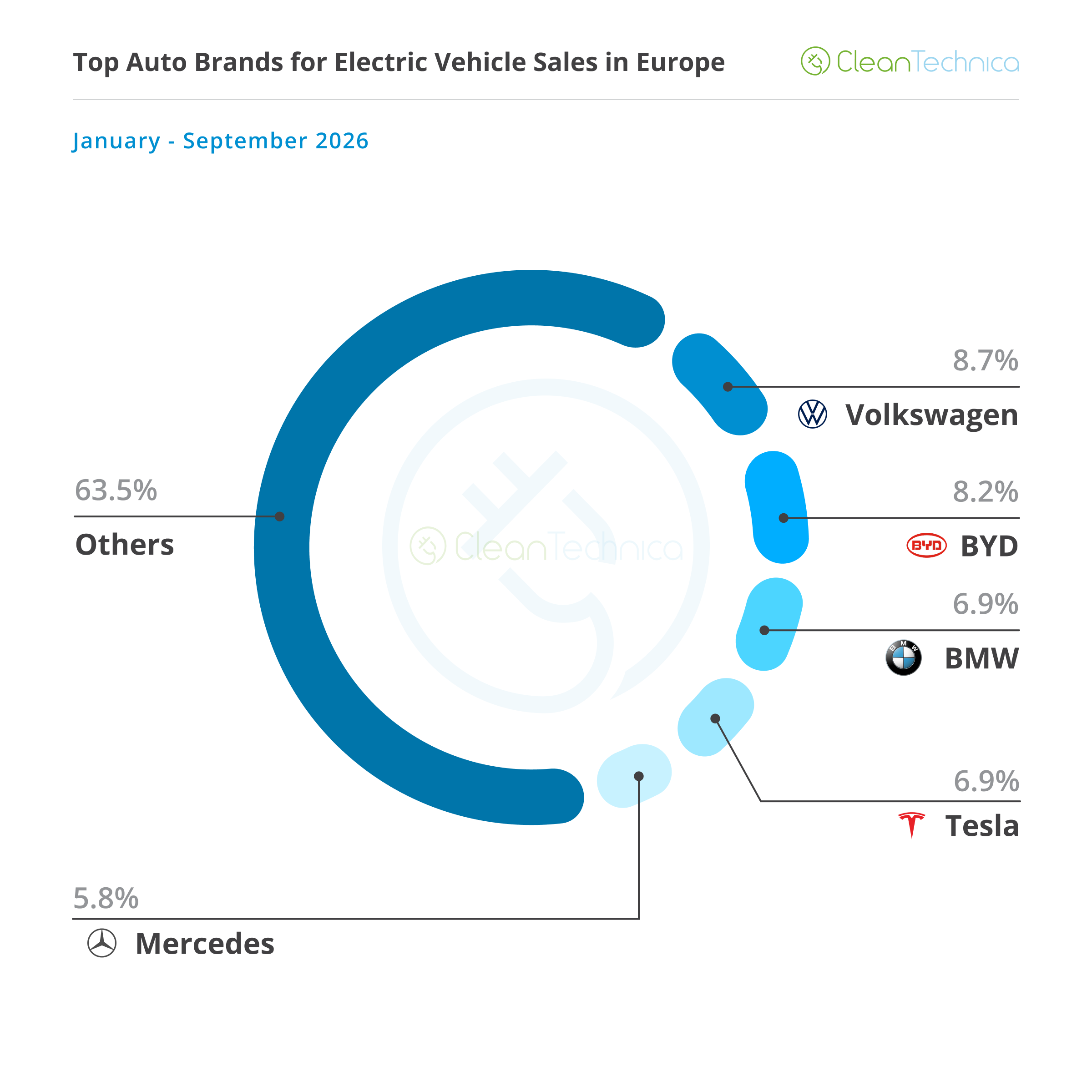
As for the plugin auto brand ranking, the leader, Volkswagen, remained in the lead, but again lost share (8.7%, down from 8.9% in August and down from 9.3% in May). Sure, it still holds a sizeable advantage over rising BYD (8.2%, up 0.2%), and its new EVs (VW ID.Polo, ID.Cross, ID.Tiguan, etc.) should help it recover some sales, but … the German brand cannot allow itself to slow down. If it does, the company will get BYD on its back real fast … in its home market. And if you can’t win at home.…
#3 BMW (6.9%, down 0.3%) is stable in the last place on the podium, but it ended the month just 100 units ahead of Tesla (6.9% share, up from 6% in August). Tesla did benefit from a higher than usual end of quarter high tide, though. This looks to be an entertaining race in the last months of the year, as BMW currently lacks models that can add significant volume that might counterweight the surging demand that Tesla is now experiencing. I mean, the iX3 alone is not enough, the new i3 sports sedan will need to ramp up fast and deliver significant volume in Q4 if BMW wants to have any chance of keeping the bronze medal in 2026.
In 5th we have Mercedes (5.8%). It is holding steady in the last position of the top 5 and even gained a little bit more distance over #6 Audi (5.3%) and #7 Skoda (5.2%).
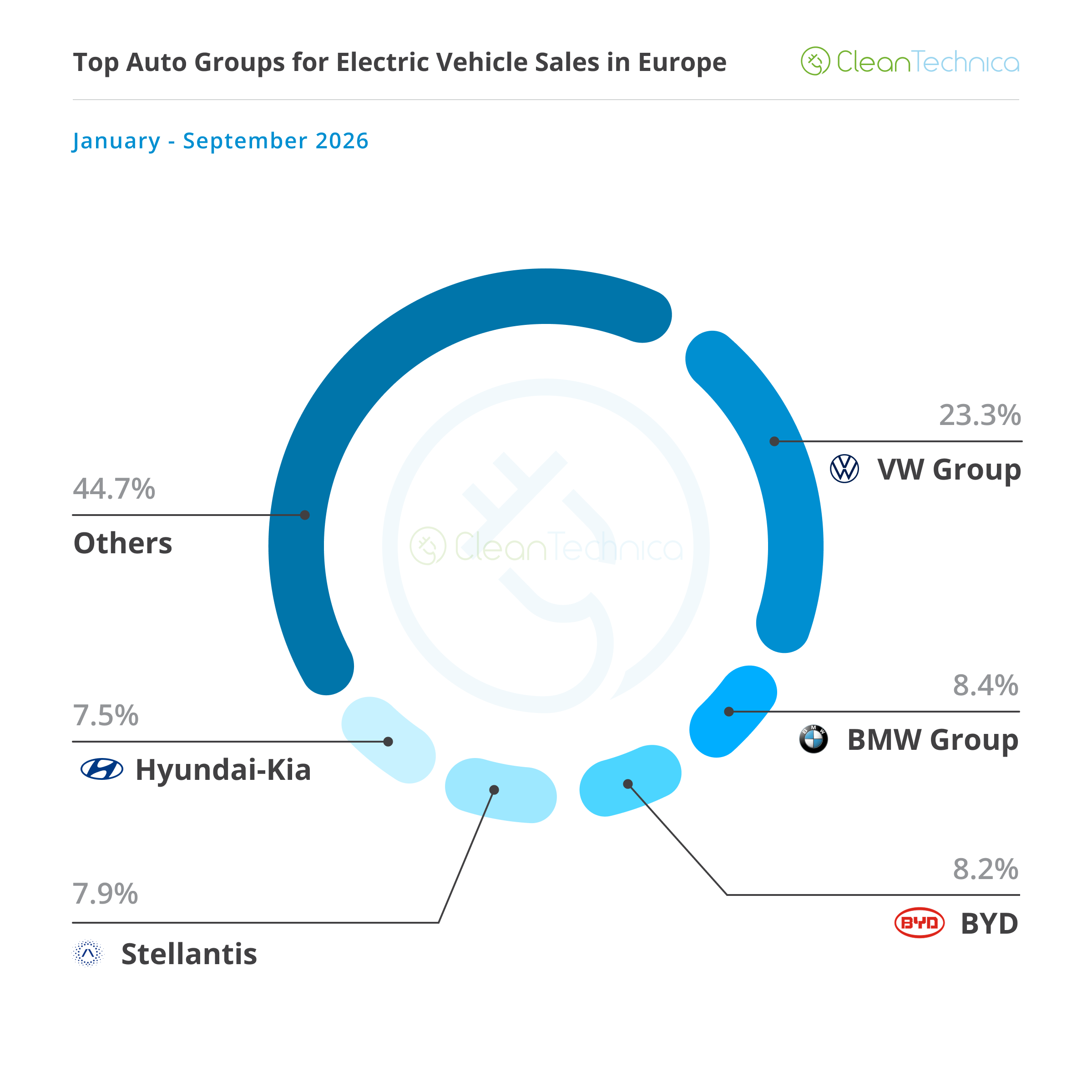
Arranging things by automotive group, everybody lost share except BYD.
Leader Volkswagen Group lost a significant amount of share, going from 23.9% share in August to its current 23.3%. Sure, the title is more than secured, but, for 2027, the fresh metal coming soon needs to correspond with expectations if the German OEM wants to stay comfortable in the lead.
#2 BMW Group (8.4%, down 0.3%) lost a worrying amount of share, especially considering that the new 3rd placed model is a rising BYD (8.2%, up 0.2%), just 0.2% behind it. At this point, it seems all but inevitable that the Chinese OEM will end the year in the runner-up spot, as its lineup is so vast and the volume deliveries increasing at such speed that it seems BYD’s true target is not BMW’s #2 spot but … VW’s throne.
As for now-4th-placed Stellantis … the never ending slide continues (7.9%, down 0.2%). The multinational OEM’s drops seem to have no end in sight. Worst of all, in a record month when every top OEM had several models scoring record results, Stellantis had … none. The multinational conglomerate lacks a star player. It has plenty of models selling okay — some 2,000–3,000 units per month — but the company lacks a frontrunner. Will that be the next Peugeot 208? One thing is for certain: that new generation has a lot of weight on its shoulders. If it fails….
Outside the top 5, #6 Geely (6.9%, up from 6.8% in August) gained ground on #5 Hyundai–Kia (7.5%). And with 7th placed Tesla (5.9%) now showing up on the radar as well, there could be an interesting race for 6th place.
Finally, an explanation for the “pants down” title….
2026 has been a wild ride in the EV world.
At the beginning of the year, legacy OEMs were happy with the growth of EV share in Europe — 20% to 30% BEV growth rates were good enough to keep investments in EVs steady, investments that would be funded by their still significant ICE business.
2025 ended with only one Chinese model in the European top 20, and Tesla ended the year in 4th, behind VW, BMW, and Mercedes. For the status quo to be perfect, you only need to convince those pesky eurocrats to soften CO2 targets….
Only, on the 28th of February 2026, with US and Israeli attacks on Iran, oil prices surged and the world has changed, and with it, so has the EV world.
In many markets, fuel prices escalated and people saw their wallets grow a hole. So many people who could buy a new car went and bought a BEV, preferably one that was readily available and cheap. It was not an ego-related buy, but a necessity-related one. And that changes the game.
Added to the Chinese auto market slump that was already happening towards the end of 2025, it was perfect timing for local OEMs to launch into export markets — sending production there that was originally meant for demand at home which had gone missing.
Now focusing on Europe, the increased EV demand quickly bought whatever existing stock was available, and waiting lists quickly started to grow.
Only, many people didn’t wanted to wait several months for their new BEV, they wanted to start saving money immediately, so they turned to whoever allowed them to receive a new electric vehicle the next day.
That was the perfect timing for Chinese OEMs and Tesla, which had been seeing its sales slowly erode in the previous couple of years. Because Tesla had competitively priced BEVs and an easily scalable production structure, it managed to quickly profit from the demand surge.
So, a win for Tesla and the Chinese EV makers.
But what about legacy OEMs?
Here’s what most numbers available do not show — how their sales are now compared to a year ago. Are they surfing the EV demand wave? Here’s a sample of European results in September:
Surfing the wave — Kia (+110% YoY), Toyota (+94%), Renault (+73%).
- The Korean is benefitting from an extensive BEV lineup (EV2/3/4/5/6/9, PV5), and with the exception of the EV6, all are relatively new to the market. Also, they are being made in several factories, in both South Korea and Europe.
- The Japanese, for a long time seen as a laggard, always had that advantage of a having a loyal buyer base that would go BEV “at the right time, with the right product.” And Toyota was lucky to launch the right product (C-HR+, Urban Cruiser, new RAV4 PHEV) at the right time, so it was only natural that it became one of the main beneficiaries of the demand surge. Also, with BYD, aka the next Toyota, going from strength to strength, if the Japanese OEM waited another year, it would risk seeing BYD steal its thunder in many Toyota-friendly markets.
- Finally, the French make. Having gone BEV-only too soon (just look at what happened at the Renault Megane a couple of years ago,, one could think that they would do a Porsche-type U-turn and leave their strong BEV commitment. But, no, they knew they had something special in the oven, called the Renault 5. And even before the current demand surge, the small hatchback was a success. So, when demand went through the roof, Renault was already hoping/expecting it. And while the Renault 4 wasn’t a sales success like its smaller 5 sibling, the new Twingo sure seems to replicate the success story, only in a category behind. Still, things could have been better. Sure, Renault’s current waiting lists, 3 to 5 months, is nothing out of the ordinary, there is one bottleneck — the R5, Megane, and Scenic are all made in Douai, like the Nissan Micra. And while it was understandable that it was a way to keep the factory running in high gear in normal times, in the current, abnormal times, this is creating a bottleneck, as the current 24/5 working schedule proves. They simply do not have much more space to increase production. So, I wouldn’t be surprised if the sales focus now went to the Slovenia-made Renault Twingo and Dacia Spring, while trying to bring Mitsubishi and Nissan back from the dead (Nissan reached 4,300 units in September, its best score in four years), as well as developing Alpine into a credible French premium alternative.
Trying to keep up — Stellantis (+53% YoY).
- Stellantis does not have a product problem. It already had a mature BEV lineup by the end of 2025. Neither does it have a production ramp-up problem. Most of its BEVs models were already ramped up in early 2026. No, its problem has been two-fold: A) it lacks demand; and B) its battery orders to suppliers were still being counted with an ICE-heavy sales mix, so it ordered accordingly. Turns out, BEV demand surged and ICE demand tanked. So, at the same time, Stellantis had the production capacity to satisfy demand but lacked the batteries to supply them. It’s no wonder, then, that models like the Peugeot e-3008 have a 5- to 8-month waiting list, or the Opel Grandland EV has a 6-month waiting list. Fortunately, small models like the Peugeot 208 EV and Opel Corsa EV have CATL as a battery supplier, so the battery maker managed to circumvent that issue for them (at a cost, I imagine). That is why a model like the veteran Peugeot 208 EV in September had its best month since March 2024, thanks to 4,580 registrations. The thing is … these models are not exactly the freshest on the market. So, Stellantis has two problems on its hand: 1) solve the battery supply issues of the C/D segment models; 2) launch and ramp up production of the next-generation Peugeot 208/2008 and Opel Corsa/Mokka (and Fiat Punto?) as fast as possible so that they can steal demand from models like the Renault 5, VW ID.Polo, etc.
With their pants down — Ford (+3% YoY), Volvo (+4%), Hyundai (0%), Volkswagen Group (+19% YoY), BMW (+12%), Mercedes (+15%).
- Among other problems, the US brand has a demand issue (see rant above). As for the Swede, after several issues with the EX90 launch, the EX60 was supposed to be a departure from that, and with impressive specs, it would signal the start of a new growth chapter for the brand. Only … several bugs regarding the new SPA3 platform, the new mega-casting production, and battery supply issues have seriously delayed the production ramp-up, leaving 50,000 orders on hold (with the waiting list said to be between 6 to 12 months). Add that to an ageing XC60 PHEV and EX40, both models now around 9 years old, and the EX30 is not enough to compensate for all of this. Volvo needs to solve the EX60’s teething issues in order to recover lost ground and pull its pants back up again. Now, the mystery of Hyundai.
- While fellow compatriot Kia is thriving, the Korean brand is stuck in neutral. While models like the IONIQ 5 and 6 were hot a few years ago, especially because of the 800V architecture, the truth is that these two were launched in 2021 and 2022, and since then … not much happened. Sure, they launched the Inster, and while it has its merits, it never found its footing. Is it an A-segment city car? Or is it B-segment? And is it a crossover thingy? Or is it a hatchback that thinks it’s an SUV? Besides being in such a no man’s land, its divisive design doesn’t helped it to reach wide appeal. With the new IONIQ 3 starting its career soon, expect things to improve, but until then … it’s waiting for better days.
- As for the Volkswagen Group galaxy, this could be a case of being between growth waves. Last year, around half of the top 20 belonged to the German conglomerate, with the Skoda Elroq/Enyaq and the VW ID.3/4/7 populating the top positions. The MEB-platform models this year are either stable or losing sales. On the other hand, the MEB+ platform for smaller models is still in its infancy, with models like the Cupra Raval, Skoda Epiq, and VW ID.Polo still ramping up production, looking to satisfy an overwhelming waiting list said to be around 10 months. And VW’s management decided to make all MEB+ platform models in Spain, for cost benefits, leaving the German plants running half empty.
- Next, BMW. Sure, the BMW iX3 and i3 are engineering marvels, and surely justify their high prices. But despite a 6-month waiting list, the iX3 seems stuck at some a production rate of some 7,000-8,000, which is not bad … but not exactly a reason to launch fireworks, especially if i3 production gets stuck at the same rate. With their older models suffering from a sort of blackhole effect that the iX3/i3 are creating, it seems BMW is more interested in keeping a waiting list than expanding production and growing fast.
- Finally, Mercedes. While its new 800V BEVs are not as impressive as their BMW counterparts, one thing is certain: their management read the room correctly and understood that it was now or never. Besides an onslaught of new BEV models, in which the CLA, GLC, and GLB have rapidly ramped up and are hitting record results, others are set to start their ramp-up soon (GLA, VLE, C-Class), keeping their momentum in high gear. So … why only a 15% growth rate? Answer: The winding down of its EQA best seller and far fewer PHEV sales. Up until recently, Mercedes was PHEV-heavy, and now it is transitioning into being BEV-first. Things will continue to improve, especially since the GLA is fully deployed on the market, and the distance to its BMW arch rival is slowly closing … at least in Europe.
Sign up for CleanTechnica’s Weekly Substack for Zach and Scott’s in-depth analyses and high level summaries, sign up for our daily newsletter, and follow us on Google News!
Have a tip for CleanTechnica? Want to advertise? Want to suggest a guest for our CleanTech Talk podcast? Contact us here.
Sign up for our daily newsletter for 10–15 new cleantech stories a day. Or sign up for our weekly one on top stories of the week if daily is too frequent.


CleanTechnica uses affiliate links. See our policy here.
CleanTechnica’s Comment Policy