
The natural gas industry has barely contributed a dribble of new power plants to the US grid since January of 2025, when US President Donald Trump declared an energy emergency. The lack of progress — attributed partly to a years-long gas turbine backlog — demonstrates once again that wind, solar (especially solar), and energy storage are the fastest, most economical ways to address whatever emergency currently exists, assuming that such a one does exist. The missing piece of the puzzle consists of next-generation power systems that support even more wind, solar, and storage on the grid. With that in mind, let’s take a look at some fresh developments in the grid modernization area.
1. The US Department Of Energy Still Supports Energy Storage
Despite last year’s sharp U-turn in federal energy policy, the US Department of Energy is still supporting new energy storage technologies. While storage can benefit non-renewables, wind and solar are the primary targets because energy storage can fill in the gaps when wind and solar availability are less than optimal.
One recent development in that area cropped up in the field of distributed energy resources (DERs), meaning small-scale power generating resources including energy storage as well as wind, solar, and anything else outside of the centralized power plant model.
A coordinated network of DERs can make a powerful contribution to grid reliability and resilience. In that regard, the New York-based battery startup Viridi (not to be confused with similarly named companies) draws attention to its partnership with the Energy Department’s Oak Ridge National Laboratory in Tennessee.
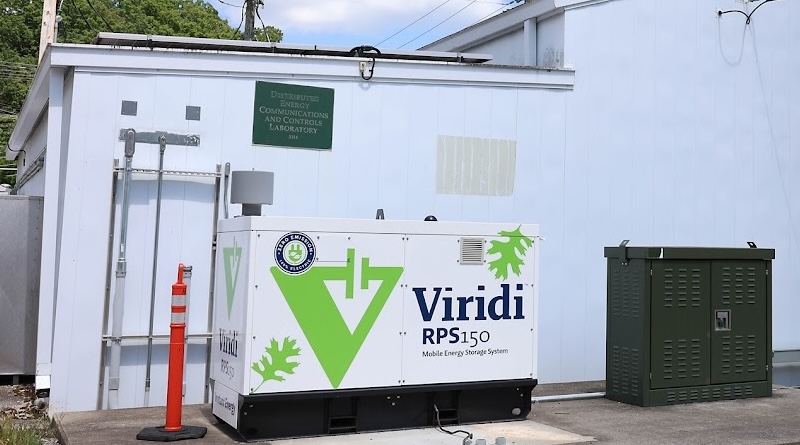
“As part of the partnership, Viridi’s BESS [battery energy storage system] was selected and installed at ORNL’s Grid Research Innovation and Development Center (GRID-C) as part of the testing platform for a DOE resource integration and evaluation project,” Viridi explains, referring to the modest-looking, containerized lithium-ion battery system pictured above.
The Viridi battery was installed to help test ORNL’s new system for coordinating multiple batteries in a DERs network. The project began with simulation models. The Viridi battery represents the next stage, a live trial to validate the simulated findings.
So far, ORNL is satisfied with the results of the live trial, though it will take several months to analyze the data in detail.
“This project bridges an important gap by integrating real electrical equipment to understand realistic performance challenges, proving the robustness of ORNL’s new control strategies and AC/DC architecture for supporting the future grid,” explained ORNL Program Manager Dr. Madhu Sudhan Chinthavali in a press statement.
Keep an eye on Viridi for further developments in the battery-enabled grid of the future. The BESS project marks the beginning of a new phase in Viridi’s ongoing collaboration with ORNL, and last September the company was tapped for participation in the new Accelerating Resilient Infrastructure Initiative. With about 20 or so participants, ARII is hosted by the leading global firm Schneider Electric with a focus on community-based DERs.
Meanwhile, Viridi is not letting the grass grow under its feet. In June, the the energy-as-a-service startup Budderfly tapped Viridi to install its battery system at 100 commercial locations under Budderfly management.
2. Energy Conservation Is A Grid Solution, Too
Trimming waste and improving resiliency on the demand side is another element in the grid modernization effort. Last week, General Motors surfaced with some interesting news in that space.
While the automaker has cut back on its near term EV plans for the US market, GM is still engaged in a longstanding commitment to next-generation energy solutions. The latest news involves the UK-based startup IONATE, which has developed a power control technology it calls HIT for Hybrid Intelligent Transformer.
A GM factory in Romulus, Michigan, will host the first use of HIT in the US. On the down side, that particular factory is being retooled to boost the automaker’s production of gasmobiles. On the up side, the new system will improve resiliency and prevent energy waste inside and outside the facility, while also helping to accelerate DERs uptake.
Going by IONATE’s track record of success with HIT in Europe, the Romulus project will not be the firm’s last venture into the US market. “The deployment will give GM real-time visibility into power quality and consumption at sub- millisecond resolution, strengthening the resiliency, quality and efficiency of the plant’s energy usage — while also benefitting the surrounding grid by identifying and preventing surges or outages before they happen,” GM emphasizes.
As described by GM, the HIT supports 33% more distributed energy resources on the grid, while accommodating 25% more power on existing grid infrastructure while avoiding the cost upgrading poles and wires.
Somewhat weirdly, earlier this week GM hosted President Trump at its Milford Proving Ground innovation center in Michigan, where the busy sequence of events included an up-close tour of the company’s current lineup including two EVs, the Cadillac Escalade IQ and the GMC Hummer.
GM also used the opportunity to tout its $400,000 custom-commissioned EV, the Cadillac Celest IQ. “The President got into the rear seat of an Emerald Lake-colored Cadillac CELESTIQ to experience the interior of this ultra-luxury vehicle,” GM noted briefly. Let your imagination do the rest…
3. The Virtual Power Plant Angle
Custom-built or not, EVs are rolling energy storage units with a significant role to play in the DERs landscape, particularly in regards to the VPP (virtual power plant) space. As the name suggests, one key function of a virtual power plant is to reduce, if not entirely eliminate, the need to build new gas “peaker” power plants that only kick in during spikes in demand.
In a VPP, next-generation grid software incentivizes a network of ratepayers to store electricity during low-demand periods, and/or reduce electricity use during periods when demand would otherwise spike. Among other devices, VPPS can include heat pumps and hot water heaters as well as rooftop solar panels, stationary battery systems, and EVs.
The latest development involves a significant new vehicle-to-grid collaboration between five leading US firms, Eversource, National Grid, EnergyHub, Sunrun, and the Vehicle-to-X innovator Mobility House. Under the initiative, Eversource and National Grid customers who drive a V2G-capable EV can sign up for an existing V2G system administered by the firm ConnectedSolutions. The effort applies to ratepayers in the renewables-friendly state of Massachusetts, where EV uptake has already topped 150,000 units.
Not all of those EVs have V2G capability. However, Mobility House has assessed that interest in V2G capability is rising as EV owners and EV-curious auto buyers become more aware of the financial advantages of participating in grid balancing programs.
That’s all for today. While natural gas and nuclear stakeholders are taking their sweet time with capacity additions — and coal continues to flop despite a string of Trump administration interventions — renewable energy is on the move with an assist from energy storage and next-generation grid technologies.
If you have some grid modernization news to share, drop a note in the discussion thread.
Photo: The US energy storage startup Viridi is among the US stakeholders deploying advanced technologies that improve resiliency while adding more distributed energy resources — namely, wind and solar power — to the nation’s grid (cropped, courtesy of Viridi).