

Support CleanTechnica’s work through a Substack subscription, on Patreon, or on Stripe. Help us produce all of the high-quality, original content we publish week after week despite the challenges of content-scraping AI, antisocial media, inflation, and other hurdles.
The global solar industry has been taking off like a rocket while relying primarily on silicon, a material first introduced back in 1954. Now a new wave of 21st century materials is poised to turbo-boost solar power into the next level, with perovskite solar cells front and center. Perovskites are inexpensive materials that can reduce the cost of solar cells while expanding the supply chain and opening up new windows of opportunity — literally, in the field of transparent or semi-transparent solarized window glass.
See-Through Solar Windows Are Coming For Your Fossil Fuels, Eventually
The dream of a see-through solar window is heady stuff. After all, windows are notorious for leaking energy out of buildings. Transforming them into clean power generating stations is a game-changer. However, the devil is in the details. Silicon is a mature technology but it faces limitations as applied to solarized windows. Advanced thin film materials are in the running, but the expense can be prohibitive. Ideally, a solar window lets in enough light to take advantage of daylight, while capturing and converting enough solar energy to justify the additional expense (see more see-through solar window background here).
The latest news in that space comes from the top research institution University College of London, where a team of materials scientists has been working on scaleup as well as improving solar window efficiency.
Their material of choice is perovskite, a class of lab-grown synthetic crystals based on the naturally occurring mineral perovskite. Their new study, published in the journal Advanced Energy Materials, makes the case for perovskites to achieve a desirable range of transparency while also converting solar energy to electricity.
How Did They Do It?
The new study, titled “Multimodal Strategy for Efficient Semi-Transparent Perovskite Solar Cells and Modules with Record Indoor Performance,” describes how perovskite-enabled solar windows can achieve a balance between transparency and power generation.
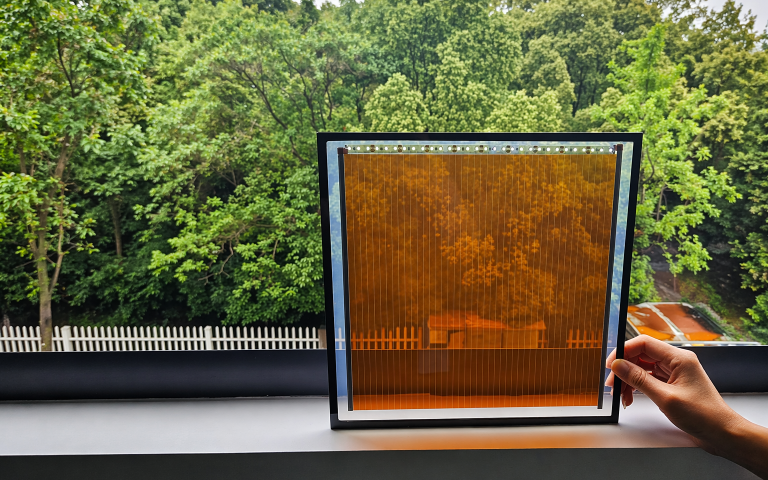
The lead author on the study, Ph.D. candidate Siming Huang, explains that their semi-transparent solar window provides the same function as a tinted window by helping to keep interior spaces cool, while also generating electricity. “This is especially important in hotter areas of the world that use a high proportion of energy on air conditioning,” Huang notes.
In the study, the UCL team affirms that their window allows a reasonable amount of light in, at 30% compared to 80-90% for conventional window glass, while delivering a respectable 14% solar conversion efficiency as a solar module.
The study is also noteworthy because the UCL team established that their perovskite solar cell delivered 22% solar conversion efficiency for bright indoor light, and they demonstrated the first scalable 30 × 30 square centimeter module of its kind, too.
Published in the peer reviewed journal Advanced Energy Materials, the study lays out the details:
“Guided by transfer matrix simulations, a 1.7 eV FAMA-based perovskite layer with a thickness of ∼185 nm was integrated with an optimized MoO3/Au/MoO3 top electrode (59.9% transmittance). Incorporation of the bifunctional molecule 3-trifluoromethyl-1H-1,2,4-triazole, which coordinates with undercoordinated Pb2+ via ─CF3 group and forms N…H interactions with FA+/halide species, effectively suppresses trap-assisted recombination and stabilizes the lattice.”
Got all that? UCL also offers a plain-language explanation. The molecule m3-trifluoromethyl-1H-1,2,4-triazole reduces defects called “traps,” within which electrons can get stuck before giving up their energy. “This molecule also helped stabilise the perovskite crystal structure, preventing degradation over time,” UCL adds.
The school also notes that the electrodes in perovskite solar cells are typically made with gold, which blocks light. The research team engineered transparency into their electrodes by creating a sandwich comprised of an ultra-thin layer of gold in the middle, and transparent layers of molybdenum oxide on each side.
Meanwhile, Back In The USA
The UCL researchers are looking forward to next steps. Because perovskite solar cells are lightweight and flexivle, they can be applied to curved glass surfaces and windows, including car parts. Scaling up beyond 30×30 cm is also on the to-do list.
In the meantime, perovskite solar cell stakeholders in the US have not been asleep at the wheel. One example is the Kentucky-based startup Sofab Inks, which has been producing specialized perovskite solutions aimed at resolving the durability issues that plagued earlier efforts in the perovskite solar cell field.
Sofab has come up with a formula that eliminates C60, a fullerene commonly used in perovskite solar cells. Fullerenes are variations on the structure of carbon, with C60 being known for its soccer ball shape. C60 is also a relatively fragile material.
“A perovskite cell is only as good as its weakest layer, and the industry has been stuck with C60, a fullerene,” explains Sofab co-founder and CEO Blake Martin.
“It’s the largest source of voltage loss in the device and the point where fielded modules crack first. That’s the layer we replace,” Martin elaborates. “Our metal-oxide nanoparticles bond six to ten times more strongly than C60 and hold up at real sizes, running at 22.3% on 30-centimeter single junction modules.”
Follow The Money
Sofab spun out of research at the University of Louisville and private sector investors are taking note as the company fine-tunes its manufacturing method. On July 21, Sofab announced the close of a $6 million round of seed funding, with the firm Cloudberry Ventures taking the lead role. The funds will enable Sofab to expand its engineering team and transition into high-velocity production.
As with the UCL team, Sofab notes that perovskite solar cells are lightweight and flexible, opening up applications on curved surfaces that are unavailable to conventional silicon solar cells. The company is also among those anticipating the space solar field will provide another window of opportunity.
“Our investment reflects our confidence in Sofab’s trajectory as they solve a critical technical bottleneck and scale production to meet the global demand for innovative materials for next-generation solar,” enthused Cloudberry founder and general partner Mahir Sahin in a press statement.
You can say that again. Sofab states that it has already engaged, to one degree or another, with about 90% of the perovskite industry. In particular, the company name-checks Alpha Precision Systems, Energy Materials Corporation, and Halocell Energy among others.
APS, for example, has been contributing its resources to Sofab over the past two years, including its slot die coating process. “APS looks forward to continuing our collaboration with Sofab, with the objective of providing customers with a total solution that integrates Sofab Tinfab materials deposited with APS slot die coating and drying systems,” explains APS CEO Miguel Friedrich, with Tinfab referring to Sofab’s tin-oxide formula.
Sofab also has a relationship with Arizona State University, where a research group has been applying Tinfab as a fullerene replacement to improve perovskite solar cell durability. “We have observed that fullerene-based materials are the mechanical weak link in terms of extremely low fracture energies that trigger delamination and restrict the commercial viability of perovskite-based technology,” explains ASU professor Dr. Nick Rolston, who heads up the school’s Renewable Energy Materials and Devices Lab.
For further news on the US perovskite scene, keep an eye on another durability solution that involves combining a layer of silicon with perovskite for a low-cost efficiency boost.
Photo: Perovskite solar cells are contributing to the see-through solar window field, providing the cooling benefits of tinted windows alongside the ability to generate electricity from window glass (cropped, courtesy of UCL).

Sign up for CleanTechnica’s Weekly Substack for Zach and Scott’s in-depth analyses and high level summaries, sign up for our daily newsletter, and follow us on Google News!
Have a tip for CleanTechnica? Want to advertise? Want to suggest a guest for our CleanTech Talk podcast? Contact us here.
Sign up for our daily newsletter for 15 new cleantech stories a day. Or sign up for our weekly one on top stories of the week if daily is too frequent.

CleanTechnica uses affiliate links. See our policy here.
CleanTechnica’s Comment Policy