
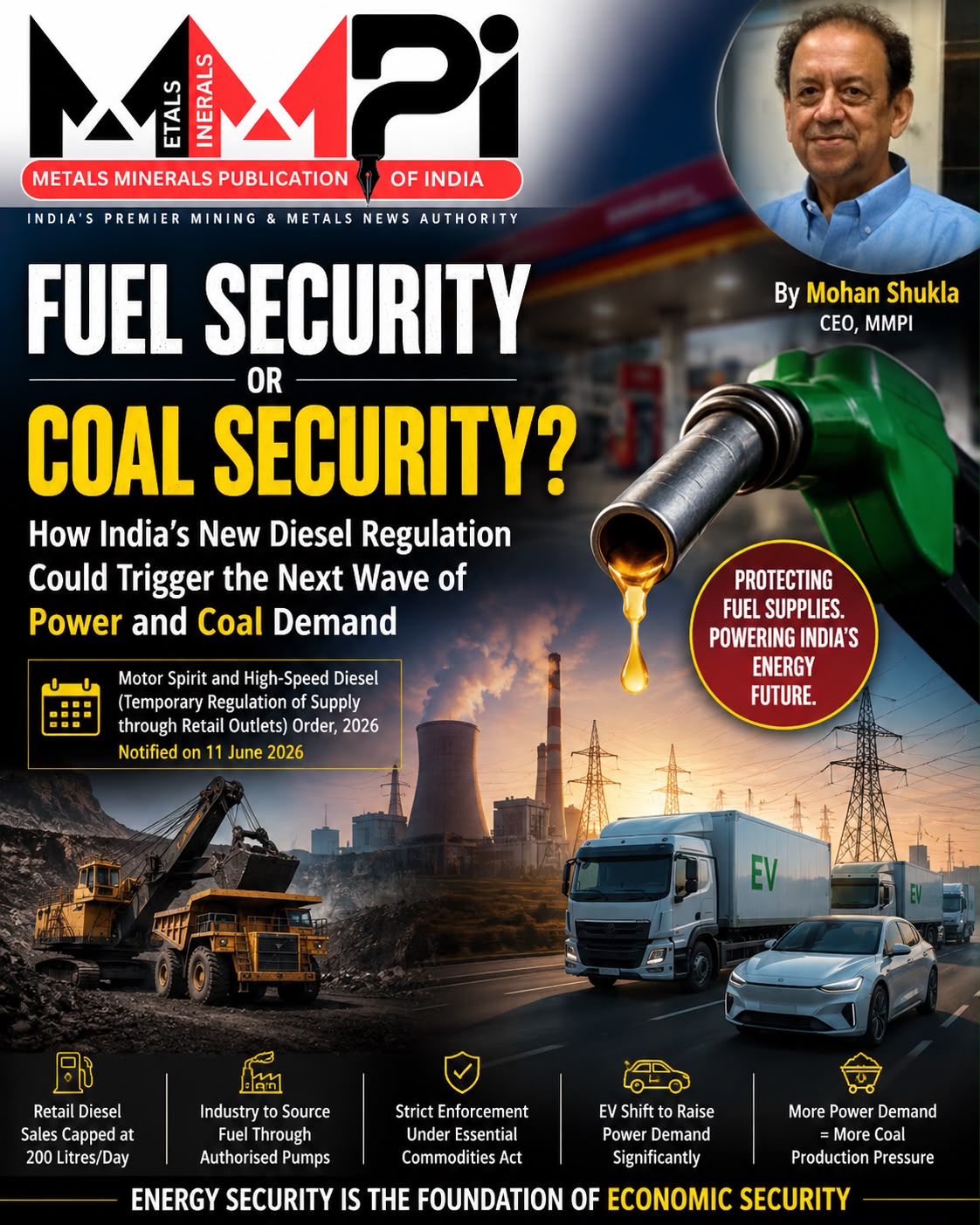
FUEL SECURITY OR COAL SECURITY?
How India’s New Diesel & Petrol Regulation Could Reshape Mining, Logistics, Power Generation and the Energy Transitio

By Mohan Shukla
CEO, Metals & Minerals Publication of India (MMPI)
In a significant policy intervention aimed at safeguarding India’s energy security, the Ministry of Petroleum & Natural Gas has notified the Motor Spirit and High-Speed Diesel (Temporary Regulation of Supply through Retail Outlets) Order, 2026, empowering the Government to temporarily regulate the sale and distribution of petrol and diesel through retail outlets whenever circumstances so demand.
At first glance, the notification appears to be a routine regulatory measure designed to prevent fuel shortages, hoarding and diversion. However, a deeper examination reveals that this order carries implications far beyond petrol pumps and diesel dispensers.
Its impact could potentially extend into India’s logistics sector, mining industry, construction ecosystem, electric vehicle transition, power generation sector and ultimately coal production itself.
The notification therefore deserves careful attention from policymakers, mining companies, infrastructure developers, transport operators and energy planners alike.
Why Has the Government Acted Now?
The Ministry has clearly identified two major concerns.
The first is the prevailing global geopolitical uncertainty affecting petroleum supply chains, shipping routes and availability of petroleum products across international markets.
The second concern arises from an increasingly visible market distortion.
Industrial, commercial and institutional consumers have reportedly been procuring diesel and petrol from retail fuel stations because retail prices in many cases were lower than bulk fuel prices.
As large consumers shifted to retail outlets, abnormal demand began emerging in certain regions, creating the possibility of localized shortages and diversion of fuel supplies intended for ordinary consumers, transport operators, farmers and essential services.
The Government has therefore chosen to establish a formal mechanism to regulate such situations before they evolve into a larger supply challenge.
Key Features of the New Order
Under the notification, the Government may issue special or general orders imposing temporary restrictions whenever required in public interest.
The principal provisions include:
Industrial and Commercial Users Restricted
Institutional, industrial, commercial and direct customers will not be permitted to procure petrol or diesel from retail outlets whenever restrictions are activated.
Such consumers must source fuel requirements through their own authorized consumer pumps and bulk procurement arrangements.
Diesel Sales Limited
Retail fuel stations can dispense diesel only into:
• Vehicle fuel tanks; or
• PESO-approved containers.
Further, diesel sales may be restricted to a maximum of 200 litres per customer or vehicle per day.
Fuel purchased under this provision cannot be resold.
Compliance Responsibility
Oil Marketing Companies and retail outlet dealers have been tasked with ensuring compliance and preventing any attempt to circumvent the restrictions.
Temporary but Extendable
Any restriction imposed under the order can remain valid for up to ninety days initially and may be extended through a fresh Government order if circumstances warrant.
Enforcement Powers
Authorized government officers, police officers not below the rank of Deputy Superintendent of Police and designated oil company officers have been empowered to conduct search and seizure operations.
Penalties
Violations will attract action under the Essential Commodities Act, 1955 and other applicable laws.
Immediate Impact on Mining, Construction and Industrial Operations
The sectors likely to feel the immediate operational impact include mining, construction, logistics, manufacturing and infrastructure development.
Large mining projects consume enormous quantities of diesel through:
• Dumpers and haul trucks
• Excavators
• Surface miners
• Drills
• Dozers
• DG sets
• Material handling systems
• Construction equipment
Many contractors and project operators supplement their fuel requirements through retail fuel stations because of convenience and pricing advantages.
Under the new framework, such practices could become increasingly difficult whenever restrictions are activated.
Mining companies, MDO operators, EPC contractors, industrial facilities and infrastructure developers would therefore be well advised to immediately review:
• Fuel procurement models
• Bulk fuel supply agreements
• Consumer pump infrastructure
• Fuel storage capacities
• Supply-chain resilience plans
Fuel security is no longer merely a procurement issue; it is becoming an operational continuity issue.
The Hidden Consequence: Accelerated Electrification
An important secondary effect of the notification may emerge in the transportation and industrial equipment sectors.
If diesel procurement becomes more regulated and operationally restrictive during certain periods, fleet operators may accelerate migration toward electric mobility solutions.
This could include:
• Electric commercial vehicles
• Electric buses
• Electric logistics fleets
• Battery-powered mining support equipment
• Electric material handling systems
• Electrified industrial mobility solutions
From a sustainability perspective, such a shift aligns perfectly with India’s net-zero ambitions.
However, this transition introduces a new challenge.
Every litre of diesel displaced by electricity transfers energy demand from petroleum infrastructure to the power grid.
Pressure on India’s Electricity System
India is already witnessing unprecedented growth in electricity consumption driven by:
• Rapid EV adoption
• AI and data centre expansion
• Manufacturing growth
• Railway electrification
• Green hydrogen projects
• Urbanisation and cooling demand
• Digital infrastructure expansion
An accelerated shift away from diesel-powered transportation and industrial equipment will further increase electricity demand.
This could result in:
• Higher peak power requirements
• Greater stress on transmission infrastructure
• Increased requirement for grid balancing
• Additional investments in energy storage systems
• Higher dependence on reliable baseload generation
The Coal Connection Nobody Is Talking About
This is where the discussion becomes particularly relevant for MMPI readers.
Despite remarkable growth in renewable energy, coal continues to remain the backbone of India’s electricity system.
Approximately seventy percent of India’s electricity generation continues to originate from coal-based thermal power stations.
Consequently, every significant increase in electricity demand eventually creates pressure on thermal generation capacity.
The chain reaction is straightforward:
Diesel Procurement Restrictions → Accelerated Electrification → Higher Electricity Consumption → Increased Thermal Power Generation → Greater Coal Demand → Higher Coal Production Requirements
This means a fuel regulation issued for petrol and diesel today could indirectly influence coal production planning tomorrow.
What It Means for Coal India and the Mining Sector
India’s power demand trajectory is already pointing upward.
The combination of EV adoption, industrial growth, digital infrastructure and energy-intensive manufacturing will continue pushing electricity requirements higher.
As a result:
• Coal India Limited may face sustained pressure to maintain elevated production levels.
• SCCL and captive coal producers may need to enhance output reliability.
• MDO operators may witness increased demand for long-term production contracts.
• Coal evacuation infrastructure may require further strengthening.
• Mining equipment demand could rise over the medium term.
Ironically, a policy intended to regulate petroleum supplies could indirectly reinforce the strategic importance of coal within India’s energy ecosystem.
MMPI Perspective
The Government’s move is prudent and timely.
No responsible nation can afford to wait for a supply disruption before creating mechanisms to protect essential commodities.
The notification provides policymakers with a flexible instrument that can be activated during extraordinary circumstances to prevent hoarding, diversion and supply distortions.
However, the broader lesson extends beyond fuel management.
The order reminds us that India’s energy systems are deeply interconnected.
Petroleum security influences transportation.
Transportation influences electrification.
Electrification influences power generation.
Power generation influences coal production.
And coal production ultimately influences India’s economic growth trajectory.
The future may indeed be electric.
But for the foreseeable future, much of that electricity will continue to be powered by coal.
That reality makes this notification not merely a petroleum policy measure, but a significant development in India’s larger energy security architecture.
For the mining and metals sector, the message is unmistakable:
Fuel Security, Power Security and Coal Security are no longer separate conversations. They are three pillars of the same national strategy.