

MMPI Editorial & Policy Analysis
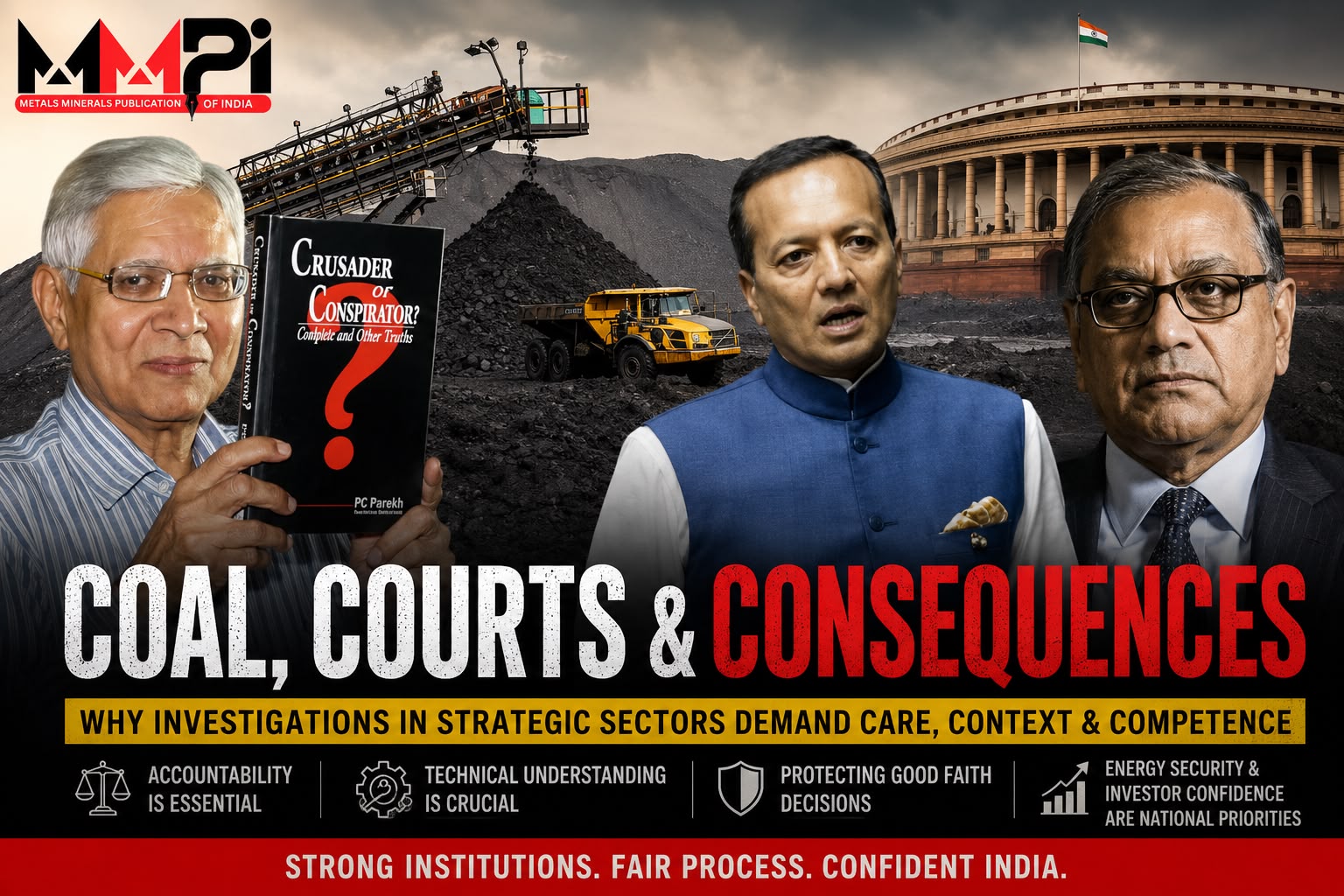
The recent summoning of industrialist and Member of Parliament Naveen Jindal, former Coal Secretary P.C. Parekh and others in a coal block allocation matter has once again brought national attention back to the long and complex chapter of India’s coal allocation controversies.
As the matter is presently before the courts, MMPI neither seeks to influence any judicial process nor expresses any opinion on the guilt or innocence of any individual. The judicial system must be allowed to function independently and arrive at its conclusions based solely on evidence and law.
However, the development raises a larger policy question that India cannot afford to ignore.
Lessons from the Coal Allocation Era
The coal allocation controversy of the previous decade fundamentally altered the relationship between policy-making, resource allocation and public accountability.
The debate was amplified by estimates of presumptive losses running into massive figures, creating an environment where administrative decisions, policy choices and commercial judgments increasingly came under criminal scrutiny.
While accountability and transparency are essential pillars of democratic governance, the broader consequence was an era of decision paralysis across several sectors linked to natural resources, infrastructure and energy.
Many senior bureaucrats became reluctant to take decisions. Ministries became risk-averse. Approvals slowed. Investment pipelines weakened. The coal economy itself faced uncertainty at a time when India’s energy demand was accelerating rapidly.
The experience demonstrated that while wrongdoing must undoubtedly be investigated and prosecuted wherever evidence exists, policy-making and criminal misconduct cannot always be viewed through the same lens.
Technical Sectors Require Technical Understanding
Mining is not a conventional administrative domain.
Every major allocation decision involves:
• Geological interpretation
• Resource estimation
• Mining engineering
• End-use planning
• Environmental assessments
• Long-term investment commitments
• National energy security considerations
Investigative agencies are highly skilled in examining financial transactions, communications, procedural compliance and documentary evidence.
However, mining decisions often involve technical uncertainties that can only be understood through domain expertise.
A geological estimate that later changes, a production projection that fails, or a commercial assumption that proves inaccurate does not automatically establish criminal intent.
Before reaching conclusions in such matters, technical, commercial and policy dimensions must be examined with equal rigour alongside legal scrutiny.
Coal Remains India’s Energy Backbone
The discussion is particularly relevant today because India finds itself in a vastly different geopolitical and economic environment than it did a decade ago.
The world is witnessing:
• Supply chain disruptions
• Geopolitical conflicts
• Energy security concerns
• Commodity volatility
• Strategic competition for critical resources
Despite rapid progress in renewable energy, coal continues to remain the backbone of India’s electricity generation system.
India’s manufacturing ambitions, infrastructure growth, digital economy expansion and even its electric vehicle transformation are currently supported by a power ecosystem in which coal remains the principal source of reliable baseload energy.
Ironically, the confidence with which India is pursuing EV adoption and energy transition goals today is itself underpinned by the stability of its coal-based power generation capacity.
Importance of Investor Confidence
Global capital evaluates not only economic fundamentals but also policy stability and institutional predictability.
Over recent years, foreign institutional investors have demonstrated increasing sensitivity to regulatory uncertainty, policy delays and governance risks across emerging markets.
India continues to remain one of the world’s most attractive long-term investment destinations. However, investors also seek assurance that legitimate commercial decisions and bona fide policy actions will be evaluated fairly, transparently and with full technical understanding.
Investigations are an important part of governance. Yet investigations involving strategic sectors such as mining, energy and infrastructure must be conducted with exceptional care because they can influence perceptions regarding regulatory certainty, ease of doing business and long-term investment confidence.
The reputations of institutions, companies and business leaders are valuable economic assets. Therefore, investigative processes must remain evidence-based, objective and insulated from public narratives that may emerge before judicial determination.
A Framework for the Future
India’s institutions face the challenge of simultaneously achieving two important objectives:
- Zero tolerance for corruption and abuse of public office.
- Protection of bona fide decision-making necessary for economic growth and national development.
MMPI believes that investigations involving complex natural resource sectors should be supported by independent panels of mining engineers, geologists, energy economists, policy specialists and industry experts who can assist investigators in understanding technical realities before conclusions are drawn.
Such an approach would strengthen both accountability and fairness.
Conclusion
India’s rise as a global economic power will depend not only on strong institutions but also on the confidence of administrators, entrepreneurs, investors and policymakers who take decisions in good faith.
The nation must continue to combat corruption wherever it exists. At the same time, it must ensure that technical judgments, commercial risks and policy decisions are not retrospectively viewed without the benefit of technical context and sectoral expertise.
The objective should not merely be investigation. The objective should be justice, institutional credibility and sustainable economic growth.
As India advances toward becoming a major industrial and energy power, accountability and development must move together—not in opposition to each other.
Disclaimer: This article represents a policy and governance analysis by MMPI. It does not comment upon the merits of any ongoing judicial proceeding, nor does it seek to support, oppose or influence any individual, institution or legal process.