

Support CleanTechnica’s work through a Substack subscription, on Patreon, or on Stripe. Help us produce all of the high-quality, original content we publish week after week despite the challenges of content-scraping AI, antisocial media, inflation, and other hurdles.
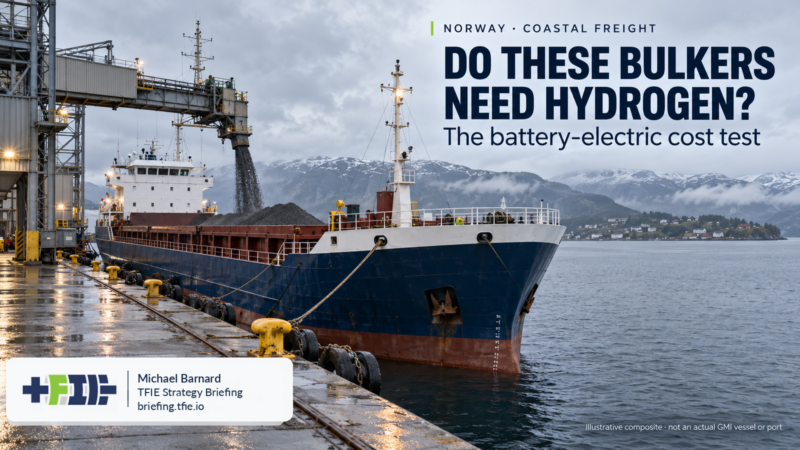
Norwegian shipping company GMI Group is moving ahead with four hydrogen-electric bulk carriers for coastal freight. In October 2026, PowerCell confirmed a follow-up order that brings the program to 24 marine fuel-cell units with 5.4 MW of combined installed capacity. The first two ships, rated at 4,000 deadweight tonnes, are planned for 2027, while two additional 3,000-tonne vessels are expected in 2029.
The project has real shipbuilding commitments and substantial public support. The question is whether hydrogen makes economic sense for the freight services these vessels will provide.
GMI says its design can deliver lifetime costs 9–10% below conventional ships. Its argument combines fuel cells, batteries, an efficient hull and wind assistance. Those are useful engineering features, but most are not exclusive to hydrogen propulsion. A diesel or battery-electric ship can have a similarly efficient hull and sails. The fuel and energy systems still need to be compared on equivalent terms.
I modeled two hypothetical 3,000-tonne coastal bulk services, covering 80 and 55 nautical miles, using comparable hull performance and operating requirements. Over fifteen years, hydrogen propulsion came out 50–58% more expensive than conventional diesel, even after assuming approximately €13.1 million in public vessel support was received upfront. Battery-electric alternatives were €11.64–14.13 million cheaper than the subsidized hydrogen vessels. These are scenario results, not estimates of GMI’s actual operating contracts.
The company has not published the route and commercial data needed for a direct assessment, and the model’s vessel acquisition prices remain important uncertainties. The battery alternatives were not the cheapest option under every assumption. In the central cases they cost somewhat more than diesel over fifteen years. Their advantage was the much smaller gap to conventional operation compared with hydrogen. Battery-electric propulsion also requires adequate grid connections, charging equipment and berth time, which cannot be assumed available at every Norwegian port.
Hydrogen has a different set of requirements. Renewable electricity must be converted into hydrogen, compressed, stored, delivered to the vessel and converted back to electricity in fuel cells. Those additional processes introduce energy losses and capital costs that efficient hulls and sails cannot erase. They matter particularly for short coastal voyages where a practical charging arrangement may be possible.
Norway is using substantial public funding to support the hydrogen ships. Norsk Hydrogenforum reports Enova awards totaling roughly €42.9 million for the four vessels. Additional public support has been awarded to GreenH hydrogen production projects. Announced grants are not necessarily fully paid, and a subsidy changes the allocation of costs rather than eliminating the equipment and energy required.
There may be coastal services where voyage length, available berth time or grid limitations favour hydrogen over batteries. That needs to be established through engineering and commercial comparisons, rather than inferred from the existence of a funded shipbuilding program.
Before further public commitments to compressed-hydrogen coastal freight, Norway should require credible battery-electric bids using vessel, charging and energy prices appropriate to the expected entry-into-service dates.
My full TFIE Strategy Briefing assessment examines the modeled voyage costs, reconstructed hydrogen supply economics, battery sizing and charging constraints, public subsidies and financial sensitivities that would determine which propulsion system is competitive. The detailed analysis is available to paid subscribers.
Sign up for CleanTechnica’s Weekly Substack for Zach and Scott’s in-depth analyses and high level summaries, sign up for our daily newsletter, and follow us on Google News!
Have a tip for CleanTechnica? Want to advertise? Want to suggest a guest for our CleanTech Talk podcast? Contact us here.
Sign up for our daily newsletter for 10–15 new cleantech stories a day. Or sign up for our weekly one on top stories of the week if daily is too frequent.

CleanTechnica uses affiliate links. See our policy here.
CleanTechnica’s Comment Policy