
Westward Ho! First Trip Cross Country with Our New 2026 Tesla Model Y & Full Self Driving V14
Support CleanTechnica’s work through a Substack subscription, on Patreon, or on Stripe. Help us produce all of the high-quality, original content we publish week after week despite the challenges of content-scraping AI, antisocial media, inflation, and other hurdles.
We were headed west again for the 6th time, driving the ~1500 miles from our lake house in Northern Wisconsin to our winter home near the grandchildren in Northern Utah. We had totaled our 2019 Tesla Model 3 in an accident in May; therefore, this was our first road trip in our new 2026 Model Y running Full Self Driving V14. As usual, we were carrying two big ebikes on the back. We plan to pause in Utah at our home for a few days and then on to Portland, Oregon, and the Pacific Ocean.
The experience was quite different this time because of the new car and the significant upgrade to Tesla’s driving automation: Full Self Driving Supervised V14.3.12.
As we approached our first Supercharger in Wausau, Wisconsin, it looked like the navigation was taking us the wrong way. However, once we got to our normal exit, it was closed. We had to drive a few miles beyond it, do a U-turn, and come back. It cost us roughly an extra 5 miles. I’m going to have to learn to trust the navigation. The Nav knows about road closures like this and even traffic jams. Unfortunately, it doesn’t explain ahead of time why it is suggesting an alternate route.
Our first stop was at the Wausau, Wisconsin Supercharger next to the Hilton Gardens Inn on highway NN. In 7 years, we’ve never seen more than a few cars charging there. For the first time, the charging station was full (see photo below). It was Sunday after a big fall-colors week in Northern Wisconsin and many tourists were headed home. On our screen, it gave a charger wait time of five minutes. As we drove the last 100 miles to Wausau, our computer screen alternated between showing an unspecified wait time and as many as two stalls open.

When we arrived, it listed two stalls as open, but, in fact, for nearly the first time across the last seven years that we’ve been Supercharging, all eight stalls were full. However, here’s the good part: within less than five minutes, one of the cars pulled out and we were able to back into the empty stall. Then, the bad part: it was the slowest charge we’ve ever experienced. It was an older V2 hardware Supercharger where you need to share charging with the adjacent car. That meant that we were charging at only a 50-kilowatt speed for the whole charge. The total charge took about 40 minutes. However, after the bathroom break and walking our small rescue dog, Zuni, we only needed to kill about 15 minutes before setting off again.
The next stop was Menomonee, Wisconsin, halfway to Minneapolis and the charger was showing three empty stalls. Since, as I mentioned, we were traveling on a Sunday, a beautiful day, with full fall colors in the Northwoods, we found another Supercharger that appeared to be full (see below), but there was one stall empty and we pulled in. When we came east in mid-May, there were seldom more than one or two cars in any of the 12 Superchargers en route.

The Menomonee Supercharger has a newer Hardware 4 charger, so we were charging faster, at almost 100 kW during our whole charge. As we pulled out, there were about three cars waiting, but the line moved quickly. No one had to wait more than a few minutes. Then we were on our way to Minneapolis.
About 20 miles east of Minneapolis, crossing the Saint Croix River on the border between Wisconsin and Minnesota, half the lanes of the bridge were shut down. The navigation took us on a town of Henderson detour going on highways U and UU, then back onto the I-90 route across the bridge. It probably saved time avoiding the worst of the traffic backup because of the closure on the bridge. Then we were on an east–west route right through the center of Saint Paul–Minneapolis. Full Self Driving V14 with Tesla navigation found its way through the big city freeways perfectly.
As we left the Minneapolis Supercharger, we couldn’t get Full Self Driving to work! It said “FSD Temporarily Unavailable.” However, temporarily lasted for a very long time. We went through a long troubleshooting process with Ara (the Grok bot) and with Tesla Customer Service on the phone. Not only did FSD fail to work, but it was reporting a speed limit of 15 mph when the actual speed limit was 65 mph. First, we stopped, put the car in park, and did the two-scroll button reboot. No luck. Then we were instructed to use the menu to reboot the car. No luck. Then we tried to recalibrate the cameras as suggested, but it was nighttime and the calibration wouldn’t finish. Not only was FSD not working, but smart cruise control also failed to operate. However, after partial re-calibration of the cameras, it did restore smart cruise control.
On day two of our cross-country trip, we left Worthington in the southwest corner of Minnesota on I-90, passing through a huge wind turbine field (see below) with hundreds of turbines on the north side of the road just as we got into South Dakota.

A short time later, we saw a wind turbine tower factory with hundreds of turbine tower sections laid down as you see in the photo.

As we began our drive through South Dakota we had smart cruise control, but no FSD.
The first Supercharger stop in South Dakota was at Murdo. I went into the pharmacy in the adjacent supermarket and bought some medical tape and taped over the back camera. I did this because we found that, with our older car, strangely, taping over the back camera was the only way to get full FSD to work with bikes on the back.
We restarted the camera celebration, which had failed the night before in the dark. This time we observed the little gray steering wheel icon in the upper-left-hand corner of the screen. A blue circle starts at the bottom around the icon, and it progresses all the way around to indicate that the calibration is in progress. However, when it was almost complete, it started over at the halfway point. It oscillated back and forth a few times for almost an hour before it finally completed the calibration and we got FSD back! We had lost FSD for the better part of two days of our 1500-mile trip. Since we pay $99/month for FSD, will Tesla give us a refund?????
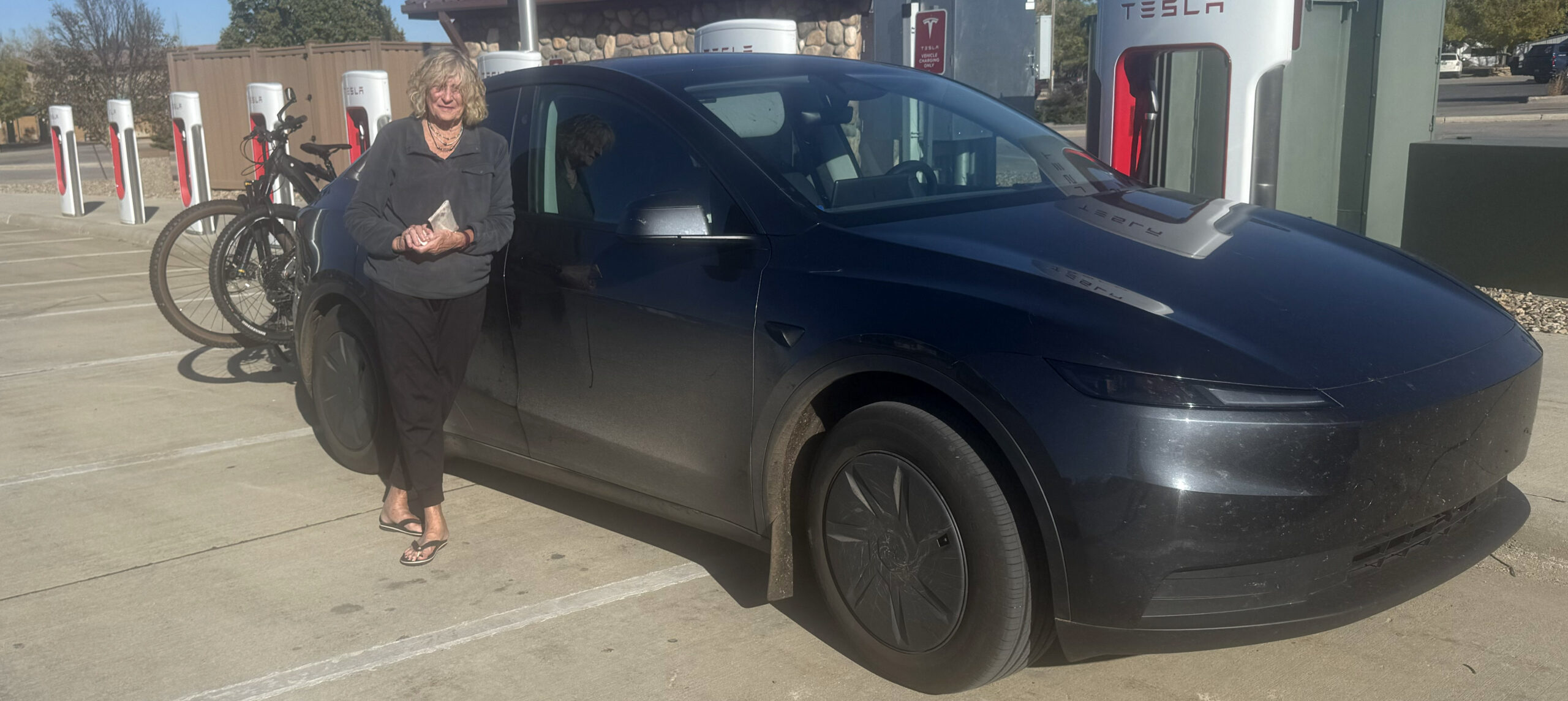
Our stop in the middle of South Dakota was at the Supercharger in Wall, home of the famous Wall Drugstore. See my wife and our Tesla with the bikes at the Supercharger in the photo below.

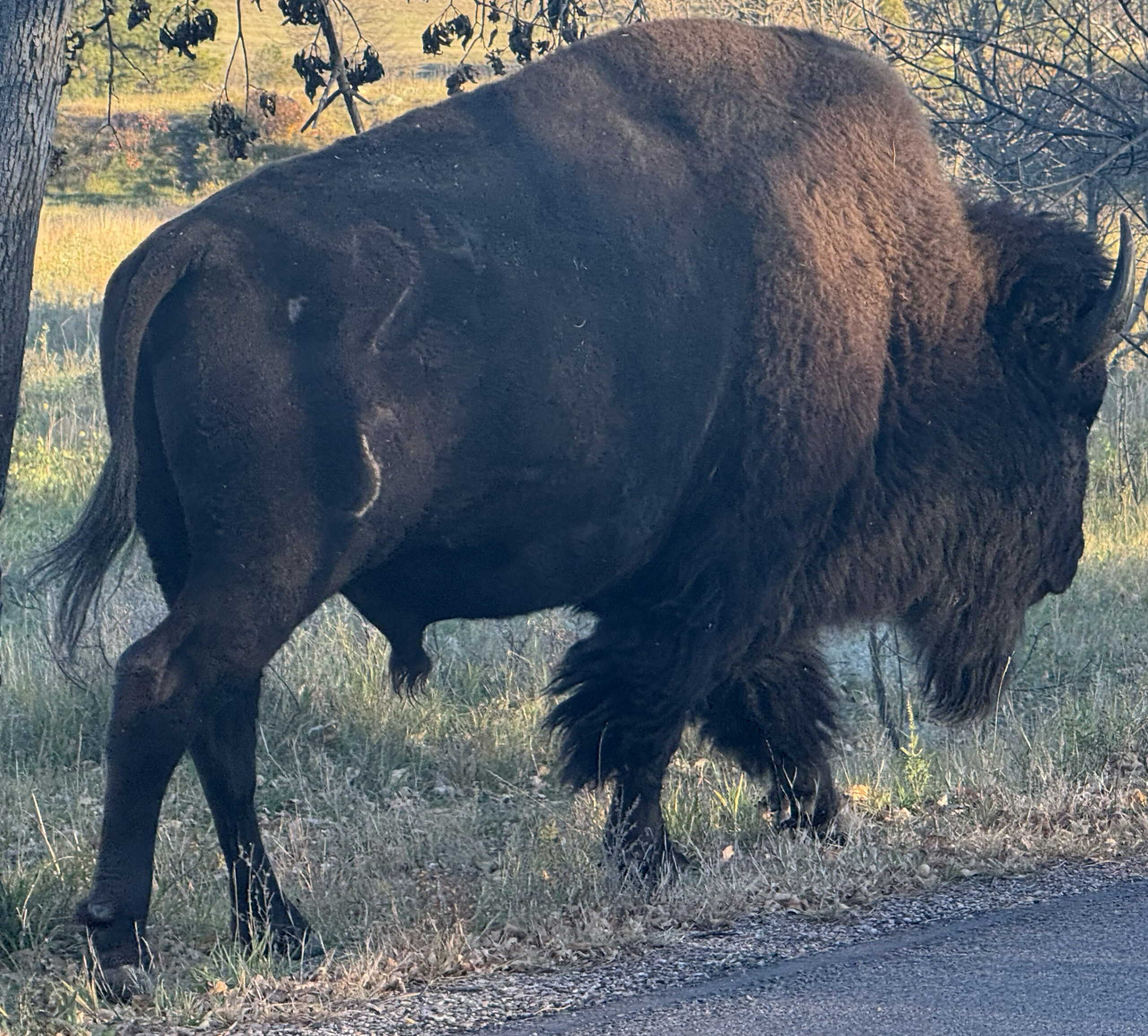
We charged in Wall, South Dakota, and drove another 80 miles to the wildlife loop at Custer State Park. There, “we ran with the bulls” — I mean, we ran with the bison (buffalo). We were driving right in the middle of a big bison herd, as you see in the photos below.


My wife spotted hundreds of pronghorns on our trip west, and the visit to Custer State Park would not be complete without seeing one, as well as feeding and petting the donkeys.

We made it by 8:00 pm to the tiny town of Lusk, Wyoming, where a four-stall Supercharger is across the street from the Pioneer Best Western where we spent the night. The next morning, we were in eastern Wyoming, where we were following double railroad tracks used to ship coal from the huge, high-quality, low-sulfur coal deposits in northeast Wyoming to power plants farther east.
“Coal Area — The Powder River Basin spans over 1,000 square miles, making it one of the largest coal-producing regions in the US,” Google shares. “Depth of Coal Beds — Coal beds in the region can be as thick as 250 feet, with only 120 feet of soil overburden.”
The photos below show one of the unit coal trains bringing coal from the Powder River Basin as we passed. Clean power is on the rise, but coal is still an important part of electrical generation in the United States.

Powder Basin coal is also going to the Dave Johnson power plant in eastern Wyoming that we passed. It is an 817 MW plant that was scheduled to shut down next year (2027). However, the Trump administration has “rescued” it and it won’t shut down or be converted to gas for at least a couple more years.

On the third day of our trip, FSD was working and we stopped to charge at Evansville near Casper, Wyoming. Then we passed Devils Gap, Independence Rock, and the pioneer handcart company memorial on our way to Rawlins. At Rock Springs, I left my wife at the TJ Max while I charged at the Tesla Supercharger 100 yards away. The final charger was in Evanston, Wyoming, and then we crossed the Utah border and passed Park City, Heber, and drove down Provo Canyon to our winter home in Lindon just north of Provo (30 miles south of Salt Lake City). It took three 500-mile days to make the trip.
Summary: Our new 2026 Tesla Model Y seemed to charge a little slower than our old Tesla Model 3 Long Range. However, it appeared to have longer battery range. This meant that we could often travel as fast as 80 mph, whereas previously we never exceeded 75 mph and occasionally had to slow down as low as 60 mph to make the next charger — in our old Model 3 with the bikes on the back. FSD was a pleasure, keeping the car precisely in the middle of the lane, passing cars, and returning to the right-hand lane just as I would do myself … except when FSD failed to work for a big part of two days during the trip. I’m 86, and it was a strain keeping the car centered in the lane and keeping a foot on the accelerator when FSD wasn’t working.
If you find any of my articles helpful to you, please use my referral link when buying a new Tesla: https://ts.la/arthur73734 (Be sure to use it when you make your order). Tesla keeps changing the program, but here’s the latest: If you are buying a new Tesla Model 3 or Y and use my link, you will get two months of free Full Self Driving (a ~$200 value) on top of the one month that comes free with every new Model Y right now. This will get you a total of 3 months free Full Self Driving. It will be $99/month after that. For a Cybertruck, you will get $1000 off your purchase price. At this moment, Tesla is offering a year of free Supercharging with the purchase of a new Model 3 Premium or Performance.
Sign up for CleanTechnica’s Weekly Substack for Zach and Scott’s in-depth analyses and high level summaries, sign up for our daily newsletter, and follow us on Google News!
Have a tip for CleanTechnica? Want to advertise? Want to suggest a guest for our CleanTech Talk podcast? Contact us here.
Sign up for our daily newsletter for 10–15 new cleantech stories a day. Or sign up for our weekly one on top stories of the week if daily is too frequent.


CleanTechnica uses affiliate links. See our policy here.
CleanTechnica’s Comment Policy