

Support CleanTechnica’s work through a Substack subscription, on Patreon, or on Stripe. Help us produce all of the high-quality, original content we publish week after week despite the challenges of content-scraping AI, antisocial media, inflation, and other hurdles.
Graphyte’s Carbon Casting process is unusually tangible for engineered carbon removal. Residual biomass is dried, compressed into dense blocks, protected from water and microbes, and stored underground so its carbon stays out of the atmosphere for a very long time. Compared with direct air capture and some other carbon-removal proposals, the physical chain is easy to follow, which makes the diligence questions fairly concrete.
I initially expected those questions to focus on the process itself. Drying wet forest residues requires energy, plastic wrappings have an emissions footprint, and transport and handling can disappear conveniently outside a narrow accounting boundary. Once I worked through those terms, though, the result was more favorable to Graphyte than I expected. Dry agricultural residues need little additional drying, the polymer burden is material but modest, and even wetter forest thinnings still retain substantial net carbon-removal value after the visible process emissions are counted.
That result pushed the analysis somewhere more interesting. In the full TFIE Strategy Briefing assessment of Graphyte, I follow the same feedstocks through competing pathways and ask what happens to their carbon, useful products, nutrients and minerals before deciding whether direct burial deserves priority.
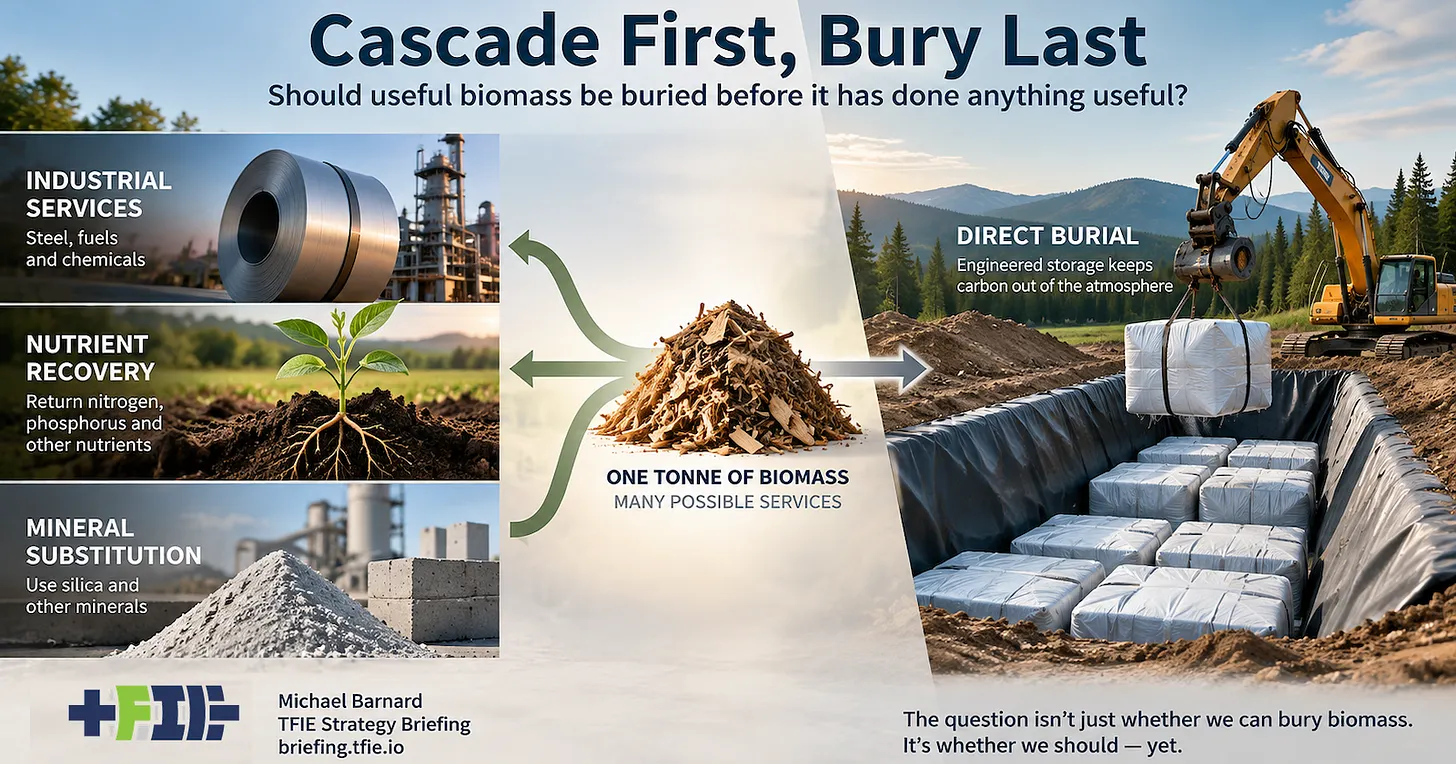
Once the process itself survives scrutiny, the important system boundary moves upstream. Biomass is not simply atmospheric carbon that happens to have been packaged by photosynthesis. Depending on the feedstock, it can also provide chemical energy, industrial molecules, nutrient value and useful mineral fractions, while forest material may continue to serve ecological functions before it is removed. Putting an intact ton into engineered storage preserves its carbon, but it also permanently closes those other options.
That makes resource sequencing a better framework than arguing that burial is either good or bad. Some biomass has valuable productive uses that can displace fossil fuels or fossil feedstocks, and some conversion pathways generate concentrated biogenic CO₂ that can be captured after the useful service has already been delivered. In those cases, carbon storage can occur later in the chain rather than being the first and only use of the material.
Other feedstocks do not fit those productive pathways well. Lignocellulosic residues can perform poorly in anaerobic digestion, wet biomass can be expensive to move, and sophisticated conversion equipment is of little value without a credible market for the resulting product. For material with no sensible local use, direct burial may be one of the best available climate options. The point is to test that option value before committing the feedstock to an irreversible endpoint.
Carbon-removal markets can complicate the allocation decision because Graphyte’s output is comparatively easy to measure. The incoming biomass can be weighed, process emissions calculated, stored blocks tracked and removal claims issued against a bounded physical system. Productive biomass pathways often spread their climate benefits across several places: fossil displacement in a fuel or industrial market, nutrient recovery in agriculture, mineral substitution in cement, and biogenic CO₂ capture at another facility. The accounting is messier even when the physical system may be doing more useful work.
As carbon-removal procurement grows, that difference can become a real feedstock-market signal. Aviation, shipping, chemical production, steel, industrial heat, agriculture and construction can all compete for different forms of biomass or the materials embedded within it. Calling something a waste residue does not erase those competing uses, particularly once carbon-removal buyers are prepared to pay substantial sums to keep the material permanently out of circulation.
A key point in this is that most of the other use cases extract economic value from the biomass. Graphyte and other biomass interment solutions produce only carbon credits. My perspective is that processes that extract economic value from biomass, return nutrients to fields and sequester only the biogenic carbon dioxide or carbon are the ones that will thrive economically.
As a result, Graphyte deserves a more nuanced assessment than either enthusiasm or dismissal. Its core storage process appears capable of delivering meaningful durable removal, and some biomass will genuinely have little useful option value left. The unresolved strategic question is whether a specific biomass resource should go directly into storage when a credible productive pathway could provide another climate or industrial service first.
For carbon removal, the useful discipline is the same one that applies elsewhere in the transition: widen the system boundary before optimizing one step inside it. Engineered burial has a legitimate place, but the best candidates are likely to be residues whose higher-value services have already been exhausted or shown not to be practical.
The full TFIE Strategy Briefing analysis contains the feedstock-by-feedstock comparisons, carbon and emissions workbook, nutrient and mineral accounting, and the economic assessment of where competing pathways become more or less attractive. Investors actively assessing Graphyte can contact me about the underlying diligence models.
Sign up for CleanTechnica’s Weekly Substack for Zach and Scott’s in-depth analyses and high level summaries, sign up for our daily newsletter, and follow us on Google News!
Have a tip for CleanTechnica? Want to advertise? Want to suggest a guest for our CleanTech Talk podcast? Contact us here.
Sign up for our daily newsletter for 10–15 new cleantech stories a day. Or sign up for our weekly one on top stories of the week if daily is too frequent.

CleanTechnica uses affiliate links. See our policy here.
CleanTechnica’s Comment Policy