

Support CleanTechnica’s work through a Substack subscription, on Patreon, or on Stripe. Help us produce all of the high-quality, original content we publish week after week despite the challenges of content-scraping AI, antisocial media, inflation, and other hurdles.
After World War II, manufacturing on the Continent was severely degraded. Automakers in France, Germany, and Italy began producing cars that were simple and cheap — cars like the Isetta, Messerschmidt, and Fiat Cinquecento. In 1949, the Citroen 2 CV went on sale, a car that looked like it was made from recycled Quonset huts. It was powered by a 9 horsepower, air cooled, horizontally opposed, 375 cc, two cylinder engine. The cooling fan was attached directly to the crankshaft and the car featured enormous suspension travel that allowed it to soak up the potholes in France’s bombed-out roads.
The whole car, including the engine, was so simple that owners could repair them themselves. They weren’t much to look at, but they were cheap, sturdy, and better than walking. Between 1949 and 1990, Citroen sold more than 5 million of the little beauties. Toward the end, the engine size was increased to 602 cc and output went up to a lofty 29 horsepower! There is still an active group of 2 CV owners who race their cars. It is a sight to see them slugging it out on track, where “acceleration” is measured in furlongs per fortnight rather than 0 to 100 km/h times.
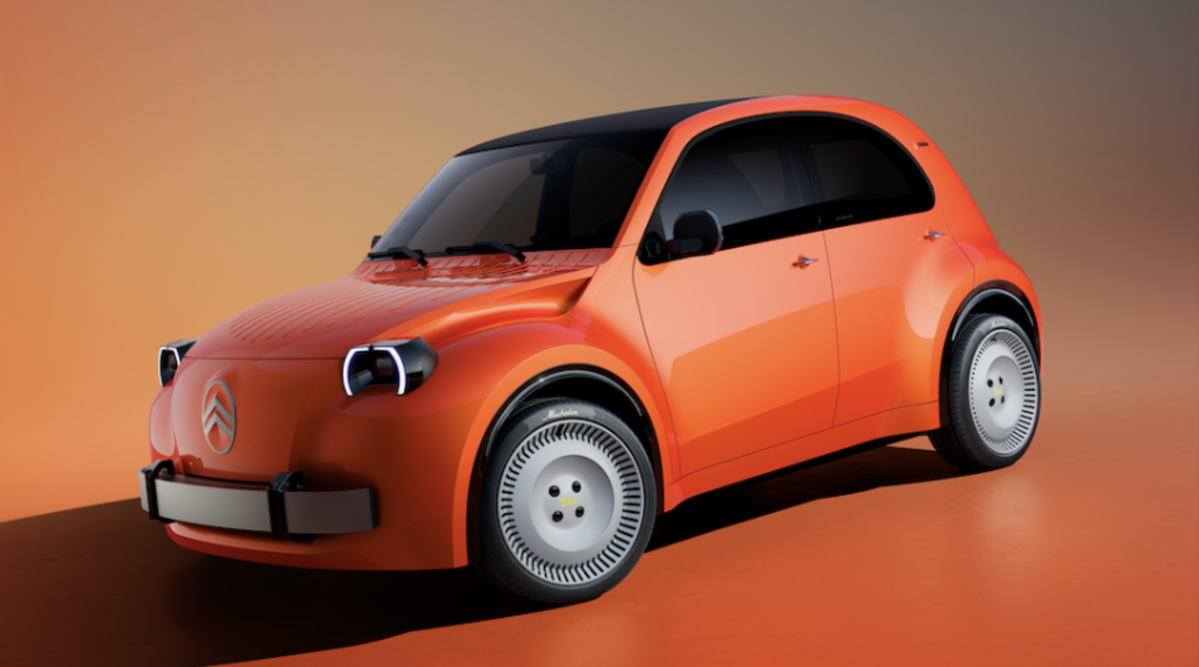
Citroen 2 CV Concept
Now the 2 CV is back, this time in battery electric form. In a press release, Stellantis said it will reveal its new 2 CV Concept at this year’s Paris Motor Show. It calls the concept car “a modern, ingenious ,and refreshing response to the mobility challenges of tomorrow. This concept embodies the core values that have always defined the 2 CV — affordability, lightness, practicality, versatility, and a distinctive character unrivalled on the road.
“With a compact length of 3.76 meters (12′ 4″), this concept embodies freedom of movement, ease of use, and affordable electric mobility. Clever and appealing, its design incorporates all the hallmarks and charm of the 2 CV, reinterpreted in a contemporary version that pays numerous tributes to its predecessor.”
Intrigued? Patience, grasshopper. The production version of the car is at least 2 years away. It is expected to cost €15,000 and will comply with the future European M1E electric car standard.
Citroen CEO Xavier Chardon, told the press, “Reinventing the 2 CV isn’t about replicating a car from the past; it’s about reinventing what made it unique — its simplicity, its accessibility and the freedom it offered. With the 2 CV Concept, we’re bringing that spirit into today’s world to make electric mobility simpler, more human, and more desirable. The world has changed, but the idea remains the same — to make life more beautiful with Citroen.”
Positively Adorable

Car and Driver was smitten by the 2 CV Concept, calling it “positively adorable. The shape is bubbly and the face is cheerful, with headlights composed of LED arches that sprout up from the pronounced fenders. The retro vibes continue with the chrome bumper that protrudes from the front bodywork, and a series of vertical lines that are indented in the hood.
“The cabin is whimsical in a way that only a French automaker could accomplish. The bench seating looks like a deck chair, with puffy cushions upholstered in yellow plaid cloth, while the center console consists of a removable wicker basket, making it feel as if you’re on a picnic while driving. Above, there are tiny lanterns strung up around the edge of the opening created by the large fabric sunroof. The door panels are almost entirely devoid of decoration, save for straps in place of traditional door handles.” That bench seat, by the way, can be removed from the car for use during picnics and other extracurricular activities.
Minimal By Design
This minimalist approach is more than a marketing stunt. By specifying a cloth roof instead of steel, and by creating an interior that focuses solely on functionality, Citroen is striving for a car that barely weighs more than 2000 pounds — something that will make one of our regular readers weep with joy. Less weight means a smaller, less expensive battery can be used to power the car.

The screens on the dashboard use a unique user interface inspired by comic books. “Everything has a hand-drawn look to it, from the climate controls to the speedometer and even the navigation. The sound system hangs onto the underside of the dashboard, looking like a classic radio, and it is detachable and doubles as a speaker,” Car and Driver reports. Electrive calls it “a microcar with a pragmatic specification designed to simplify everyday life with minimal fuss and a touch of positivity.” Cool!

The new 2 CV will not be a long distance touring car. For the journey from Paris to St.Tropez, the smart set will still prefer to use the Facel Vega, but for those who want a low cost, reliable urban vehicle, the 2 CV should be just what the doctor ordered. Quirky might be the word that best fits the concept car. But then again, the original was equally quirky and remained in production for 45 years. Citroen would be very happy if the new 2 CV matched or exceeded that lifespan.

No technical details accompanied the introduction of the concept, but its a sure bet the diminutive EV will debut with more than 9 horsepower. Perhaps later this century, the car will be the basis of a new racing series, one with all the ardor and passion of the original! There may even be a panel van variant some day, just like the original.
Sign up for CleanTechnica’s Weekly Substack for Zach and Scott’s in-depth analyses and high level summaries, sign up for our daily newsletter, and follow us on Google News!
Have a tip for CleanTechnica? Want to advertise? Want to suggest a guest for our CleanTech Talk podcast? Contact us here.
Sign up for our daily newsletter for 10–15 new cleantech stories a day. Or sign up for our weekly one on top stories of the week if daily is too frequent.


CleanTechnica uses affiliate links. See our policy here.
CleanTechnica’s Comment Policy