
Pebble Upgrades the 2027 Flow, Turning It Into A Microgrid To Power Your Adventures & Your Home,

Support CleanTechnica’s work through a Substack subscription, on Patreon, or on Stripe. Help us produce all of the high-quality, original content we publish week after week despite the challenges of content-scraping AI, antisocial media, inflation, and other hurdles.
Pebble was one of the first fifth-wheel manufacturers to truly embrace the promise of automotive-grade lithium batteries, rooftop solar, and public EV chargers bundled into a tech-centric living space.
That’s right up our alley, which is why we cover them regularly here on CleanTechnica. They invited us out to be some of the first in the world to experience the new 2027 Pebble Flow and speak directly with their leadership team about all of the things they’ve learned in their first year of volume production and what upgrades they made as a result.

Disclaimer: Pebble paid for the author’s travel and accommodations to attend this event.
On the surface, the 2027 Pebble Flow looks the same as its predecessor. Digging deeper, you start to see some of the new options and upgrades they’ve added. Pebble added a new external portable solar integrator that plugs directly into the Flow and adds a pigtail with four pairs of solar MC4 connectors. This module will be available for all Flow owners as a retrofit and lets Pebble owners add up to 3 kW of additional solar to the 1.1 kW system that comes on the roof.
That translates to up to 4 kW of solar that can keep the Pebble’s 45 kWh iron phosphate battery topped up. In more practical terms, that means you can use the Pebble for more things, for more hours, on more days of the year. Owners have the option to add as much or as little solar as they want via the new external junction box, and Pebble partnered with Jackery to more seamlessly integrate their 500W foldable solar panels with the system.

A larger solar system pumps out more power in all seasons, opening up new options for owners whether they’re looking to charge their EV from their Pebble, use it as a backup battery during grid outages, or just to run the air conditioner for more hours each day. The new energy upgrade option will begin shipping in December 2026, with an option for existing owners to retrofit their Flow.
Because the Pebble Flow is so capable and is effectively autonomous when it comes to your energy generation and consumption, it can even be used as an accessory dwelling unit (ADU) when you have guests visiting. It’s definitely a non-traditional option, but it’s really cool that you could conceivably host guests in your fifth wheel in the backyard without asking them to sacrifice anything.

Stepping inside the Pebble, perhaps the biggest interior change for the 2027 model year is the option to swap out the queen-size Murphy bed that was the only option in the original Flow for two twin-size beds that come permanently fixed to the ground, which translates to even more storage underneath (photo above).
It’s a good option for couples with older kids that aren’t interested in sleeping in the same bed and want their own space. This configuration gives the kids their own space to sleep on the two twin beds in the front of the unit while the adults can sleep on the convertible dinette bed that seems roughly equivalent to a full-size bed at the rear.

The twin bed configuration is also a great option for people who don’t like climbing into bed from the foot of the bed, which is what you have to do with the queen-size configuration. The two twins have a narrow aisle between them which lets you walk up to the side of the bed before sitting down, which is a preferred way of getting in and out of bed for many people. Of course, that comes with the tradeoff of not sleeping in the same bed as your spouse, which may also be considered a benefit, depending on how you look at it.
The Pebble Flow has electrochromatic glass on all exterior windows as well as along the bathroom and shower section of the Flow. It’s a really cool way to add legitimate privacy, which is perhaps the ultimate luxury in such a small space. It also lets you shroud the entire Pebble Flow in a cocoon of privacy for when you’re at camp changing or just don’t want to have to interact with the outside world.

On the software front, Pebble is shipping Pebble OS 2, which will come as an over-the-air update later this year to all Flow owners and come natively on the 2027 Flow. This unlocks a number of new features, including Boost Mode, which gives you the ability to leverage the Pebble’s 40 kW or 54 horsepower of tow assist.
Towing is definitely one of the strengths of the Flow, thanks to the pair of hub motors located in each of its wheels. These tap into the Flow’s onboard battery to propel the Flow when it’s being towed. It actively detects if the tow vehicle is accelerating or slowing and either accelerates to match the speed or engages regeneration to slow itself down.
Combined with its impressive aerodynamics and its active aerocap up front, the Pebble Flow is a gamechanger. Instead of an EV range of around 100 miles of range per charge with an equivalent 6,000 lb trailer, drivers can achieve upwards of 250 miles of range per charge when starting out with a full EV battery and a fully charged Flow in tow. That’s fewer charging stops, which is always a win.
The twin motors in the Flow can also be used to literally remote control the Flow, which in addition to being a great party trick around camp, makes hitching and unhitching the flow a breeze. You can use the iPad to steer and drive the Flow into exactly the right position before lowering it down onto the hitch and securing it. It’s also super handy if you’re looking to fast charge the Flow, as you can simply disconnect it and drive it into a charging stall. That’s right, it can fast charge, too.
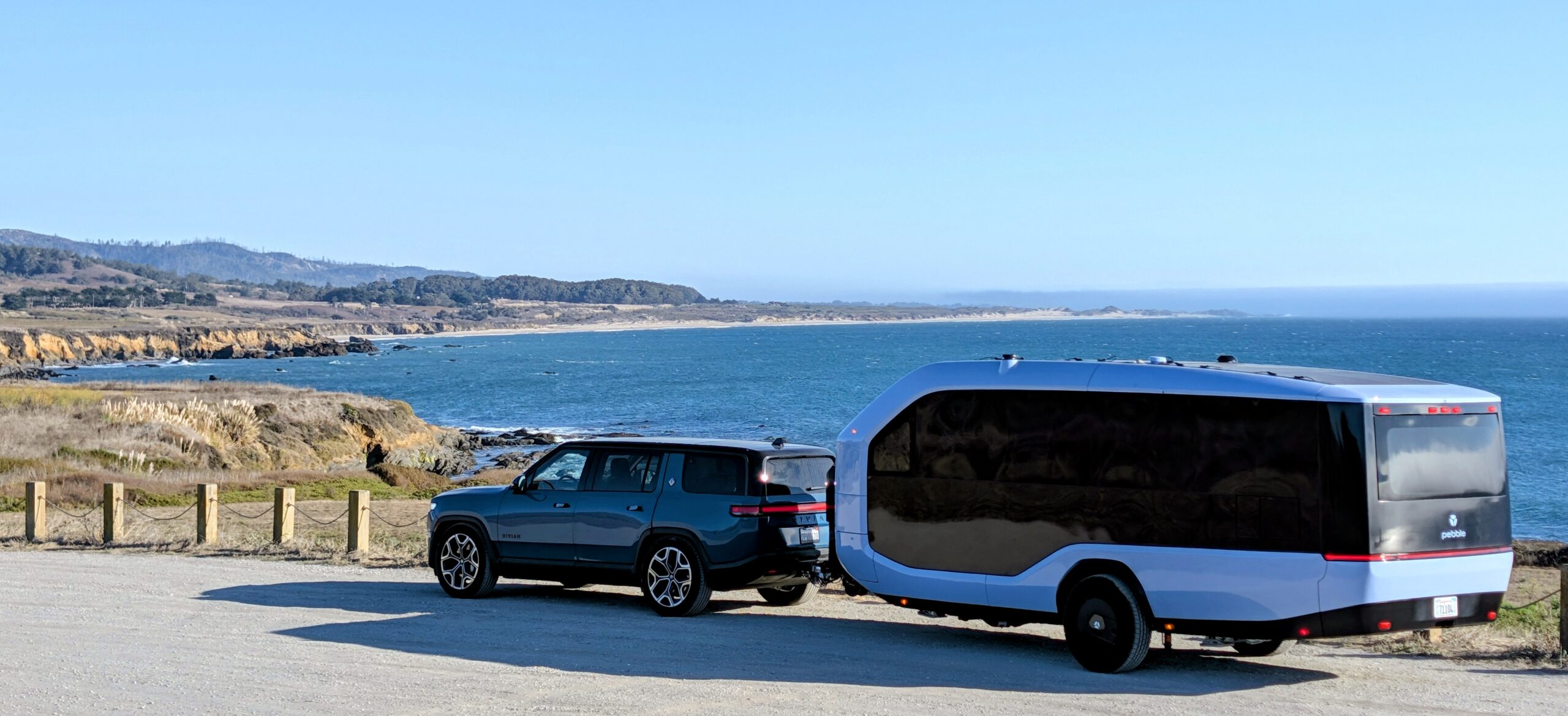
When it comes to actually towing the Flow, I’ve only driven with a trailer once, so I was nervous to tow the Flow. Just the same, I hopped into the Rivian R1S with the Flow in tow thinking I was just taking it for a loop around camp. To my surprise, I was directed to the highway where I discovered just how easy it was to tow.

I couldn’t really tell there was anything behind me for most of the trip as we flipped the Flow into different assist modes. Some provide no to low assist, while the new Boost Mode makes it effectively disappear as a tow vehicle. You can still feel it if there are any crosswinds, but it’s a noticeable improvement and a huge win for folks new to towing.
Overall, spending a long day with it and a night sleeping in the Pebble Flow showed me firsthand that it is a fantastic fifth wheel that makes getting out and adventuring easier and more comfortable than it has ever been. It lets you bring all the comforts of home with you on the road without the stress towing a large fifth wheel used to incur.

The new solar integration and partnership with Jackery makes it easy to boost solar input to up to 4 kilowatts, while its ability to push 12kW back out makes it a great option as a backup power source for your house. It’s a functional microgrid on wheels with generation, storage, utilization, and power output capabilities that are unmatched.
When you’re home, it can serve as an auxiliary living space for guests, or for you if you end up in the doghouse.

I’m seriously tempted to pull the trigger on one myself if I can only find a way to convince my wife. It’s currently $189,000 for the fully loaded Flow Founder’s Edition, $159,000 for the slightly less well equipped Pebble Flow Magic Pack, and presumably slightly less for the soon-to-be-released Pebble Flow Standard.
For more information about Pebble or the Flow, head over to their official website.
Sign up for CleanTechnica’s Weekly Substack for Zach and Scott’s in-depth analyses and high level summaries, sign up for our daily newsletter, and follow us on Google News!
Have a tip for CleanTechnica? Want to advertise? Want to suggest a guest for our CleanTech Talk podcast? Contact us here.
Sign up for our daily newsletter for 10–15 new cleantech stories a day. Or sign up for our weekly one on top stories of the week if daily is too frequent.


CleanTechnica uses affiliate links. See our policy here.
CleanTechnica’s Comment Policy