

Support CleanTechnica’s work through a Substack subscription, on Patreon, or on Stripe. Help us produce all of the high-quality, original content we publish week after week despite the challenges of content-scraping AI, antisocial media, inflation, and other hurdles.
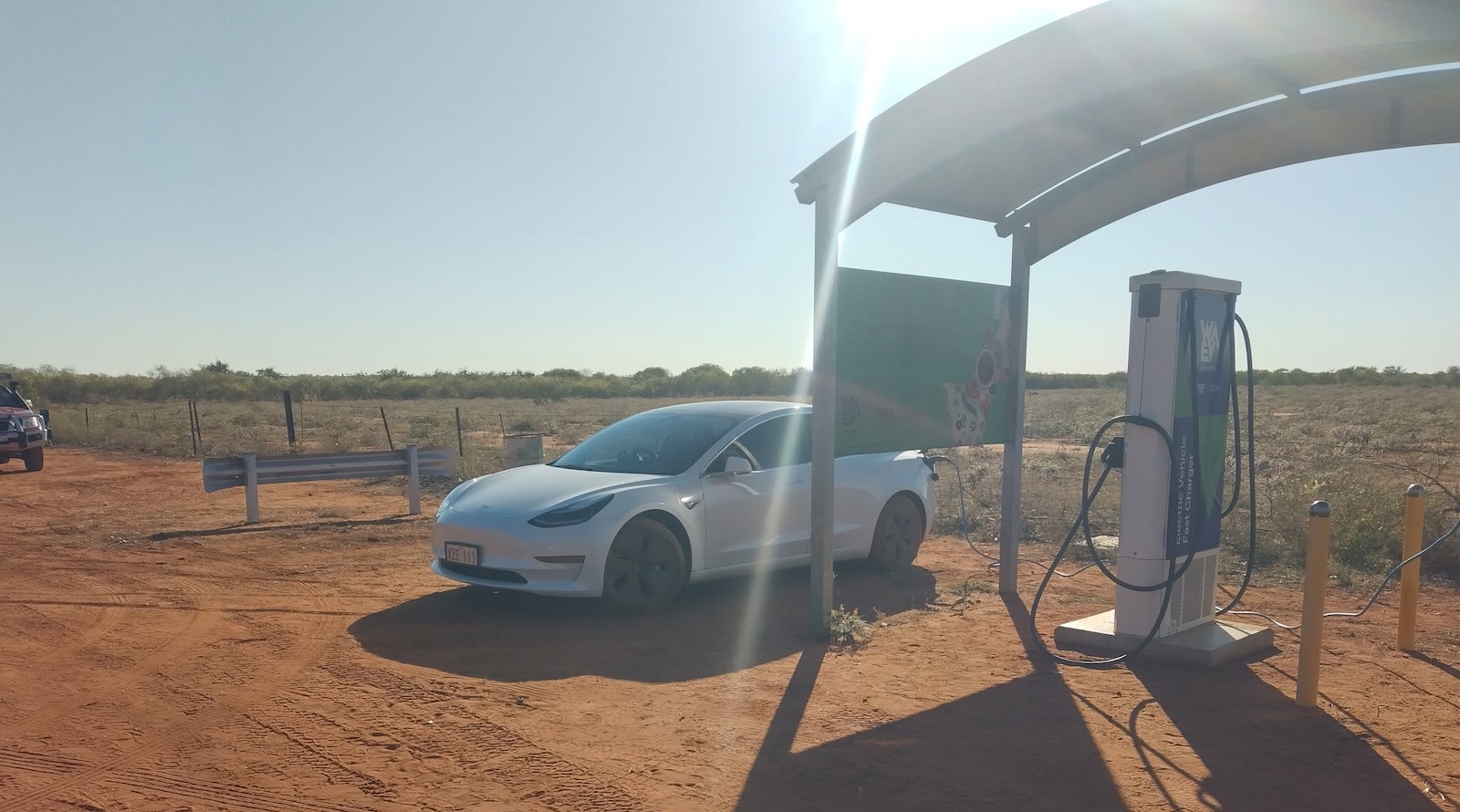
Sick of the cartoons and comments insisting that all electric cars are powered by electricity generated by fossil fuels, Andrew Mangano set out to show it is possible to travel around Australia using mainly solar energy. You probably know the cartoons I am referring to — showing an EV linked to a coal-fired power station, basically accusing EV owners of hypocrisy. There are also the photos highlighting diesel-powered backup systems at remote charging sites.

Andrew and I had a great chat on the phone (he is based in Perth — 3000 km from Brisbane where I am based). He is a retired electrical engineer. Ironically, on his trip, he charged at a shopping centre with a very large solar array within a 5-minute drive from my house. We could have met up for a coffee! He urged me to check out his blog and produce an article. What follows is an attempt. I hope to do his epic journey justice. For those who wish to read the blog and view all of his photos, you can check them out here. Apparently, over 73 people have now driven around Australia in electric vehicles. Andrew added an extra challenge — solar charging.
Andrew supplied this information about his background:
“My background is as an electrical engineer, specialising in telecommunications and associated infrastructure (optical fibre, radio, DC power, solar power, radio structures), with 40 years of experience in Telstra, Amcom, Western Power, UGL, Kentz, Worley Parsons, and as a self-employed consulting engineer.
“I converted a Ford Laser TX3 to electric (in 2001), have driven a Holden Volt EREV since 2017 and a Tesla Model 3 Long Range since this year, including hiring a Tesla Model 3 Long Range and driving a lap of Tasmania in February of this year.”

Andrew chose to use his Tesla Model 3 Long Range to make the trip. The trip was planned using PlugShare and Google Earth to locate solar powered charging sites. On his 10th day on the road, he passed Ed Darmanin going the opposite way on his electric motorbike. CleanTechnica readers would remember Ed from previous articles.
Here are Andrew’s statistics:
- Days on the road — 42
- Total km covered — 16,940
- Average efficiency — 149.4 Wh/km
- No of charge sessions — 69
- Total charging cost — AU$1,649.04
One of his Facebook followers quipped: “That’s amazing that you did that entire lap in 42 days! Not coincidental that 42 is ‘The Answer to the Ultimate Question of Life, the Universe, and Everything’? referencing the Hitchhikers Guide to the Galaxy.“
Part of Andrew’s mission was to educate those who already own an EV that it matters when and where you charge. After buying an EV, the next step is to learn the most ecologically (and cost-effective) way to charge the vehicle.
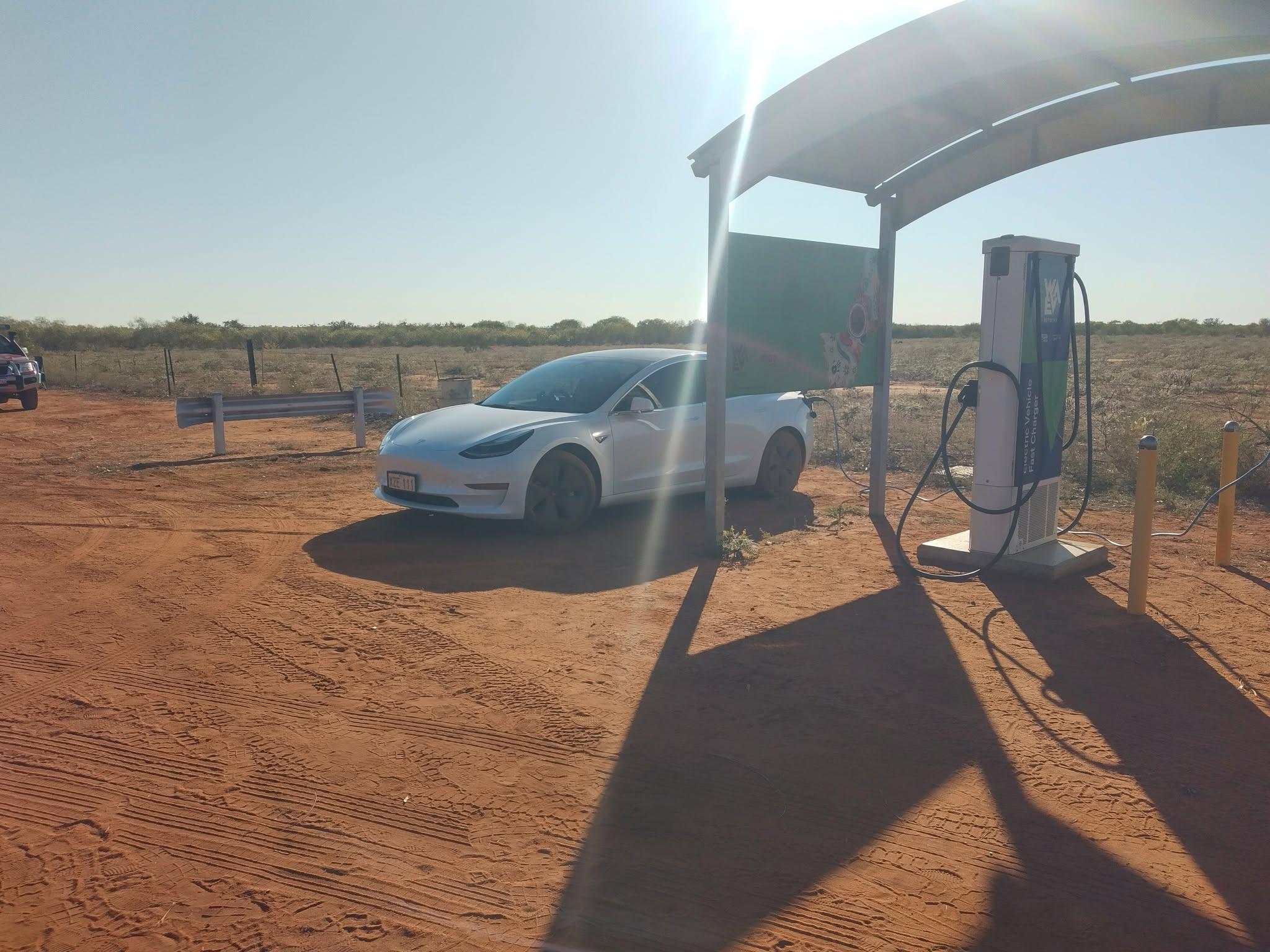

Andrew encountered the most difficulties driving north from Perth, using what he ended up nicknaming the Western Australian EV Notwork, because so many chargers did not work. Reading his blog, you get a sense of his rising frustration throughout this part of the trip. Not only did he have to contend with goats, cattle, and kangaroos; he was let down by vandalised or badly maintained equipment. Apparently, in the west, they call the roads the “long paddock.” Because they are used for grazing!
The challenges began on Day 2 at Billabong Roadhouse.
“Stopped at Billabong Roadhouse, and as per most recent experiences, it was down (well, only outputting 3kW, which is free but too slow), so headed on to Overlander Roadhouse, which is slower than Billabong when Billabong is working, but is less likely to be failed.
“Arrived at Overlander at 2:30pm with 19% charge and charged by 1.5 hours at 24kW, had lunch and checked out the solar array, which is very large (250kW backed up by 191kWh of battery and diesel also).
“Left Eighty Mile Beach Caravan Park to get to Sandfire Roadhouse for a long charge session on AC Type 2 (11kW). Arrived at 8am, confirmed that the DC charger was degraded and only outputting 8kW. The reason this is happening is the Tritium chargers have a cooling pump which are all failing at once and Horizon Power are not replacing them as routine maintenance, so they run in degraded mode.
“Left Sandfire 4 hours later with 95%, as I knew from PlugShare that Bidyadanga Turnoff was also failing, and sure enough it was! Drove the 320km from Sandfire to Broome, left Sandfire with 95%, and arrived at Broome with 15%, travelling at 90km/h.”
On day 7, he encountered the Town Beach charger in Broome (not solar powered). It was severely degraded, putting out just 2.9kW instead of 150kW. On day 8, he raised the issues of vandalism at Derby and Fitzroy Crossing with the shire president of Derby/West Kimberley. These issues ranged from a broken screen to being completely trashed.

“On day 9, I drove the 95 km to Ngumban. The DC charger is only outputting 8kW, like so many other WA EV Notwork chargers. It took over 6½ hours to get to 100% from 19%. Very frustrating indeed. I need all the charge I can get to reach Warmun late tomorrow morning. Hope like hell that charger works properly. Will be good to get out of WA!!!”
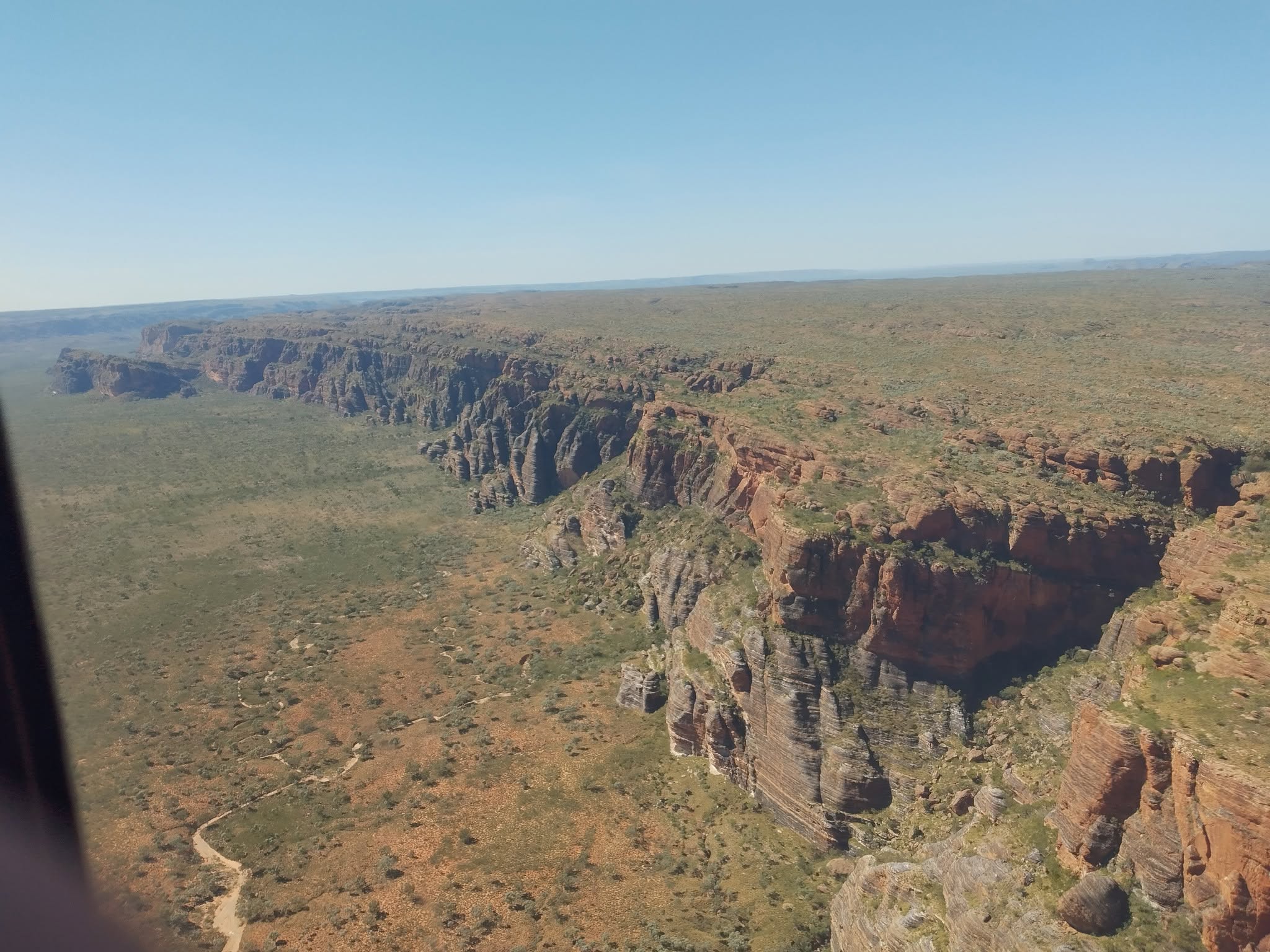
Continuing north still in WA early on the 10th day, he could only drive around 80 km/h to avoid livestock. “Arrived at Warmun around 11am. Lots of trouble getting the charger going. Needed to call Chargefox twice to manually authenticate me. Once it started, was charging at up to 114kW. Charged in just 50 minutes, in total contrast to yesterday. Warmun technically has solar, as the community has 420kW of solar on rooftops around community (government funded programme).” As a reward for his hard work, he treated himself to a chopper ride to the Bungle Bungles.
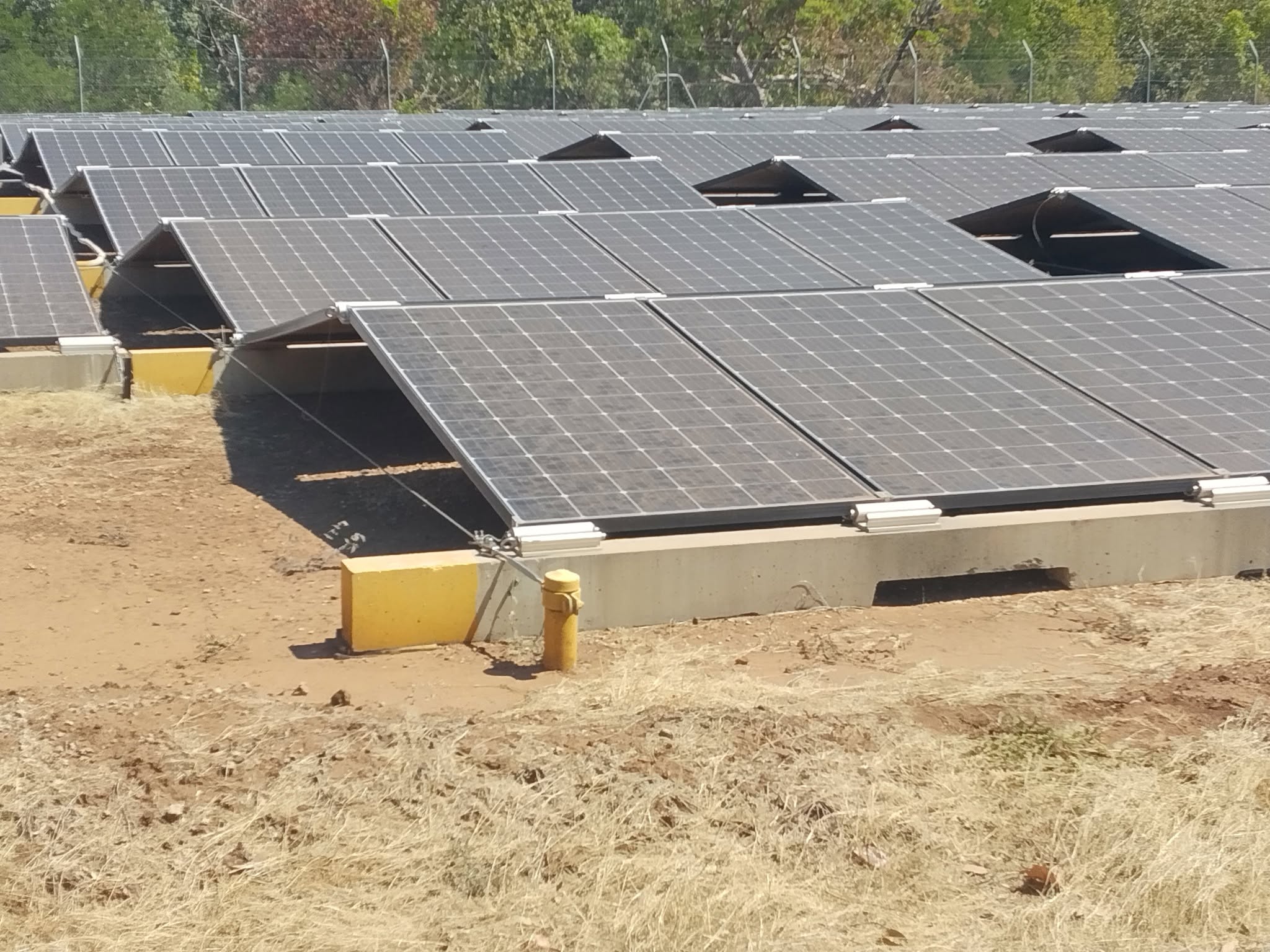
Day 11 through 15 went smoothly as Andrew left WA and headed to the Northern Territory. Check out the photo of the cyclonic rated solar panel mounting, installed at Timber Creek. “So far the NT chargers are far superior to the parlous state of the WA EV “Notwork” (the WA EV Network that does NOT work). Katherine town has a 34MW solar farm on the outskirts of town with 100,000 solar panels and also a 3.4MWh battery.”
Heading east towards Queensland, he was buffeted by crosswinds and headwinds that reduced his range by 10%. “So arrived in Camooweal (just over the QLD/NT border) with only 29% and would need a substantial charge to make to the next town, Mount Isa, which is about 200 km away, so decided to stay here and drive through Mount Isa to Cloncurry tomorrow, so a very early stop (1pm Qld time).”
On day 17, he found a Tritium charger that worked well in Cloncurry. Then he decided to drive on to Karumba — 452 km away. “It took nearly 6 hours to drive the distance and the car got down to just 7% range. It is by far the furthest I have driven on one charge. I had to drive at low speeds the last 2 hours because of all the wildlife, and just as I was coming into Karumba (just 1 km out), a roo (kangaroo) decided to run right into the side of the car just in front of the rear wheel, leaving a shallow dent.”
“Day 19. Today started early, first light to get from Georgetown to Mount Surprise to charge. This involved hypermiling to make sure I got there. That means low speeds and using momentum from downhill sections to get uphill as much as possible. Arrived with 4%.”
On day 20, Andrew got to use a Tesla Supercharger at Mount Sheridan Plaza in Cairns (Far North Queensland). “This is the first Supercharger site I have used, and the first I have seen with a solar canopy, albeit only 25–30kW, which would have been less than quarter the power I was drawing, even at peak output.” From then on, down the Queensland, New South Wales/ACT, Victoria, and South Australian coast, it was easy charging and driving, as he met up with friends and relatives as well as visiting sites from his childhood. Then came the dreaded Western Australian border, and the Nullarbor.

Day 41 — back to depending on the WA EV Notwork. “Arrived at Balladonia to charge. Unfortunately, the charger was completely dead. This site has a history of failing, because the diesel generator doesn’t start up when there is insufficient charge from solar. Fortunately, I had 50% charge left and had 191 km to get to Norseman. Got to Norseman with 6% remaining. Charged up in Norseman at 104kW peak, then headed for Esperance. Norseman town has a 758kW solar farm with 336kWh battery.”
Andrew was back into “charger anxiety” territory, so confirmed with charging service provider Chargefox that the next two chargers he needed were indeed functioning. “Drove 170 km west and arrived at Ravensthorpe about 9:30am and charged for 50 minutes at up to 114kW.” Last charge was at the Australian Electric Vehicle Association’s own charger at Corrigin Roadhouse.
The intent of Solarlap was to drive an electric vehicle around Australia using solar power wherever it was available (even a small array) and charge during daylight hours, rather than charging on diesel generators or the grid, which is generally fuelled by fossil fuels, except in rare cases like Kununurra (hydro).
The following are lessons learnt:
1. Planning. You need to identify where you are going to charge, along the entire route before you start. In my case I identified every public charging location which had some solar power on site, or in some cases the whole town has solar power (Katherine and Norseman for example). I deliberately did not charge at sites where there was no solar power associated with it. Use satellite imagery in either Plugshare or Google Earth to view the site. Check the charger is working before you drive there. Use Plugshare as your main reference tool, call Chargefox if necessary, and check in on Plugshare to inform future users of any issues.
2. Patience. Charging an EV requires patience and plenty of it. Especially at sites where the charge rate is less than 20kW. Be patient and look around without the car. On a 11kW site it can take 7 hours to charge a small EV, and lot longer for a large one. Caravan park charging can be as long as 24 hours. Also driving at high speed will eat into your range, so travel at around 100km/h unless you know for sure you don’t need the full range.
3. Choice of vehicle. I would not recommend using any vehicle with less than 400kms of highway range. Preferably it should have 500kms or more. Solar powered charger sites are too far apart in WA, QLD, NT and SA. And you need to allow for the likelihood of a charger failing that you have to back track to the last charger or reach the next charger after. In my case, Balladonia had failed so I had to continue to Norseman. Also note that the more power the car uses, the longer you will spend charging it, so more aerodynamic, smaller and lighter cars are best, which is why I used a Tesla Model 3 Long Range.
4. Cables. You need to carry the following EVSE and cables: 240V 15A (for caravan parks) 240V 10A, 32A 3 phase 5 pin captive socket for certain sites in NT and North Queensland, Type 2 to Type 2 cable for 11kW Schneider and Tesla destination chargers without cables.
5. Have RFID cards for all the chargers you plan to use if possible, but ChargeFox or AEVA RFID cards are essential, and carry a Telstra mobile to call the service provider if there are issues. The Tesla app is required for Tesla superchargers.
Andrew summarised the charger issues in Western Australia:
There were a number of charger related issues in WA as follows (also refer to waevn.tocwa.cloud which is Tesla Owner’s Club of Western Australia’s live dashboard for the WAEVN).
1. Tritium RTM50 cooling pump failures: when the cooling pump fails, the charger limits output to 8-10kW — happened many times and still not fixed.
2. SPS failures: The off-grid sites are powered by a standalone power system (solar/diesel/battery). When the battery is depleted, the diesel is supposed to start, but at Balladonia, it never starts, and hence occasionally the batteries go flat and it needs a manual reset.
3. Kempower Power unit failures: The 150kW Kempower chargers have 3 power units. When one fails, output is limited to 100kW; when two fail, 50kW; when three fail, site dead. At Karratha, two had failed.
4. Authentication issues: Communications or Chargefox-related issues required manual authentication by Chargefox — Warmun and Ngumban particularly.
5. Core issues: Core is an add-on software to slow the ramp-up of charging to protect the grid. At Town Beach in Broome (where I did not charge), there was something wrong with Core and it was limiting to 3kW on a 150kW charger
6. Vandalism, and then the charger not being repaired.
Conclusion: despite the Australian grid becoming more and more green, Andrew contends that it matters where and when you charge. His Solarlap has proven that you can use mainly solar to charge even when in the outback and in the city — despite the difficulties he faced in Western Australia. As more and more voices promote chargers running on solar, the future will become brighter and more electric.
Sign up for CleanTechnica’s Weekly Substack for Zach and Scott’s in-depth analyses and high level summaries, sign up for our daily newsletter, and follow us on Google News!
Have a tip for CleanTechnica? Want to advertise? Want to suggest a guest for our CleanTech Talk podcast? Contact us here.
Sign up for our daily newsletter for 10–15 new cleantech stories a day. Or sign up for our weekly one on top stories of the week if daily is too frequent.


CleanTechnica uses affiliate links. See our policy here.
CleanTechnica’s Comment Policy