

Support CleanTechnica’s work through a Substack subscription, on Patreon, or on Stripe. Help us produce all of the high-quality, original content we publish week after week despite the challenges of content-scraping AI, antisocial media, inflation, and other hurdles.
A new T&E analysis looking at major truck markets in the EU.
E-trucks already cheaper to operate today
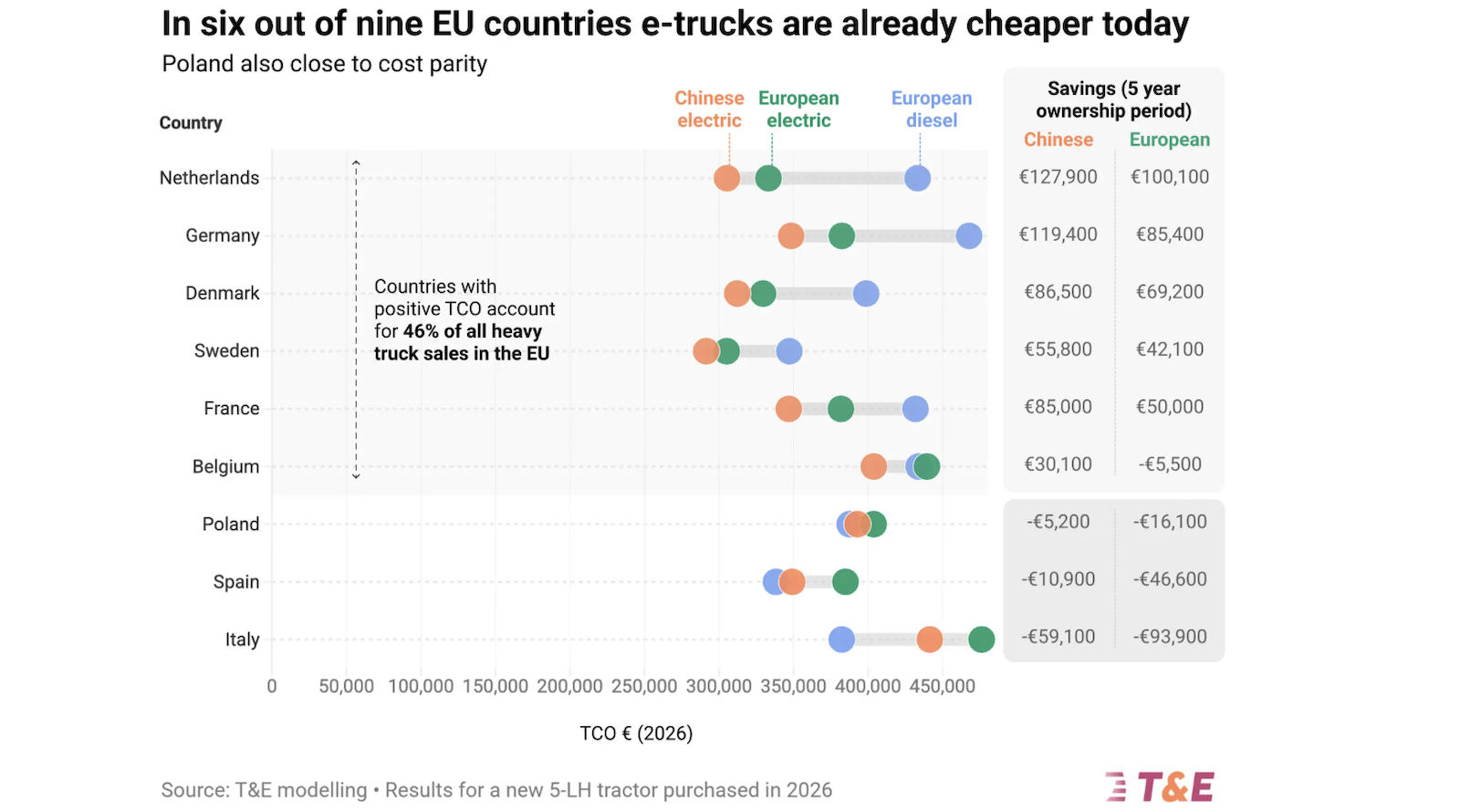
A new total cost of ownership (TCO) analysis reveals that in six out of nine major EU markets, electric trucks are already the best financial choice today. These six markets alone account for 46% of all new heavy trucks sold in the EU.
In the Netherlands, Germany, and Denmark, savings can reach €100,000, €85,000 and €69,000 respectively over five years, with electric trucks already paying off after 2 years. When operating a Chinese truck—which has a considerably lower price tag—savings over five years can go up to €128,000 in the Netherlands.

Increased scale and lower truck prices—driven by the EU’s truck CO2 targets—as well as national incentives such as vehicle subsidies and lower road tolls, explain this trend.
T&E’s findings confirm that Europe is a prime market with the right enabling conditions for truckmakers to further accelerate production and sales of e-trucks.
With a new energy crisis looming over Europe, the cost gap between operating a diesel and electric truck is widening further, making e-trucks the cheapest and safest investment for transport companies.
Total cost of ownership in 2030
T&E modelling shows that with the continuation of existing policy measures and the introduction of a limited set of new ones, such as the implementation of the Eurovignette Directive and the RED III, by 2030 electric trucks will be cheaper to operate in all nine EU Member States—even when phasing out or reducing today’s vehicle purchase subsidies.

Key recommendations
- Maintain the ambition level of the EU truck CO2 standards: The -43% 2030 CO2 target is crucial to ensure manufacturers offer more electric trucks and achieve the economies of scale necessary to further bring down vehicle prices—which is the most important variable defining a positive TCO.
- Implement CO2-based tolling: Italy, France, Spain and Poland need to implement the Eurovignette Directive exempting zero-emission trucks from road infrastructure charges (100% until 2031 and 50–75% afterwards). Member States should also introduce a CO2 charge.
- Enable REDIII e-credits for depot charging: Sweden, France, Poland, Italy and Spain need to implement REDIII for both public and private (depot) charging. This will lower electricity costs at depots–which is where most trucks charge.
Article from T&E.
Sign up for CleanTechnica’s Weekly Substack for Zach and Scott’s in-depth analyses and high level summaries, sign up for our daily newsletter, and follow us on Google News!
Have a tip for CleanTechnica? Want to advertise? Want to suggest a guest for our CleanTech Talk podcast? Contact us here.
Sign up for our daily newsletter for 10–15 new cleantech stories a day. Or sign up for our weekly one on top stories of the week if daily is too frequent.


CleanTechnica uses affiliate links. See our policy here.
CleanTechnica’s Comment Policy