
Electrification of Commercial Vehicles Continues at Faster Pace at IAA Transportation 2026

Support CleanTechnica’s work through a Substack subscription, on Patreon, or on Stripe. Help us produce all of the high-quality, original content we publish week after week despite the challenges of content-scraping AI, antisocial media, inflation, and other hurdles.
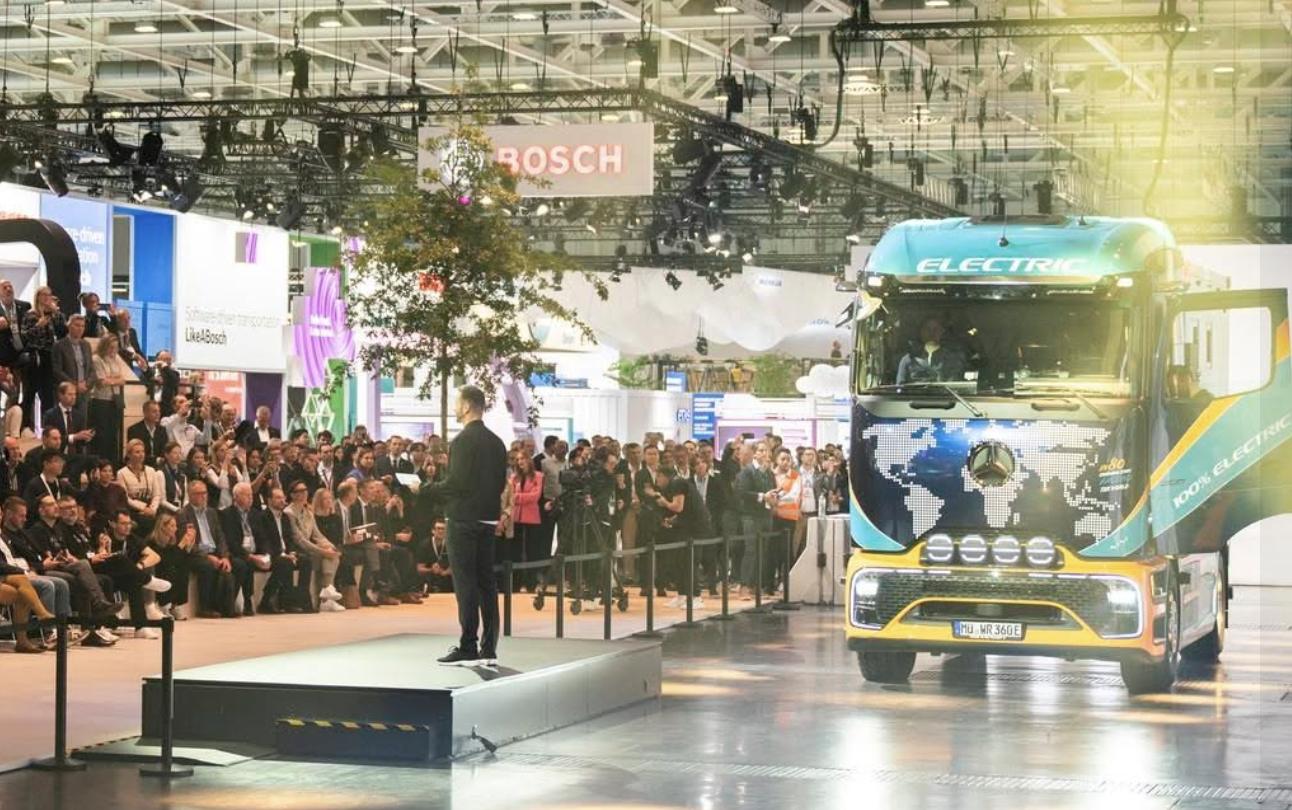
IAA Transportation 2026 opens with electric trucks,
hydrogen and a crowded show floor
HANOVER, Germany — IAA Transportation 2026 opened Tuesday to a packed Hannover, with 1,589 exhibitors from 46 countries filling the exhibition grounds. Organizers say that makes this year’s show the most international IAA Transportation yet, with five more participating countries than in 2024.
The opening ceremony set the tone for what is on display inside the halls. German Federal Transport Minister Steffen Bilger, Lower Saxony Minister-President Olaf Lies, Hannover Mayor Belit Onay and VDA President Hildegard Müller formally opened the six-day event.
Müller’s message was direct: the industry has done its part and the technology for climate-neutral freight transport is ready.
Electrification is in production
Walking the halls after the opening, there is plenty of evidence for the first half of that argument. Electric trucks are no longer confined to experimental corners of the show. They are being displayed as production vehicles, with manufacturers putting serious range and payload figures behind them.
Volvo Trucks is showing its new electric FH, FH Aero, FM and FMX heavy trucks. The four models have already received the International Truck of the Year 2027 award, with the jury citing their range, efficiency and wider operating capability.
MAN is displaying an electric truck range that runs from the 12-ton eTGL to the 50-ton eTGX. The eTGX can cover up to 660 kilometers in a 4×2 configuration, while a 6×2 version with an additional battery is rated for up to 720 kilometers.
Renault Trucks is showing the E-Tech T 780, another indication that battery-electric propulsion is moving into the long-haul segment. Its claimed range is up to 660 kilometers, while the truck’s electric axle and high-energy-density batteries are intended to preserve payload capacity.
Daimler Truck’s Mercedes-Benz eActros 600 is also here, and it is no longer a vehicle whose credentials depend entirely on laboratory figures. Daimler says customers have accumulated more than 160 million kilometers with the truck since it entered the market at the end of 2024.
The eActros 600 has a claimed range of up to 560 kilometers in its most efficient configuration at a gross combination weight of 40 tons. Daimler is also displaying the new eActros Lowliner for applications where vehicle dimensions and loading capacity are particularly important.
Stellantis Pro One’s broader strategy is seen at IAA. The commercial-vehicle division is displaying 13 vehicles from Citroën, Fiat Professional, Opel and Peugeot, while also presenting its NEXT fleet operating system and connected services. But of its vehicles, it is the BOW sits at the extreme end of that strategy, where the vehicle becomes part of an automated logistics system rather than simply a means of transporting a driver and cargo.
Then there is hydrogen
The hydrogen story at IAA is considerably more complicated than simply putting a fuel-cell truck beside an electric one. Daimler Truck is pursuing fuel cells, Volvo is developing both fuel-cell and hydrogen-combustion trucks, and Toyota is bringing its long experience with fuel-cell systems into the commercial-vehicle market.
Daimler says its fuel-cell trucks have already covered almost 600,000 kilometers in customer operations. The company plans to put 100 next-generation fuel-cell trucks into customer use from the end of 2026.
The NextGenH2 Truck uses liquid hydrogen and is intended for long-distance work. Daimler says it will offer well over 1,000 kilometers of range while retaining the rapid refueling that long-haul operators require.
That makes hydrogen particularly interesting in a show where battery-electric trucks are also pushing into longer routes. The two technologies are being developed for different operating realities rather than one simply replacing the other.
Fuel cells use hydrogen to generate electricity for an electric drivetrain. Hydrogen combustion takes a different route, burning hydrogen directly in an engine. Volvo and Daimler are both developing hydrogen-combustion technology, giving fleets another possible route to zero-carbon operation at the vehicle level.
Toyota is supplying fuel-cell technology and bringing more than 30 years of experience in the field. Bosch, meanwhile, is showing hydrogen components and refueling technology for both gaseous and liquid hydrogen. Bosch says its fuel-cell systems have accumulated more than 30 million kilometers on the road.
The companies are also trying to address the part of hydrogen trucking that has been hardest to solve: where the fuel comes from and where trucks will get it.
Air Liquide, TotalEnergies, TEAL Mobility and MB Energy are working with the truck manufacturers on the supply and refueling side. The proposed high-capacity stations are designed to handle as many as 100 trucks a day.
Germany is being used as the first large-scale test of the model. Applications under the latest German funding program included more than 70 high-capacity hydrogen stations and about 800 heavy-duty trucks, according to the companies involved.
The electric infra
Battery-electric vehicles have their own infrastructure challenge, of course, and that is just as visible at IAA. Manufacturers and suppliers are displaying high-power charging systems, depot charging, energy management and technologies designed to make better use of limited grid capacity.
MAN, for example, has built its electric truck strategy around more than the truck itself. Its charging services include depot infrastructure, energy management, smart charging and access to a growing public charging network.
There is also a middle ground between a full battery-electric truck and a vehicle that relies entirely on another energy source.
ZF’s TraXon Hybrid won the Truck Innovation Award 2027. The system integrates an electric motor into the transmission rather than treating electrification as an entirely separate drivetrain.
MAHLE is showing another approach with a range-extender system developed specifically for battery-electric trucks. The idea is to provide additional electrical energy when a vehicle needs more range without simply making the battery larger.
The same mix of technologies is appearing in commercial vans. Kia is showing its PV7 electric van, while Renault and Stellantis are bringing new battery-electric commercial vehicles to the European market. Ford Pro is displaying electrified versions across its commercial-vehicle range, including plug-in hybrid and battery-electric models.
What stands out walking through IAA this year is not that the industry has settled on one answer. It has not. There are battery-electric trucks with increasingly long ranges, fuel-cell trucks being prepared for customer fleets, hydrogen-combustion vehicles, hybrid systems and range extenders. The manufacturers are clearly betting that different transport jobs will require different solutions.
Olaf Lies used the opening to describe Lower Saxony as one of Europe’s leading locations for the trucking industry. Mayor Belit Onay welcomed the return of the industry to Hannover. For the next six days, the exhibition halls will provide the more tangible version of the opening ceremonies. The trucks are here. The technology is here. What remains to be demonstrated is how quickly the infrastructure, energy supply and economics can catch up with them.
Sign up for CleanTechnica’s Weekly Substack for Zach and Scott’s in-depth analyses and high level summaries, sign up for our daily newsletter, and follow us on Google News!
Have a tip for CleanTechnica? Want to advertise? Want to suggest a guest for our CleanTech Talk podcast? Contact us here.
Sign up for our daily newsletter for 10–15 new cleantech stories a day. Or sign up for our weekly one on top stories of the week if daily is too frequent.


CleanTechnica uses affiliate links. See our policy here.
CleanTechnica’s Comment Policy