

Support CleanTechnica’s work through a Substack subscription, on Patreon, or on Stripe. Help us produce all of the high-quality, original content we publish week after week despite the challenges of content-scraping AI, antisocial media, inflation, and other hurdles.
China spent much of the 2010s electrifying urban bus fleets while most countries were still testing whether battery-electric buses could replace diesel. By the end of 2025, it had 551,400 new-energy urban buses, representing 87.5% of the fleet. That early success has brought China to a stage other countries will encounter later, when large numbers of batteries reach the end of their automotive service and owners must decide what to do with them.
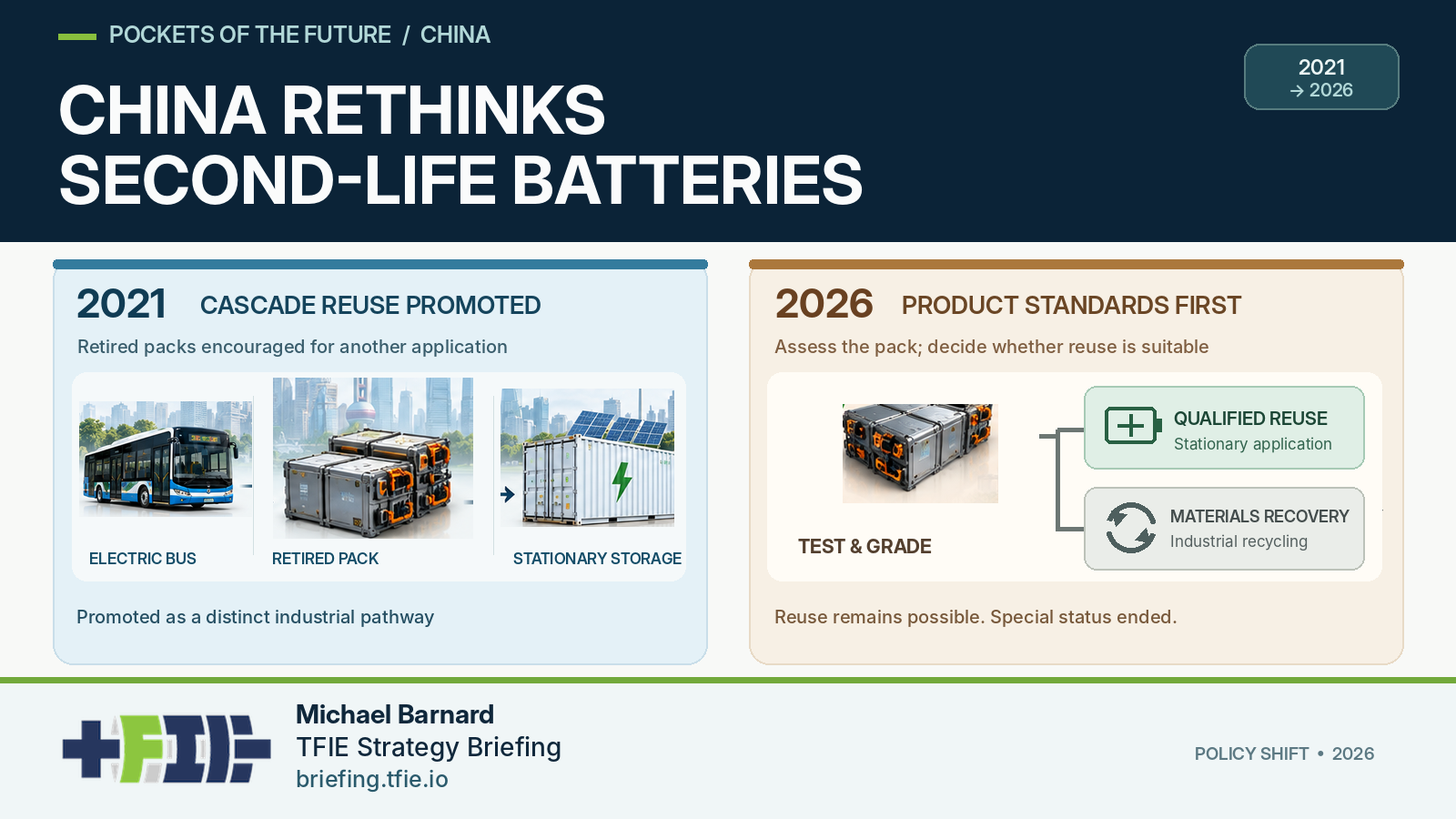
In 2021, Chinese policy encouraged companies to give retired EV batteries a second life in stationary energy storage, backup power and charging infrastructure. The idea was attractive. A battery that had lost enough capacity to become less useful in a vehicle could still store substantial electricity, potentially avoiding the manufacture of another battery.
China has now changed its regulatory approach. New rules effective in April 2026 repealed the earlier cascade-utilization framework. A July 30 announcement from the Ministry of Industry and Information Technology withdrew special recognition for cascade-utilization companies and directed industry associations to discontinue promotional activities associated with the category.
Some reporting has described this as China banning second-life batteries. That misrepresents the change. Retired vehicle batteries can still be used in suitable applications when the resulting products meet the applicable standards. Reuse in electric bicycles and other restricted applications is prohibited. The ministry’s stated concern is the safety of inadequately tested, reassembled batteries with varying remaining capacity and inconsistent cell condition.
China’s experience deserves attention because battery retirement is becoming an industrial activity rather than a small collection of pilot projects. Electric buses have been operating for years, battery manufacturers have expanded production, and companies have invested heavily in recovering materials from retired packs. The assumptions that looked sensible when batteries were expensive and early electric fleets were young are now being tested against practical experience.
There is also an economic question beyond the regulatory change. New lithium iron phosphate batteries have become much cheaper, while old packs differ in age, condition, design and operating history. Testing, repackaging, controls and warranties can consume the savings from reusing cells. A second-life installation has to compete with new products designed for the same application.
That does not eliminate useful reuse opportunities. Operators with known battery histories and suitable stationary applications may have advantages that companies buying mixed retired packs do not. Product quality and economics will determine how much of the anticipated second-life market develops.
In my longer TFIE Strategy Briefing assessment, I examine how those conditions are changing, what China’s recycling industry reveals and why European policymakers and investors should reconsider assumptions about the supply of retired batteries. Subscribe for the deeper evidence and analysis.
Sign up for CleanTechnica’s Weekly Substack for Zach and Scott’s in-depth analyses and high level summaries, sign up for our daily newsletter, and follow us on Google News!
Have a tip for CleanTechnica? Want to advertise? Want to suggest a guest for our CleanTech Talk podcast? Contact us here.
Sign up for our daily newsletter for 10–15 new cleantech stories a day. Or sign up for our weekly one on top stories of the week if daily is too frequent.

CleanTechnica uses affiliate links. See our policy here.
CleanTechnica’s Comment Policy