

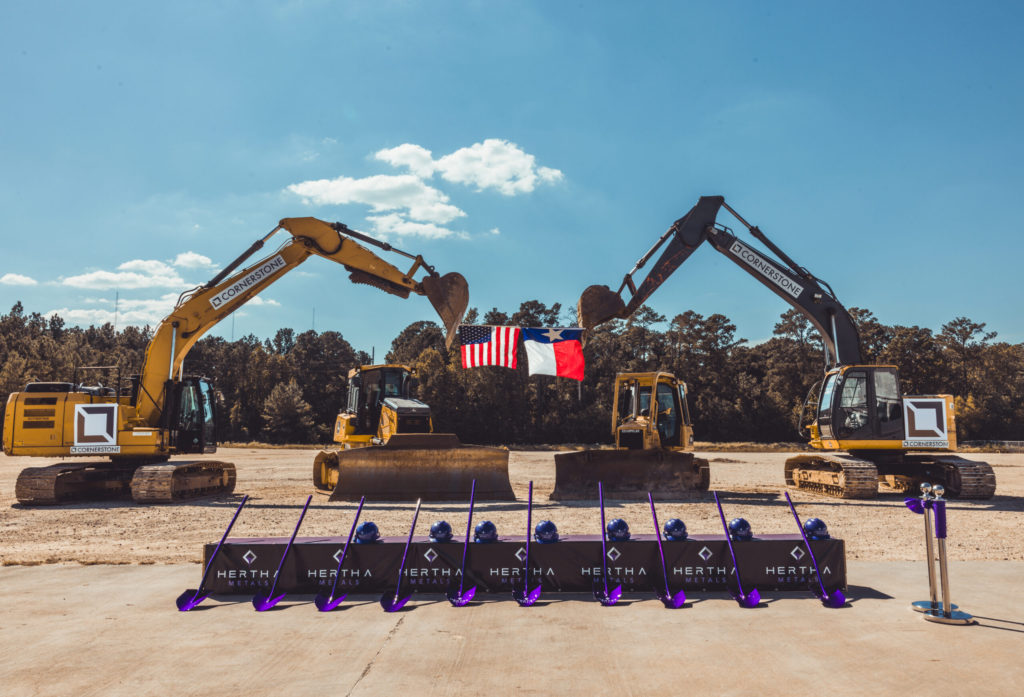
Hertha Metals has launched construction of a planned $100 million industrial facility in the United States to produce magnet-grade iron, a material used in manufacturing permanent magnets and supporting technologies across electric vehicles, wind turbines and other advanced industrial applications.
The project highlights growing efforts to strengthen domestic supply chains for critical materials as governments and manufacturers seek to reduce dependence on overseas suppliers and expand production capacity for energy-transition technologies.
$100 Million Investment Targets US Supply Chain Dependence
The plant, named Hertha Chalyx, is being built in Conroe, Texas, near Houston. It is designed to produce approximately 10,000 metric tonnes annually of steel-grade and magnet-grade high-purity iron combined. The company expects the facility to begin operations in late 2027, with magnet-grade iron production targeted for early 2028.
High-purity iron is an important component of neodymium-iron-boron (NdFeB) permanent magnets, which are used in electric vehicle motors, wind turbines, robotics, data centres and defence equipment. The United States currently relies heavily on imported high-purity iron for these magnets, with China accounting for an estimated 94% of production, according to industry reports.
Hertha Metals aims to establish a domestic source of this material, helping US manufacturers reduce exposure to overseas supply disruptions and geopolitical risks.
Single-Step Technology Aims to Lower Production Costs
Hertha Metals has developed a proprietary process designed to produce iron and steel in a single step using iron ore and natural gas. The company says its technology can work with different grades of iron ore, including lower-grade material that can be difficult to process through conventional methods.
According to the company, the process can reduce production costs by approximately 25% compared with traditional blast-furnace steelmaking and cut emissions by around 50% when using natural gas. The company says emissions reductions could reach as much as 98% when hydrogen is used, although actual performance will depend on operating conditions and the energy inputs used.
The new facility will use domestic iron ore, primarily sourced from Minnesota’s Iron Range, alongside natural gas from Texas. CV Engineering has been selected to lead engineering, procurement and construction management for the project.
Government and Investor Support
The project is part of a broader US effort to expand domestic manufacturing capacity for materials considered strategically important to industry and national security.
Hertha Metals recently announced a $133.65 million Series A funding round that includes a $65 million equity investment from the US government. The funding is intended to support the company’s commercial expansion and development of its high-purity iron production technology.
The company hopes that successfully operating the Chalyx facility will establish a foundation for a much larger iron and steel plant with a planned capacity of approximately 500,000 metric tonnes per year. That expansion remains a future development goal rather than existing production capacity.
Outlook for the Iron and Magnet Industry
The project comes as manufacturers and governments seek to diversify supply chains for critical industrial materials. Demand for permanent magnets is supported by electric mobility, renewable energy, automation and defence applications.
If Hertha Metals achieves its production targets and meets customer specifications at commercial scale, the plant could provide US magnet manufacturers with an additional domestic source of high-purity iron. However, the project’s longer-term impact will depend on construction progress, operating costs, product qualification and the ability to compete with established international suppliers.
For the US steel and critical-materials industries, Hertha Chalyx represents an effort to combine new processing technology with domestic resources to strengthen industrial resilience.