

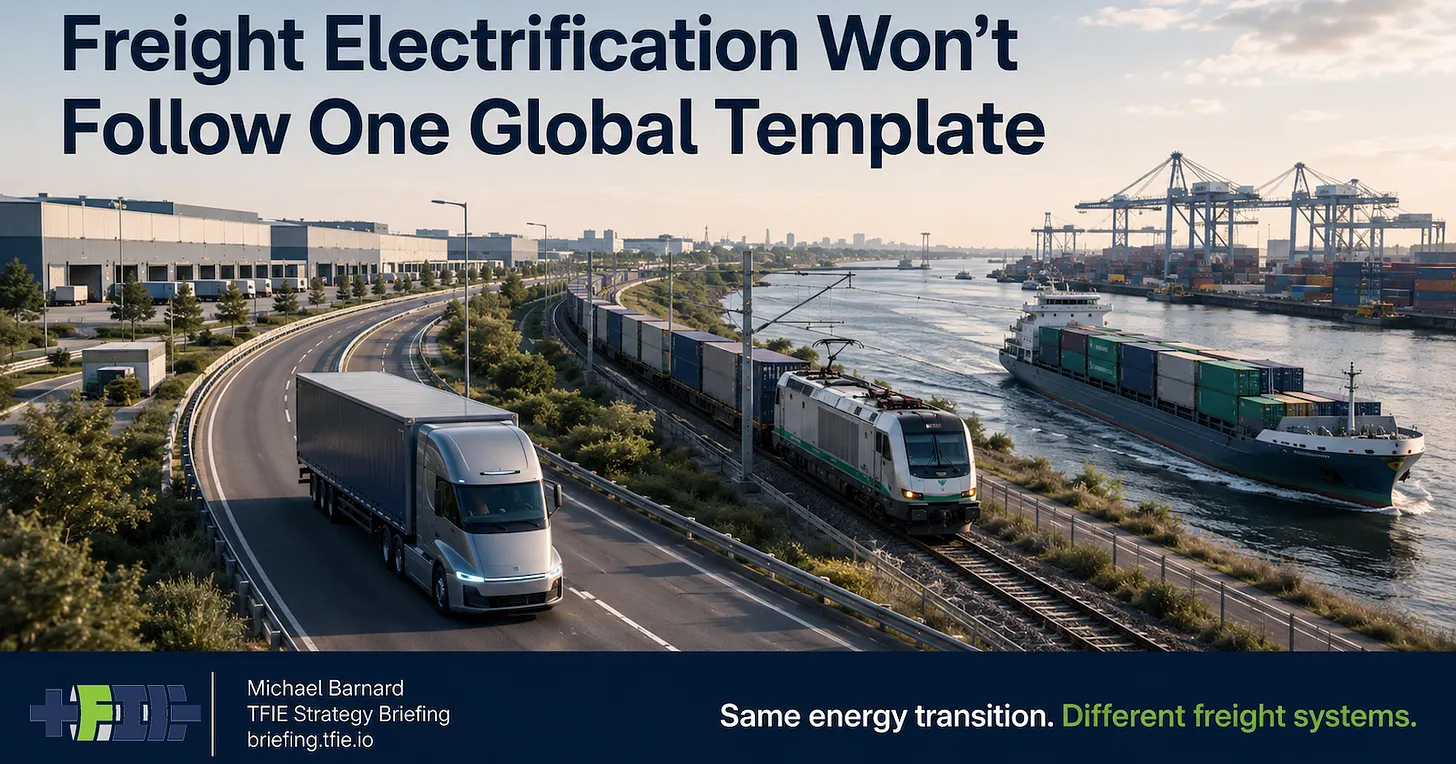
Battery costs are falling globally, but freight does not begin from a common starting point. China, India, Europe and the United States move domestic cargo through very different combinations of road, rail and water, so cheaper batteries will not produce one standard freight-electrification pathway.
Using the best comparable data I could assemble, China’s 2025 domestic freight work across road, rail and water was roughly 44% road, 20% rail and 36% domestic water. The EU-27 comes out at about 54% road, 12% rail and 34% internal water freight, although those European statistics are recombined from separate mode datasets rather than published as one harmonized split. India’s NITI Aayog modelling baseline is much more road-heavy at about 69% road, 23% rail and 8% water. A reconstructed U.S. comparison is roughly 53% road, 36% rail and 10% water, with lower confidence than the other rows.
The modal split is only the starting point. The full TFIE Strategy Briefing follows how those inherited systems change the economics of electrifying trucks, rail and water, where the same falling battery-cost curve produces different capital decisions, and what that means through the 2030s.
Those differences determine where electricity has to enter the freight system. China can electrify an enormous truck fleet while continuing to move huge volumes by rail and water. India can electrify trucks while expanding freight on a railway whose broad-gauge network is now almost completely electrified. Europe already has extensive electrified rail, but road has still gained inland freight share. The United States retains a commercially important freight railway that is overwhelmingly diesel-powered.
China is moving fastest on electric heavy trucks. About 140,000 new-energy heavy trucks were sold there in the first half of 2026, up 78.6% year over year. “New energy” is broader than battery electric, so that number should not be casually relabelled as BEV sales, but the scale is already industrial. China is targeting new-energy heavy trucks at around 40% of annual heavy-truck sales by 2030 while building charging and swapping infrastructure along major freight corridors.
India is pushing a different lever. Around 2,800 kilometres of Dedicated Freight Corridors have been completed, and by early 2026 they were handling roughly 480 freight trains per day. Electrification by itself does not move cargo from road to rail, but dedicated capacity, heavier axle loads, higher speeds and more reliable schedules can make an already-electrified railway a more competitive freight product.
Europe is a useful warning against assuming infrastructure automatically determines modal share. It has more than 200,000 kilometres of rail and a substantial electrified share, yet road gained about 3.3 percentage points of inland freight share from 2014 to 2024. Electrically chargeable trucks above 3.5 tonnes reached 4.2% of EU registrations in 2025. Europe therefore has to do two things at once: improve the performance and utilization of existing electric rail and electrify the road freight that is not going away.
The United States is the longer-duration competitive case. Freight rail retains major advantages in train length, labour productivity and long-distance movement of dense cargo. But battery-electric trucking changes the energy and operating-cost comparison. NREL modelling finds zero-emission trucks capable of reaching total-cost-of-driving parity or better across market segments by 2035 under continued technology improvement. Rail has battery-electric options too, so a serious long-term comparison cannot hold locomotives technologically static while allowing trucks to improve.
The common direction is straightforward: fossil fuels progressively leave road, rail and domestic water freight, and electricity takes their place through wires, chargers and batteries. What differs is how much freight remains on each mode and how much infrastructure is needed to electrify the system already in place. Battery costs are global. Freight geography is not.
The full analysis in TFIE Strategy Briefing examines the deeper infrastructure economics, modular battery systems and freight-capital choices emerging across road, rail and water.