

Support CleanTechnica’s work through a Substack subscription, on Patreon, or on Stripe. Help us produce all of the high-quality, original content we publish week after week despite the challenges of content-scraping AI, antisocial media, inflation, and other hurdles.
Quarterly reports from the Postal & Telecommunications Regulatory Authority of Zimbabwe (POTRAZ) always bring out some interesting insights. I am always on the lookout for these whenever they get published, especially these days since the launch of Starlink in Zimbabwe. Starlink launched in Zimbabwe in September 2024. The uptake was always going to be exponential, as there is a large underserved market for internet services in Zimbabwe. In most countries, fibre to home connections (along with ADSL connections historically) are the major conduits for fixed broadband internet connectivity. The situation was similar in Zimbabwe for a long time. However, the monthly subscriptions for fibre services were inhibitive for the majority of consumers looking to get access to reliable home and office internet.
For example, before the entry of Starlink, a decent family monthly subscription from local home fibre service providers was at least USD $150 per month! At times, these could even go as high as over $200 per month. At that time, the total number of active fibre subscriptions was just over 100,000 in a country with a population of over 17 million. That goes to show that there was room for growth and a massive underserved market for fibre subscriptions at the right price.
Well, September 2024 came, Starlink entered the Zimbabwe market, and guess what? Consumers rushed to sign up for Starlink so fast that Starlink had to quickly pause new activations in Zimbabwe’s major urban centres since available capacity was quickly taken up! Have a look at the incredible rise in the number of Starlink subscribers in Zimbabwe in the chart below. To see this incredible rate of adoption for Starlink, look at the rise in VSAT/Starlink subscribers. In POTRAZ reports, Starlink is classified under VSAT.
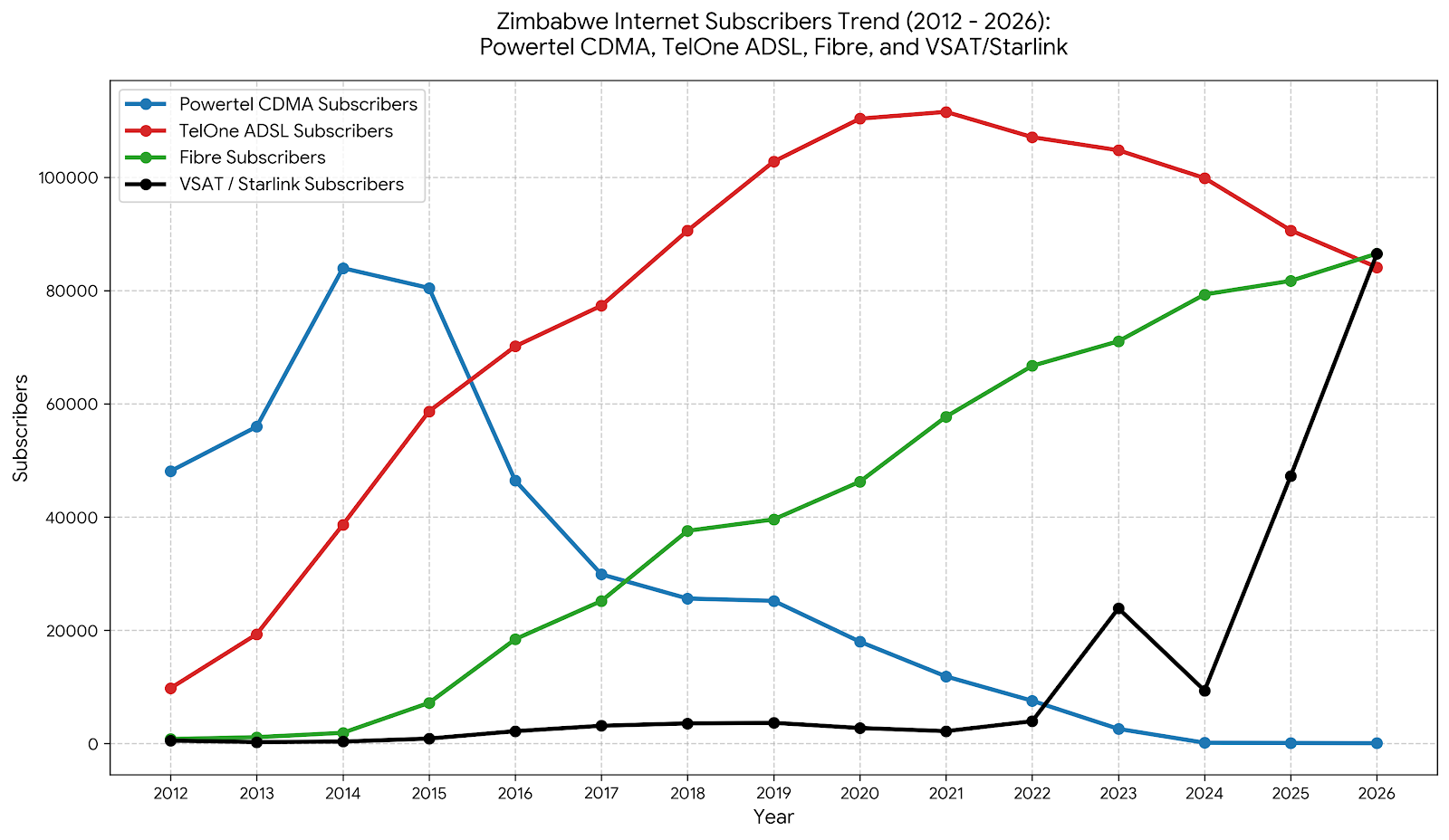
You can clearly see that VSAT was essentially dead in Zimbabwe before 2024. There was a small boost in VSAT numbers before Starlink came to Zimbabwe from 2022 and 2023 due to a government VSAT program to connect rural schools around the country. Back to fibre vs. Starlink, of course Starlink is more ideal for less densely populated areas such as small towns, farms, villages, and especially remote places where getting fibre to those places is quite a challenge. As Starlink paused new activations in sold-out areas in Zimbabwe’s major urban centres, signups continued to gain ground in smaller towns, villages, farming, and mining areas around Zimbabwe where most people had no access to a fibre connection and, more importantly, Starlink’s monthly subscriptions were now available at an affordable rate.
In a very price sensitive market, people rushed to get Starlink even in urban centres before activations were paused because Starlinks packages ranged from just over $30 per month for the Starlink Mini Plan to just over $50 per month for the Standard Residential Plan. So you can see it was a no-brainer for most people — going from not being able to afford to subscribe to a $200 monthly package to now having access to a $50 monthly plan. You can see that from 2021, the number of fibre subscribers had started to drop a bit, indicating some affordability challenges for some subscribers.
This dropoff is more visible from 2022 and even more prominently from 2024, coinciding with the arrival of Starlink. From 2025 to Q1 of 2026, the number of Starlink subscribers in Zimbabwe shot up and overtook the number of fibre subscribers from all local ISP! Remarkable, isn’t it? It shows that the local ISPs were leaving money on the table, as the uptake of Starlink suggests there was inherent demand. By the way, since the launch of Starlink, a number of ISPs in Zimbabwe have recalibrated their pricing and fibre packages, now starting from about $90 per month. From over $200 down to $90 per month! Competition is good, yeah!
Please note, in this article, I am not doing a tech comparison and all that stuff about how fibre to home is a better value proposition than Starlink, especially in urban densely populated areas. I am simply showcasing the rapid adoption of Starlink in Zimbabwe. A more technical followup article will come soon. Of course, at the moment, in urban centres, you get a better experience from your fibre connection than via Starlink most of the time. In rural areas, where you can’t get fibre the moment, Starlink’s service is of course a game changer! Another thing to highlight is Starlink’s seamless process. Anyone in Zimbabwe can sign up (in non-sold-out areas, that is), and in a couple of days the Starlink kit is delivered straight to your door. In terms of customer experience, Starlink’s logistical game has taken things to a whole new cool level in a market where the logistical landscape is usually characterized by a fair bit of friction.
One big takeaway from all of this news in Zimbabwe, as well as a lot of countries in Africa, and of course around the world is that if you come up with a well packaged service that is priced right, you can unlock a significant market. Solving real pain points unlocks inherent demand, as Starlink has shown in Zimbabwe. One interesting area is public transport. A lot of long-distance bus operators as well as intercity minibuses have installed Starlink. On most of the country’s major highways, you can comfortably use the internet in Zimbabwe on most luxury coaches as well as on low-budget intercity buses. A 6-hour bus ride journey from Harar to Bulawayo is now less of a pain, as you get Starlink service all the way on the highway.
Hopefully Starlink comes up with a solution for sold-out areas in Zimbabwe’s major urban centres soon to unlock more of the incredible demand in those areas. Hopefully the local ISPs will also accelerate the rollout of fiber connection in the country’s major urban centres. The demand is there, Starlink has shown it! In this age of connected devices, AI, and digitalisation of everything, we need to bridge the digital divide. More work is needed to bridge the digital divide. One cool development is that the government as well as other private players have launched a Starlink program for rural schools and clinics where thousands of Starlink kits are now being installed. Getting better connectivity for rural schools located in areas where fibre connections won’t be coming anytime soon is great news!
Sign up for CleanTechnica’s Weekly Substack for Zach and Scott’s in-depth analyses and high level summaries, sign up for our daily newsletter, and follow us on Google News!
Have a tip for CleanTechnica? Want to advertise? Want to suggest a guest for our CleanTech Talk podcast? Contact us here.
Sign up for our daily newsletter for 15 new cleantech stories a day. Or sign up for our weekly one on top stories of the week if daily is too frequent.


CleanTechnica uses affiliate links. See our policy here.
CleanTechnica’s Comment Policy