

Support CleanTechnica’s work through a Substack subscription, on Patreon, or on Stripe. Help us produce all of the high-quality, original content we publish week after week despite the challenges of content-scraping AI, antisocial media, inflation, and other hurdles.
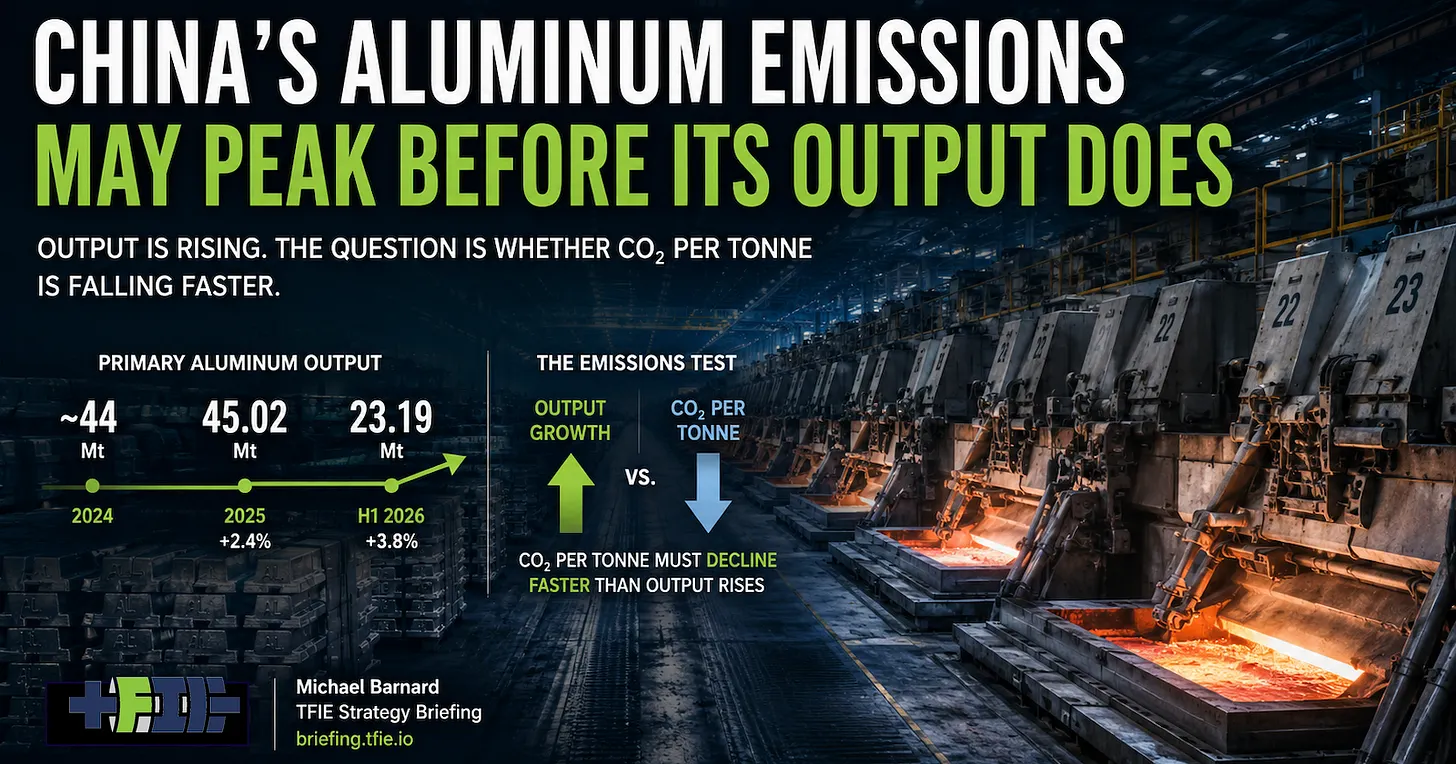
Earlier this year I argued that China’s aluminum-sector carbon emissions had probably peaked around 2024. Since then, the output data have weakened one important part of that case. China produced 45.02 million tonnes of primary aluminum in 2025, 2.4% more than the year before, and another 23.19 million tonnes in the first half of 2026, up 3.8% year over year.
I was too quick to treat China’s nominal 45-million-tonne capacity constraint as something close to a hard annual production ceiling. It clearly isn’t operating that way.
That doesn’t necessarily kill the emissions-peak thesis. Aluminum smelting is enormously electricity-intensive, so tonnes of metal and tonnes of CO₂ do not have to keep rising together. If emissions per tonne fall faster than production grows, China can make more aluminum while total sector emissions flatten and then decline.
In some ways, that would be a more useful industrial decarbonization story than the one I expected six months ago. A peak caused partly by making less primary aluminum is straightforward. A peak while production remains near record levels means the production system itself is getting cleaner fast enough to break the historical relationship between industrial output and emissions.
There are reasons to think that is possible. China’s Ministry of Industry and Information Technology says clean energy supplied about 25% of the energy used by electrolytic aluminum in 2024, while average AC electricity consumption had fallen roughly 2% from 2020 levels. The government’s 2025–2027 aluminum plan pushes the clean-energy share above 30% and calls for continued upgrading or retirement of inefficient capacity.
Aluminum is so electricity-intensive that the source of that power matters enormously. For years, the easy shorthand was that Chinese smelters were moving from coal-heavy northern provinces toward hydropower-rich Yunnan and Sichuan. That happened and it helped, but it is no longer the whole story. Northern and northwestern China are now major wind and solar development regions themselves.
The useful measure is increasingly the carbon intensity of the electricity delivered to each smelter, not whether the province containing it gets labelled “coal” or “hydro.” China is also encouraging producers to participate directly in renewables, storage and clean-power procurement while squeezing more efficiency out of the electrolysis process.
Recycling provides another large lever. China produced roughly 10.5 million tonnes of secondary aluminum in 2024 and is targeting more than 15 million tonnes by 2027. That doesn’t mean another 4.5 million tonnes of recycled aluminum simply knocks the same amount off primary production. Scrap availability depends on product lifetimes, collection systems, alloys and the quality requirements of the next use.
But China has spent decades putting huge quantities of aluminum into vehicles, buildings, machinery, appliances and infrastructure. More of that stock is now returning as scrap. Secondary aluminum can therefore supply a growing share of a still-large market while primary production remains around its current plateau.
Cleaner electricity, better efficiency and more recycling can work together. Primary production does not have to collapse before absolute emissions start declining.
China’s carbon market helps around the edges, but I would not give it too much credit yet. Aluminum, steel and cement entered the national ETS in 2025, and the aluminum rules cover direct CO₂ emissions and the potent perfluorocarbons produced during smelting. Purchased electricity and heat are excluded, however.
For aluminum, that is a big qualification. Changing the electricity system remains central to changing the sector’s total carbon footprint, so grid decarbonization and clean-power procurement matter more right now than the simple fact that smelters have entered the ETS.
I’ve therefore changed the way I would state the conclusion. I no longer think 2024 should be treated as the likely settled peak for China’s aluminum emissions. It is a plausible candidate. Continued production growth in 2025 and 2026 raises the hurdle because average emissions per tonne have to fall by more than output is rising before absolute emissions can decline.
The production data weakened the output-saturation part of my earlier case. At the same time, the evidence on cleaner electricity, recycling and efficiency has strengthened the emissions-intensity side.
The next few years should tell us which effect wins. If China’s aluminum emissions peak while output is still increasing or sitting around record levels, that is a much more consequential result than simply reaching a production ceiling. It would show that a huge industrial sector can continue supplying more material while changing electricity, efficiency and circularity enough to push absolute emissions downward.
For the full updated analysis, including the production-capacity issue, changing smelter geography, recycling constraints and the limits of China’s aluminum ETS, read China’s Aluminum Emissions May Peak Before Its Output Does at TFIE Strategy Briefing:
Sign up for CleanTechnica’s Weekly Substack for Zach and Scott’s in-depth analyses and high level summaries, sign up for our daily newsletter, and follow us on Google News!
Have a tip for CleanTechnica? Want to advertise? Want to suggest a guest for our CleanTech Talk podcast? Contact us here.
Sign up for our daily newsletter for 15 new cleantech stories a day. Or sign up for our weekly one on top stories of the week if daily is too frequent.

CleanTechnica uses affiliate links. See our policy here.
CleanTechnica’s Comment Policy