

Support CleanTechnica’s work through a Substack subscription, on Patreon, or on Stripe. Help us produce all of the high-quality, original content we publish week after week despite the challenges of content-scraping AI, antisocial media, inflation, and other hurdles.
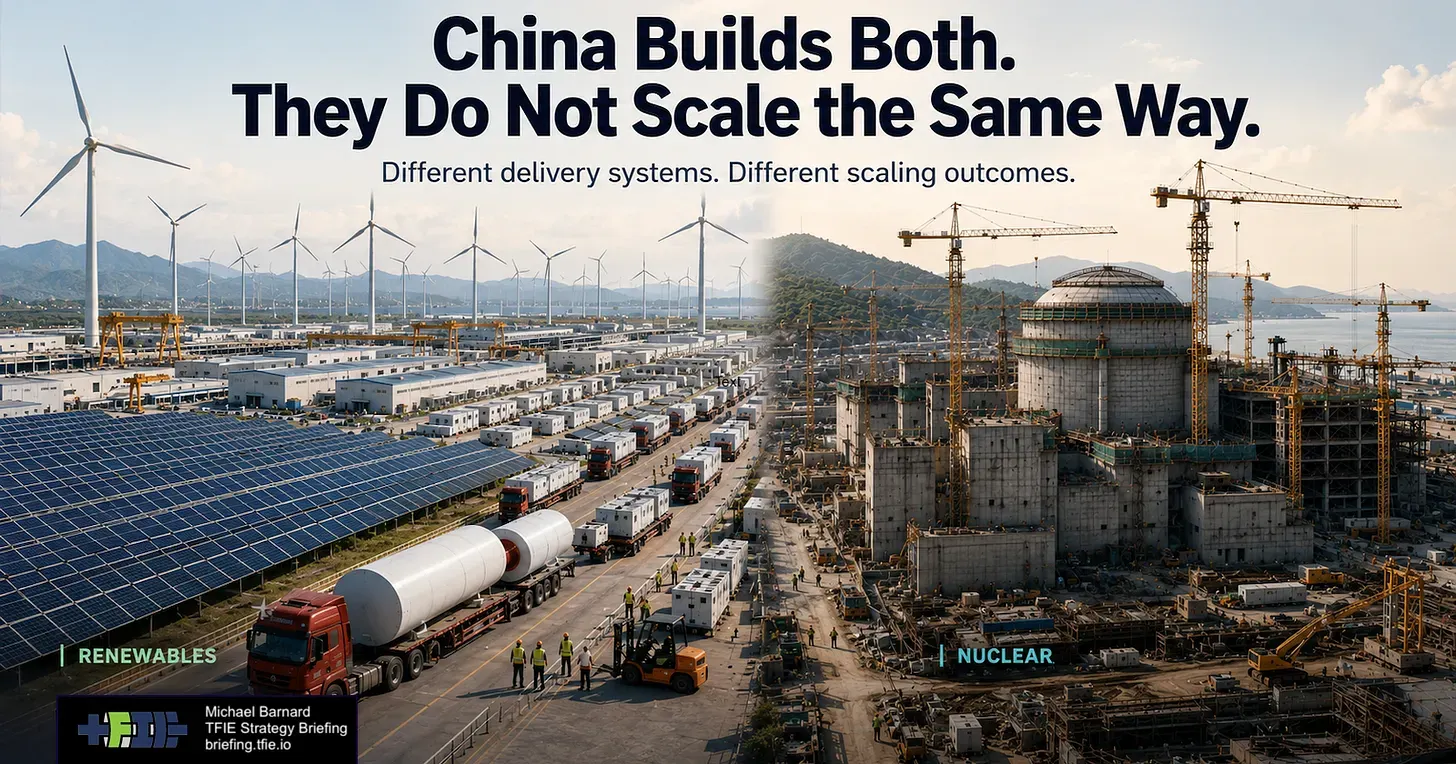
China’s renewable and nuclear targets are often quoted as equivalent statements about the future. The delivery record says otherwise. Wind and solar targets have repeatedly been overtaken, sometimes years early, while nuclear operating-capacity targets have been missed despite continued approvals, construction and political support. Forecasts should be built from what each delivery system has demonstrated that it can bring into operation.
China makes this comparison unusually difficult to dismiss. It has centralized planning, large state-owned developers, deep domestic supply chains, abundant state-directed capital and experienced engineering organizations. The familiar explanations for weak nuclear delivery elsewhere, including fragmented permitting, political hostility, financing difficulty and limited industrial capability, have much less explanatory power. China is committed to building wind, solar and nuclear capacity, yet the same state keeps getting different results. I’ve been following this natural experiment since 2014, when it was obvious to me that renewables would vastly outscale nuclear.
China set a 2020 wind target of 210 GW and finished the year with about 282 GW. Its solar target was 110 GW, while delivery reached roughly 253 GW. The later commitment to reach at least 1,200 GW of combined wind and solar by 2030 was crossed in 2024, six years early. By the end of 2025, China had about 640 GW of wind and 1,202 GW of solar, for a combined 1,842 GW. Nuclear moved in the other direction: about 50 GW against a 58 GW target in 2020, and about 62 GW against a 70 GW target in 2025. The current goal of 110 GW by 2030 may still be achieved, but the previous record gives no reason to convert it directly into a forecast.
This is not evidence that Beijing has quietly abandoned nuclear power. China has the world’s largest reactor construction programme, continues approving new units and is building an increasingly domestic supply chain around designs such as Hualong One. The divergence lies between approval and operation. Another difference is that when renewables blow past targets China set much bigger targets, but when nuclear misses targets, the targets don’t change. That difference is harder to explain than the results.
Wind and solar now arrive through industrial production systems. Factories manufacture repeated components, developers assemble large numbers of projects in parallel and installation crews move continuously from one site to the next. A delayed substation, unsuitable site or weak developer can hurt an individual project without materially interrupting the national programme. Nuclear capacity arrives through a much smaller number of long, sequential projects, each of which must progress through civil works, equipment installation, testing, fuel loading, grid connection and commercial operation. A design issue, approval pause or critical-component delay can affect a meaningful share of the programme and leave a thin commissioning cohort years later.
Annual additions make the difference visible. Using China-specific mature capacity factors, the wind capacity added in 2025 represented about 282 TWh of annual generation and solar about 414 TWh. New nuclear capacity represented about 13 TWh. Wind and solar therefore added assets capable of producing roughly 696 TWh annually, about 54 times the generation represented by that year’s new nuclear capacity.
One strong year would not establish the pattern. Across 2022 through 2025, new wind and solar capacity represented about 1,912 TWh of additional annual generation, compared with roughly 73 TWh from new nuclear capacity. The ratio was about 26 to one. The exact multiple matters less than the persistent delivery pattern: renewable additions form a growing industrial flow, while nuclear completions remain smaller, irregular and dependent on a limited project inventory.
The comparison does not claim that variable renewable electricity has the same hourly value as firm nuclear generation. It does not compare total generation from the existing fleets, and it does not solve the transmission, storage, demand-flexibility or curtailment problems created by installing variable generation at terawatt scale. It uses one denominator that forecasts often blur: the annual electricity represented by the assets each system is actually adding.
The forecasting method should follow the delivery system. Wind and solar pathways should begin with demonstrated manufacturing and installation throughput, then test whether grids, markets and flexibility resources can absorb the output. Nuclear pathways should begin with named reactors under construction, their observed progress, likely commissioning sequence and schedule risk. Future reactor starts can be added through an explicit assumption, but approvals and targets should not receive automatic credit as operating capacity.
Chinese nuclear delivery may improve substantially as domestic designs are repeated across more sites. That possibility deserves serious treatment. Standardization, stable regulation, continuous construction and experienced teams are the conditions most likely to shorten schedules and reduce variance, and China is better positioned than any other country to demonstrate them. Unfortunately, China has two major domestic reactor families and is building multiple variants of each of them, so is losing most of the benefits of repetition. Bespoke engineering continues.
A stronger nuclear forecast would require several consecutive years of high reactor deliveries from a repeated domestic design, accompanied by falling construction-duration variance. A growing approval pipeline is a positive signal, but it remains several stages removed from commercial operation. Faster and more consistent Hualong One completions at the same capacity would matter more than another record approval year.
Renewables face a different constraint. China has already demonstrated that it can manufacture and install wind and solar capacity at immense scale. The binding issue is whether transmission, storage, demand flexibility, market reform and curtailment management can keep pace. Renewable scenarios differ by terawatts because the industrial system may outrun the grid’s ability to absorb it. Nuclear scenarios differ by tens of gigawatts because the main uncertainty remains how quickly a limited cohort of large projects reaches commercial operation.
Policymakers, investors and analysts should stop treating announced energy targets as interchangeable evidence. Modular technologies should be forecast from demonstrated throughput and the constraints that might slow it. Megaproject technologies should be forecast from the committed inventory, completion cadence and correlated risks that could affect several projects together.
China will continue building both renewables and nuclear power. Its wind and solar targets deserve to be treated as policy floors until deployment and integration data weaken that conclusion. Its nuclear targets remain aspirations until the construction inventory and operating-completion record support them.
Read the full analysis and download the 2014–2035 workbook at TFIE Strategy Briefing.
Sign up for CleanTechnica’s Weekly Substack for Zach and Scott’s in-depth analyses and high level summaries, sign up for our daily newsletter, and follow us on Google News!
Have a tip for CleanTechnica? Want to advertise? Want to suggest a guest for our CleanTech Talk podcast? Contact us here.
Sign up for our daily newsletter for 15 new cleantech stories a day. Or sign up for our weekly one on top stories of the week if daily is too frequent.


CleanTechnica uses affiliate links. See our policy here.
CleanTechnica’s Comment Policy