

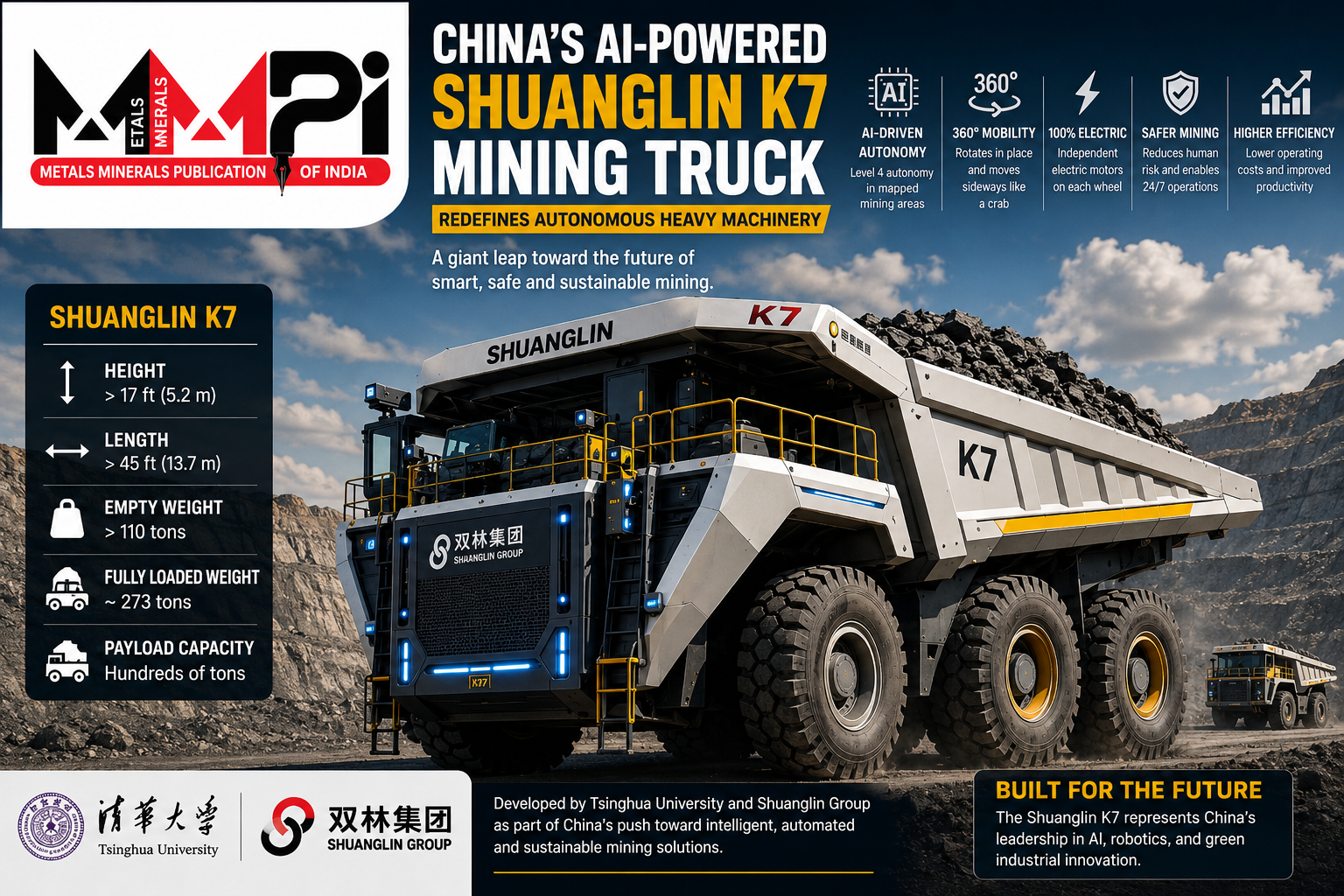
China has unveiled a futuristic autonomous mining truck that is rapidly capturing global attention for its advanced capabilities and massive industrial scale. Named the Shuanglin K7, the next-generation vehicle combines artificial intelligence, electric mobility, and autonomous navigation technologies in a way that could reshape the future of mining operations worldwide.
Developed jointly by Tsinghua University and the Shuanglin Group, the K7 represents China’s growing investment in industrial automation and smart infrastructure. The truck is designed to operate in mining environments without a human driver and is capable of performing highly unusual movements for a heavy industrial vehicle, including rotating in place and moving sideways like a crab.
According to reports highlighted by Fast Company, the Shuanglin K7 operates with Level 4 autonomy inside mapped mining zones. This means the vehicle can independently handle driving tasks in controlled environments without active human supervision. Advanced sensors, onboard computing systems, and AI-driven navigation software enable the truck to move safely across mining sites while transporting enormous loads of material.
The machine’s physical scale is equally impressive. The K7 stands more than 17 feet tall and extends over 45 feet in length. Even without cargo, the truck weighs more than 110 tons. When fully loaded, its total weight reaches approximately 273 tons, placing it among the largest autonomous mining vehicles currently in development.
Unlike conventional mining trucks that rely on traditional mechanical drivetrains, the K7 uses independently controlled electric motors on each wheel. This innovative setup allows for enhanced maneuverability, including zero-radius turning and sideways movement, capabilities rarely seen in vehicles of this size. Engineers believe these features could improve operational efficiency in confined mining environments while reducing tire wear and fuel consumption.
Industry experts view the K7 as part of a broader transformation underway in global mining. Autonomous trucks are increasingly being adopted to improve worker safety, reduce operational downtime, and maintain around-the-clock productivity. Mining companies are especially interested in technologies that can operate continuously in hazardous environments where human exposure carries significant risks.
China has been accelerating investments in AI-enabled industrial systems, robotics, and electric heavy machinery as part of its long-term strategy to modernize manufacturing and infrastructure sectors. The development of vehicles like the Shuanglin K7 highlights the country’s ambition to become a global leader in autonomous industrial transportation.
While autonomous passenger cars continue to face regulatory and safety challenges in public road environments, industrial zones such as mines provide a more controlled setting for rapid deployment of self-driving technologies. This has allowed companies and research institutions to push automation capabilities much further in heavy industries than in consumer transportation.
The Shuanglin K7 could eventually become a blueprint for future autonomous mining fleets, particularly as mining companies worldwide seek ways to lower costs, improve productivity, and meet environmental goals through electrification and AI integration.