
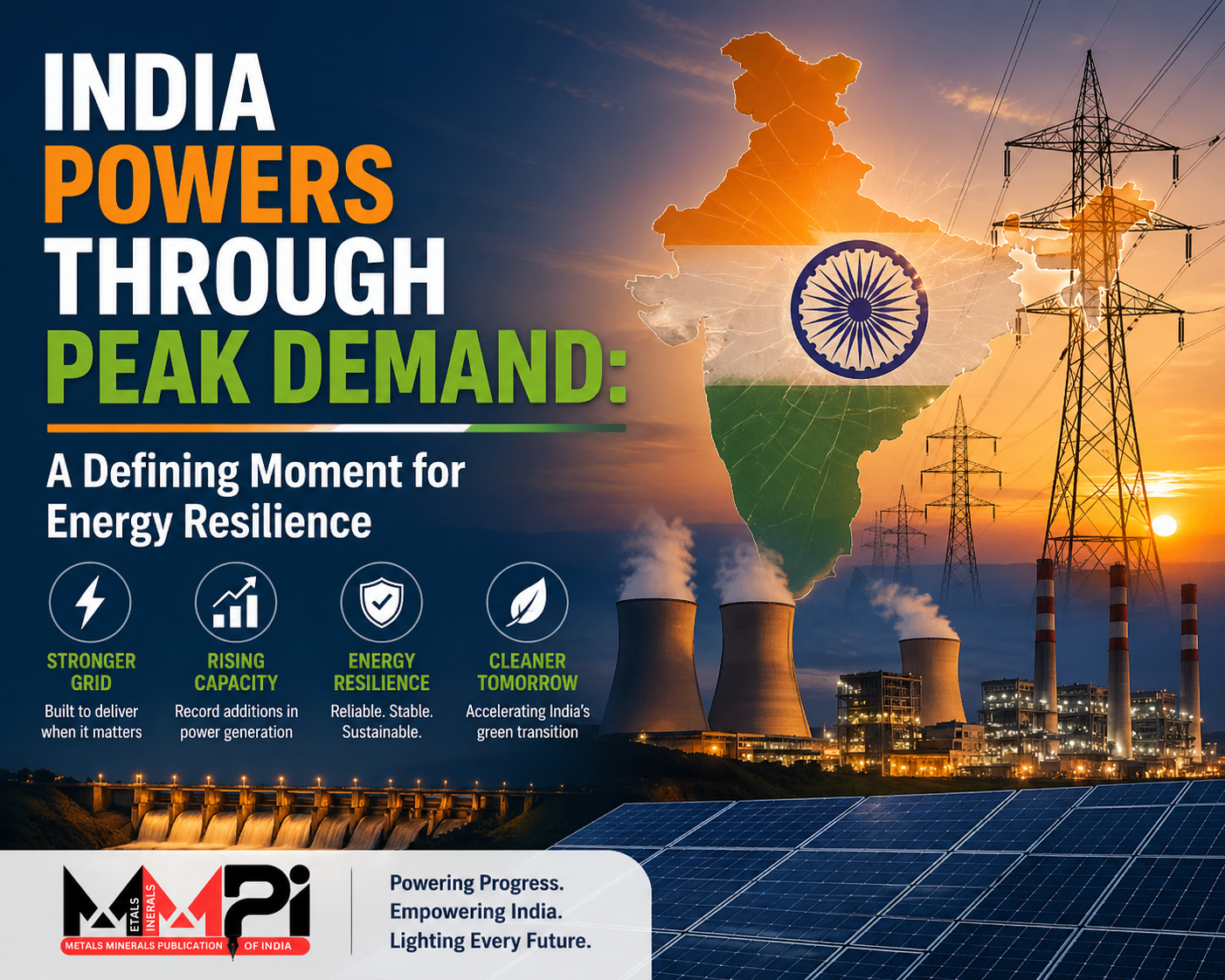
India Powers Through Peak Demand: A Defining Moment for Energy Resilience

MMPI Special Editorial | Metals & Minerals Publication of India
By MMPI Editorial Board
India has entered a decisive new phase in its industrial and energy evolution. On April 25, 2026, the country achieved a historic milestone by successfully meeting an all-time peak electricity demand of ~256 GW—without any shortage.
At a time when large parts of the country were reeling under intense heatwaves, pushing electricity consumption to extreme levels, India’s power ecosystem responded with discipline, depth, and resilience. Even more notably, the country continued power exports to neighbouring regions, underlining surplus management capability.
This moment is not just an operational success—it is a structural declaration:
India is no longer managing scarcity; it is engineering reliability at scale.
From Constraint to Capability: A System Rewritten
For decades, India’s growth was constrained by power deficits, unreliable supply, and regional imbalances. Today, the system has transformed into a coordinated, technology-enabled, multi-source energy architecture.
Key Structural Enablers Behind This Achievement:
- Integrated National Grid with advanced load dispatch centres
- Real-time demand forecasting using data-driven models
- Flexible generation mix combining thermal, renewable, hydro, and nuclear
- Improved coal logistics and stock management
- Policy-led capacity addition (~65 GW in FY25–26)
This convergence has enabled India to move from reactive load management → proactive energy orchestration.
Thermal Power: The Strategic Anchor
Despite rapid renewable expansion, the April 25 peak reinforces a fundamental reality:
Thermal power—primarily coal—remains the backbone of India’s energy security.
At Peak Demand:
- ~67% of supply from thermal
- Remaining from solar, hydro, wind, and nuclear
Why Thermal Still Dominates:
-
Dispatchable and controllable in real time
-
Essential for base-load stability
-
Critical for peak-hour reliability (especially evenings)
-
Not dependent on weather variability
Implications for the Mining & Coal Ecosystem
For India’s mining sector—especially coal—this milestone is a strong reaffirmation of long-term relevance:
Coal Demand Is Structurally Secured
- Industrial growth + power demand = sustained coal consumption
- Imports may reduce, but domestic coal production will scale aggressively
Shift Toward Efficiency & Mechanisation
- Higher output expectations from Coal India and private blocks
- Increased deployment of:
- High-capacity HEMMs
- Longwall and continuous mining technologies
- Digital mine monitoring systems
Rise of Underground Mining (Strategic Push)
- With land and environmental constraints tightening
- Underground mining—especially longwall systems—will see renewed policy focus
This aligns directly with emerging PSU strategies and future tender pipelines.
Renewable Energy: From Supplement to Strategic Contributor
India’s renewable capacity has grown rapidly, and solar power is now playing a meaningful role during daytime peaks.
However, the real challenge is:
Integration, not just installation
Structural Gaps:
- Intermittency (solar/wind variability)
- Storage limitations
- Grid balancing complexity
The New Frontier: Storage & Hybrid Systems
To sustain future peak demands (~300–350 GW), India must invest in:
- Battery Energy Storage Systems (BESS)
- Pumped hydro storage
- Hybrid power plants (solar + wind + thermal backup)
Industrial Opportunity:
For metals & mining:
- Surge in demand for:
- Lithium, cobalt, rare earths (storage systems)
- Copper & aluminium (transmission expansion)
- Development of integrated energy ecosystems at mining sites
Transmission & Grid: The Next Bottleneck
Meeting 256 GW is a milestone. Managing 350+ GW will be a challenge of infrastructure depth.
Emerging Stress Points:
- Inter-state transmission constraints
- Renewable evacuation bottlenecks
- Peak load balancing during evening hours
Required Interventions:
- Ultra-high voltage transmission corridors
- Smart grid technologies
- AI-driven load balancing systems
- Decentralised energy management
Impact on Core Industries:
- Steel demand for towers and infrastructure
- Aluminium demand for conductors
- EPC and heavy engineering sector growth
Industrial Demand Surge: The Hidden Driver
This peak demand is not just about weather—it reflects India’s accelerating economic activity:
- Manufacturing expansion
- Infrastructure push
- Urbanisation & real estate growth
- Electrification of mobility and industry
Mining Sector Transformation:
- Electrified mining fleets (reducing diesel dependency)
- Renewable-powered captive mines
- Smart, automated mining ecosystems
India in the Global Energy Context
Globally, energy systems are facing:
- Grid instability in renewable-heavy economies
- Energy price volatility
- Supply chain disruptions
India, in contrast, is demonstrating:
Scale + Stability
Growth + Governance
Thermal strength + Renewable ambition
MMPI Strategic Insight
“India’s 256 GW milestone is not just about meeting demand—it reflects the emergence of a resilient, hybrid energy model where thermal reliability anchors renewable expansion, enabling industrial growth at unprecedented scale.”
The Road Ahead: 300+ GW Era
Forecast:
- ~270 GW expected in Summer 2026
- ~350–380 GW projected within 5 years
Key Strategic Themes Going Forward:
Coal + Renewable Coexistence
Not a transition—but a co-evolution model
Energy-Linked Industrial Strategy
Mining, metals, and power sectors will become deeply interdependent
Technology-Led Mining
Automation, AI, and digital twins will redefine mining efficiency
Policy-Driven Expansion
- PSU-led capacity addition
- Private participation in mining & power
- Incentives for storage and hybrid systems
Final Word from MMPI
India’s ability to meet record power demand without shortage is a signal to the world—and more importantly, to its own industrial ecosystem:
The demand cycle is real
The infrastructure backbone is strengthening
The energy transition will be uniquely Indian—balanced, pragmatic, and growth-oriented