

Support CleanTechnica’s work through a Substack subscription, on Patreon, or on Stripe. Help us produce all of the high-quality, original content we publish week after week despite the challenges of content-scraping AI, antisocial media, inflation, and other hurdles.
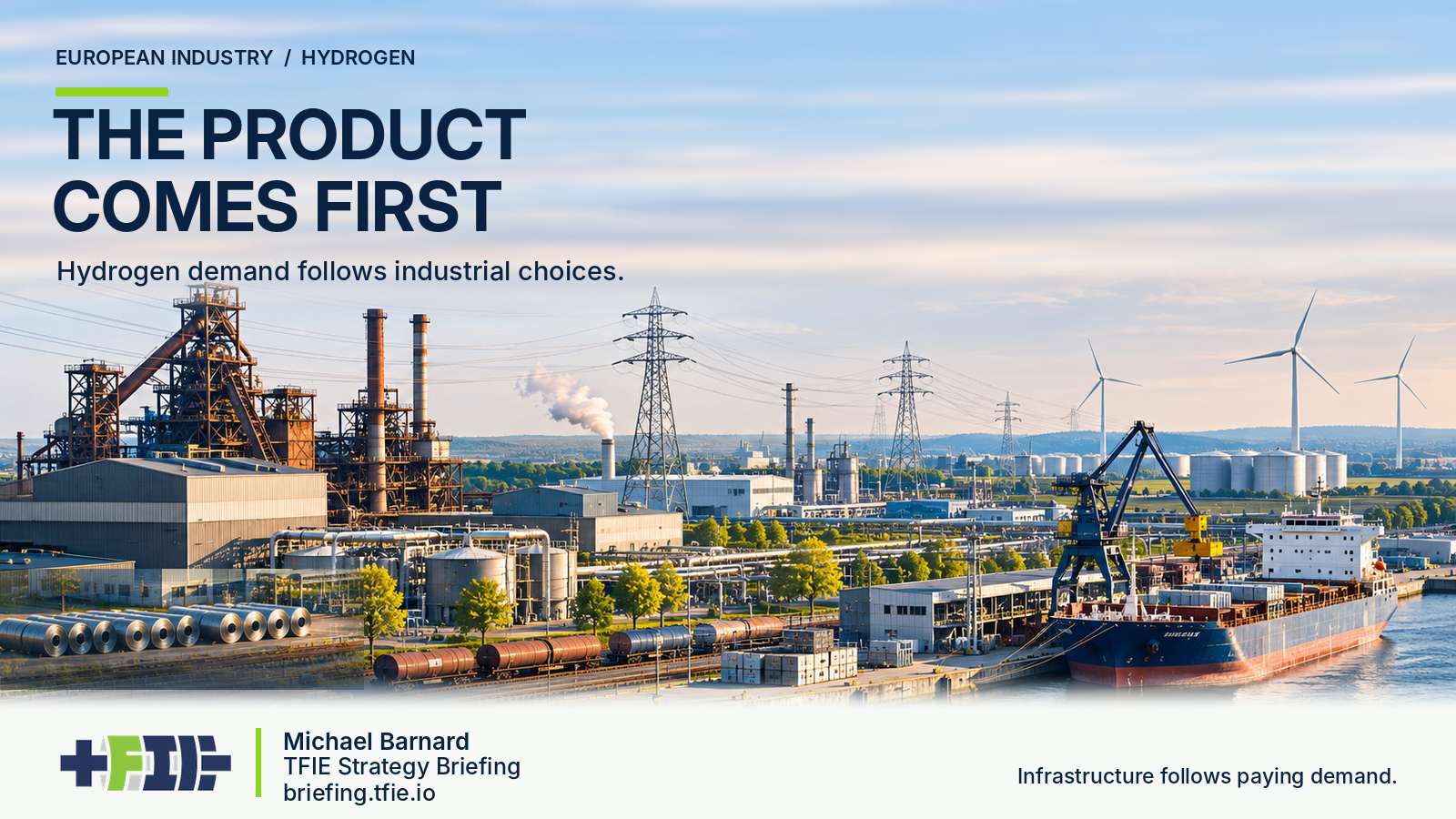
A European fertiliser manufacturer buys ammonia. Its immediate concern is getting the right product, at the right quality and price, with reliable deliveries. The manufacturer may produce ammonia using hydrogen made on its own site, buy hydrogen through a pipeline, or import ammonia made somewhere else. The last choice preserves much of the downstream industrial work but creates no demand for additional hydrogen production or pipelines inside Europe. That distinction belongs at the start of Europe’s hydrogen strategy.
The European Commission has reopened the strategy for consultation, with submissions due November 23. The Commission acknowledges that renewable and low-carbon hydrogen production and use have grown more slowly than expected. Europe’s public investment decisions now need a closer look at the industries expected to use hydrogen, the products they make, and the routes by which those products can be supplied competitively. The consultation is open until November 23, 2026.
I submitted a demand-led assessment to the Commission on November 11. My TFIE Strategy Briefing explains the industrial argument, and the open research report documents the model and its assumptions.
Europe’s existing hydrogen market is primarily a market for industrial chemicals. ACER estimated EU consumption of about 7.4 million tons in 2024, including 4.2 million tons for petroleum refining and 1.9 million tons for ammonia. Passenger cars, building heat and power generation account for very little of that established market. Refining faces structural decline as petroleum demand changes, while fertiliser and chemical producers can keep manufacturing products even when some upstream inputs come from elsewhere.
Steelmaking also has choices that cannot be captured by a single hydrogen-demand target. Producers can use recycled scrap, purchase reduced iron made where electricity is cheaper, or use hydrogen-based direct reduction where its economics work. The equipment, feedstock quality and production location determine the actual hydrogen requirement. Industrial heat offers direct electrical options for many duties. Transport electrification cuts the amount of liquid fuel that must be produced in the first place. These choices determine hydrogen demand long before anyone chooses a pipeline route.
Electricity costs expose why the industrial comparison matters. Electrolysis consuming 55 kWh/kg uses €3.30 of electricity per kilogram at €60/MWh, and €5.50 at €100/MWh. Those prices exclude the electrolyser, finance, maintenance, compression and delivery. An industrial customer pays for the finished product, not for the complexity of the process used to manufacture it.
The new assessment compares qualifying green ammonia imported into Europe at modelled 2050 delivered costs of €755–839/t with European ammonia made using on-site hydrogen at about €1,222/t. The €383–467/t gap puts a substantial price on choosing the domestic route in this model. Emissions certification, quality, reliability and supply concentration belong in the procurement appraisal, alongside the cost and strategic value of retaining European upstream production. They do not turn a forecast of ammonia demand into a forecast of domestic hydrogen demand.
Industrial policy has reasons to support European production beyond the lowest immediate price. Domestic facilities provide employment, technical capabilities and supply security. The right decision is to identify those benefits, calculate the extra cost and state who will pay it. Hydrogen production quotas bury that choice in a volume target and risk making European industrial products less competitive.
The infrastructure consequence follows. A pipeline needs industrial customers who can afford delivered hydrogen. A capacity reservation or a project announcement provides neither a binding purchase agreement nor a business case for long-term utilisation. Germany’s hydrogen-network reservations and the Netherlands’ lower demand projections already make that difference worth examining. Europe should assess its planned networks against the industrial customers likely to remain after process and sourcing choices change.
European network planners already run scenarios covering industrial activity, technology and hydrogen supply. My November submission proposes adding direct competition between ways of supplying equivalent industrial products and transport services, including the location of production. The resulting hydrogen requirements then become inputs to infrastructure appraisal instead of predetermined outputs of hydrogen policy.
The next step is practical. Keep a proposed pipeline’s design, cost, capacity and planned opening date unchanged. Assess that same investment first under a policy-aligned case that includes existing hydrogen mandates, and then under a separate economic-competition case in which industrial buyers can select other emissions-qualified production routes. Publish projected utilisation, binding customers, delivered costs, tariffs and public exposure. After seeing the downside in the original proposal, compare smaller pipes, staged construction, local hydrogen supply or imported industrial inputs. Redesigning the pipeline at the outset of every scenario hides the risk of the investment actually under consideration.
The accompanying research uses a reproducible Python model, an evidence workbook and an interactive dashboard. Readers can change assumptions about industrial imports, technology and production costs and see how the modelled hydrogen requirement responds. In the Strong pathway with central costs, selected European industrial markets and transport services require 1.887 million tons of physical hydrogen in 2050. Halving the assumed import capacity for industrial products raises that result to 3.206 million tons. These figures describe selected markets and exclude hydrogen embodied in imported finished products; they are not a forecast of total EU demand.
A competitive industrial economy can still need hydrogen for chemicals and some other applications. It needs production and pipelines sized for customers, with any extra capacity supported by a stated security or industrial rationale. The Commission’s renewed strategy should begin with Europe’s industrial products and services, then calculate the hydrogen system worth paying for.
Read the original TFIE Strategy Briefing, the open European hydrogen assessment, and explore the interactive dashboard, evidence workbook and reproducible Python model.
Sign up for CleanTechnica’s Weekly Substack for Zach and Scott’s in-depth analyses and high level summaries, sign up for our daily newsletter, and follow us on Google News!
Have a tip for CleanTechnica? Want to advertise? Want to suggest a guest for our CleanTech Talk podcast? Contact us here.
Sign up for our daily newsletter for 10–15 new cleantech stories a day. Or sign up for our weekly one on top stories of the week if daily is too frequent.
CleanTechnica uses affiliate links. See our policy here.
CleanTechnica’s Comment Policy