

Support CleanTechnica’s work through a Substack subscription, on Patreon, or on Stripe. Help us produce all of the high-quality, original content we publish week after week despite the challenges of content-scraping AI, antisocial media, inflation, and other hurdles.
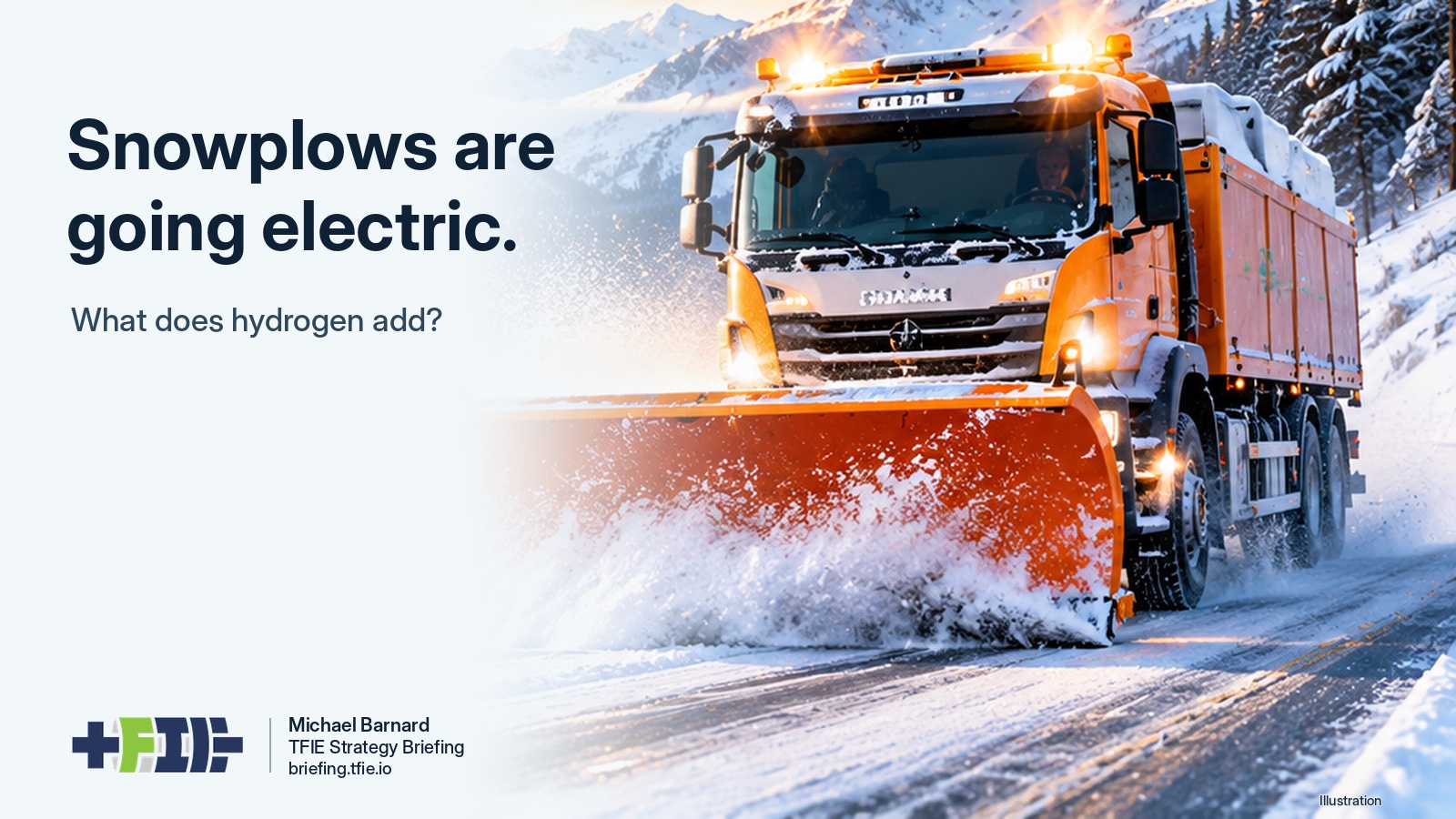
Norway has already demonstrated battery-electric snowplowing on one of its toughest mountain highways. A Scania 45 R covered roughly 7,000 km on Hardangervidda, plowing, grading and spreading sand through a Norwegian winter. Its performance exceeded expectations. Meanwhile, Sweden has unveiled a hydrogen snowplow that is, in fact, another large battery-electric truck, with a fuel cell and hydrogen tanks added for extra range. The engineering question is why that second energy system is worth having when batteries are already doing the work, and when a conventional generator running on renewable diesel could offer a simpler, potentially cheaper route to occasional extended operation.
The Swedish vehicle has to compete with more than diesel snowplows. My full TFIE Strategy Briefing examines Norway’s measured electric operation, China’s expanding snow-removal equipment market and the additional costs hydrogen must justify.
Sweden’s project brings together Scania, MaserFrakt and Peab. The vehicle carries a 356 kWh rechargeable battery and 56 kg of hydrogen. The fuel cell generates electricity to extend the truck’s operating time between charging sessions. That gives the vehicle two energy-storage systems, plus the equipment to convert hydrogen into electricity. It will still need electric charging, and it will also need hydrogen production, delivery, storage and refueling.
Norway’s experience makes the starting point uncomfortable for hydrogen advocates. The Norwegian Public Roads Administration’s 2025 trial demonstrated that a production-based heavy electric truck could do demanding winter-maintenance work. Its measured consumption averaged approximately 2.02 kWh/km, with around six and a half hours of operating endurance under evaluated mixed-duty conditions. The trial identified shortcomings in charging compatibility and payload, but these were engineering and operating problems to resolve, not evidence that battery-electric snowplows were incapable of doing the job.
China is moving toward broader deployment. Municipalities have used smaller electric snow-removal equipment for years, while manufacturers have developed full-sized specialized electric vehicles. Beijing’s Mentougou district awarded contracts for 24 multifunction snow-removal trucks in September 2026. The final chassis specifications have not all been confirmed as battery-electric, but the procurement demonstrates a market moving beyond isolated demonstrations.
China’s much larger battery-electric truck industry is also providing specialized equipment manufacturers with an expanding supply of powertrains, batteries and heavy-duty chassis. Electric snowplows benefit from components developed and manufactured for freight vehicles at much greater volumes.
The Swedish approach looks increasingly difficult to justify against that background. If six or seven hours of productive operation is adequate, a battery-electric truck can already do the work. If longer shifts are required, larger batteries, better charging arrangements, mobile charging equipment or operational changes deserve assessment first. Hydrogen cannot claim the extreme-duty market merely because charging requires planning.
There is another alternative that the hydrogen comparison tends to omit. A conventional generator running on hydrotreated vegetable oil, or HVO, could supply additional electricity when the battery needs support. Diesel generators, fuel tanks and liquid-fuel distribution systems are mature technologies. Major generator manufacturers already approve suitable equipment for HVO, which can use conventional diesel-type storage and handling systems. Integrating a generator into a particular electric truck still requires engineering, certification and emissions controls, but it avoids constructing a hydrogen supply chain for a small fleet of seasonal vehicles.
For some operators, the even easier solution is to retain existing diesel snow-removal equipment and use certified renewable diesel for the relatively few extreme shifts that electric vehicles cannot cover. Copenhagen Airport has already adopted that approach, progressively electrifying its equipment while using HVO in compatible heavy vehicles, including snow-removal machines.
HVO is not unlimited, and its climate benefits depend on feedstock origin and production. Burning it also produces exhaust emissions. These constraints are important, particularly in populated areas. But a relatively small quantity used for exceptional winter duty is a different proposition from trying to replace a large share of road transportation with biofuels.
The hydrogen proposal must beat all these alternatives. It needs to demonstrate that the additional hours gained from the fuel cell are worth the vehicle cost, maintenance, fuel premium and refueling infrastructure. It also needs to outperform the cost of providing those hours with conventional generating equipment or retaining a small reserve fleet.
Snow-removal authorities have an obligation to maintain roads during severe weather. They should purchase equipment that meets that obligation with the lowest defensible whole-system cost and emissions. Norway has shown that batteries can perform demanding winter work, and China’s industrial scale is making specialized electric vehicles more accessible. Sweden’s hydrogen truck is entering a market in which the simpler electric solution is already working.
The full TFIE Strategy Briefing analysis examines the operating results, procurement evidence, charging limitations, airport fuel-cell trials and the practical alternatives that make hydrogen’s business case so difficult.
Sign up for CleanTechnica’s Weekly Substack for Zach and Scott’s in-depth analyses and high level summaries, sign up for our daily newsletter, and follow us on Google News!
Have a tip for CleanTechnica? Want to advertise? Want to suggest a guest for our CleanTech Talk podcast? Contact us here.
Sign up for our daily newsletter for 10–15 new cleantech stories a day. Or sign up for our weekly one on top stories of the week if daily is too frequent.

CleanTechnica uses affiliate links. See our policy here.
CleanTechnica’s Comment Policy