

Support CleanTechnica’s work through a Substack subscription, on Patreon, or on Stripe. Help us produce all of the high-quality, original content we publish week after week despite the challenges of content-scraping AI, antisocial media, inflation, and other hurdles.
West Yorkshire has made two substantial commitments to its bus network. On November 2, FirstGroup announced a £109 million agreement with the West Yorkshire Combined Authority covering five depots, associated infrastructure and 330 buses, including 79 battery-electric vehicles. The authority is also spending £120 million on more than 250 new buses through a separate programme. These investments will help establish the region’s new franchised Weaver Network, but many of the assets being acquired will remain in use long after the first operating contracts have ended.
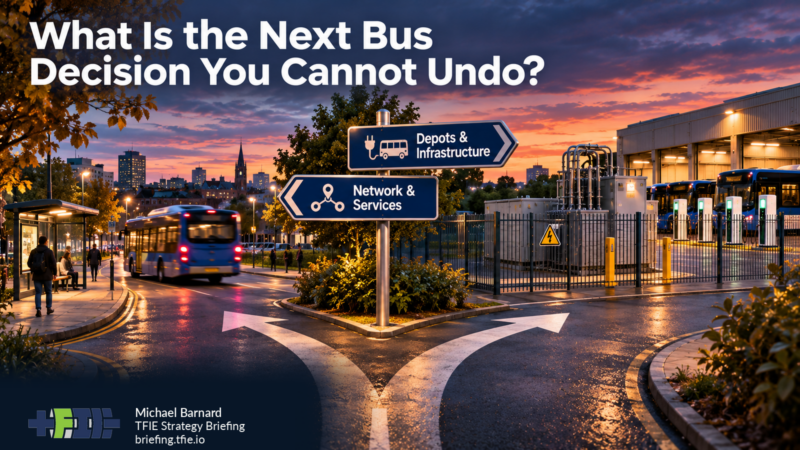
West Yorkshire’s fleet and depot commitments illustrate a problem explored in my 83-page report, The Bus Is Not the System. The accompanying TFIE Strategy Briefing assessment examines which decisions are becoming expensive to reverse and what authorities should establish before making their next commitments.
The Weaver Network changes the relationship between public transport planning and private bus operations. The Combined Authority will specify services and retain responsibility for passenger revenue under its initial large contracts, while private operators deliver the routes. The region is securing assets that will remain important regardless of which company operates the buses. In principle, that can make future competition easier because bidders do not each have to provide a new depot and fleet.
The challenge is that buses, operating contracts and infrastructure follow different clocks. An operating contract might last five or seven years. Vehicles can work through successive contracts, while depot buildings and electrical connections may remain useful for decades. A change in route patterns, population or employment locations can make an established depot less convenient. A bus can often be reassigned, but a multi-megawatt electricity connection cannot be transferred to another site because the network needs charging capacity elsewhere.
West Yorkshire has arranged a staged transition. The five depot sales have completed, while the buses are scheduled to transfer as new franchises begin operating between May 2027 and October 2028. First Bus will continue delivering existing services under temporary depot leases and will manage electrification at Bradford and Huddersfield, with the authority paying for that work. The arrangements allow services and infrastructure development to proceed while ownership and operating responsibilities change.
Securing strategically important depots is a defensible approach. It reduces dependence on an incumbent operator’s control of scarce infrastructure and can help new companies compete for future contracts. The authority also assumes long-term responsibilities for the assets, including maintenance, future electrical capacity and their suitability for a changing passenger network. A depot can be worth purchasing without every potential alternative having been examined, but the consequences of losing those alternatives should be understood before the agreement becomes binding.
Electrification makes this especially important. Charging equipment, substations and electricity connections involve different suppliers, construction schedules and contractual responsibilities from the buses themselves. Vehicle orders can proceed before chargers are fully commissioned when the infrastructure delivery pathway is sufficiently assured. Problems arise when a fleet commitment depends on electrical capacity that cannot be delivered in time, or when the fallback arrangements are inadequate.
The passenger network can also change in ways that alter the original investment case. Better bus priority can reduce the number of vehicles needed to maintain a timetable. New housing developments can shift demand toward different corridors. A major employment centre or hospital relocation can change the value of existing routes and depots. The infrastructure secured today should support those possibilities rather than make sensible network improvements prohibitively expensive.
None of this argues for delaying every investment until uncertainty disappears. Authorities need to secure land, procure vehicles and obtain electrical connections years before some services begin. The useful distinction is between preparation that reduces uncertainty and commitments that substantially increase the cost of changing direction. Both need to be assessed against the passenger services the authority intends to deliver.
West Yorkshire’s programme offers a concrete example of the opportunity and challenge. Securing assets and specifying passenger services across the metropolitan network may produce a more coherent system than leaving every operator to optimize its own routes and depots. The long-term measure of success will be whether the authority can continue improving that network through changing demand, successive contracts and further electrification without having to reconstruct infrastructure it has already paid to provide.
This assessment concludes my five-part series drawn from The Bus Is Not the System, an 83-page TFIE Strategy report examining four decades of British and Irish metropolitan bus governance. The full West Yorkshire Briefing connects the report’s findings to current fleet, depot, electricity infrastructure and franchising decisions.
Sign up for CleanTechnica’s Weekly Substack for Zach and Scott’s in-depth analyses and high level summaries, sign up for our daily newsletter, and follow us on Google News!
Have a tip for CleanTechnica? Want to advertise? Want to suggest a guest for our CleanTech Talk podcast? Contact us here.
Sign up for our daily newsletter for 10–15 new cleantech stories a day. Or sign up for our weekly one on top stories of the week if daily is too frequent.

CleanTechnica uses affiliate links. See our policy here.
CleanTechnica’s Comment Policy