

Support CleanTechnica’s work through a Substack subscription, on Patreon, or on Stripe. Help us produce all of the high-quality, original content we publish week after week despite the challenges of content-scraping AI, antisocial media, inflation, and other hurdles.
The Ford Motor Company is still disguising the soon-to-arrive Fathom electric pickup truck under a layer of camouflage, but the iconic automaker is more than happy to share what’s going on inside. In the latest news drop, Ford wants everyone to know that you don’t need an expensive inverter to convert the truck into a mobile, zero emission generating station for your home.
Who Needs A Mobile Generating Station, Anyways?
The idea of using an EV battery to power household appliances seemed pretty futuristic back in the early 2010’s, but nowadays the technology is commonplace. The key is bidirectional charging technology, which enables an EV battery to discharge electricity as well as receive it from a charging station.
One obvious use is backup emergency power, where EV batteries have the advantage of quiet, pollution-free running — unlike gas or diesel generators. In case of a prolonged power outage, drivers can travel outside of the blackout area, charge up, and return with a fully charged battery to keep the lights on at home.
EV batteries can also help ratepayers avoid higher peak demand electricity rates. Households with home EV charging stations can time their charging sessions to take advantage of utility discounts for off-peak use, and discharge their battery to avoid high rates during peak periods.
Bidirectional Charging Good, No Inverter Better
The sticky wicket, of course, is cost. Generally speaking, home EV charging stations are not free, and neither is the inverter needed to convert the DC current from an EV battery into an AC current for household use.
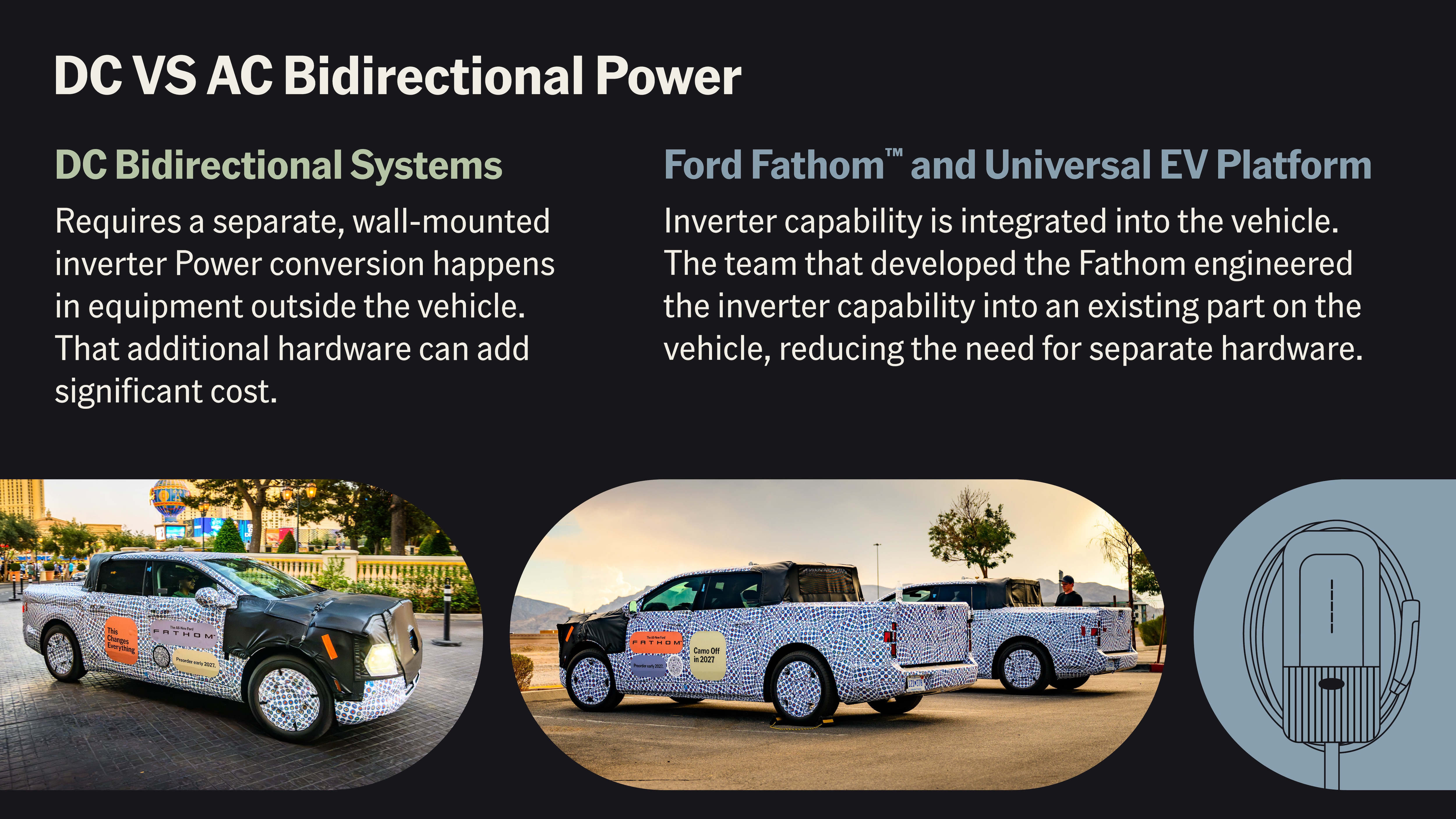
Ford’s answer is a built-in system that eliminates the need for an external inverter. “Our goal wasn’t just to add bidirectional power to our EVs. It was to redesign the system to cost far less so more people can access bidirectional power,” Ford Model e general manager Kay Hart explained in a new post earlier today.
“With Fathom offering bidirectional power at an MSRP starting below $30,000, even more people can benefit from potential energy savings and home backup power,” Hart added.
That seems to suggest that the cost is included in the company’s target MSRP of $28,350, though in another part of the post Hart uses the word “available,” which typically means an add-on:
“In 2027, the all-new Ford Fathom™ electric truck will start at $28,350 MSRP and offer available bidirectional AC power. That means it does not need a separate wall-mounted inverter to supply over a projected 10 kW of AC power to a home.”
But Wait, There’s More
I’ll reach out to Ford for further clarification on that. In the meantime, Hart notes that the company expects its next-generation “Ford Home Power Station” EV charger to cost about half as much as the first-generation edition, which helps support the economic case for deploying an EV battery as a matter of routine, to take advantage of time-of-day utility discounts.
For drivers who plan to use their EV batteries as backup generators, Ford has also dropped the cost of its “Ford Home Backup Power Panel.” The final figure is not available yet, but Hart expects it to land at least 60% less than Ford’s first-generation backup power system.
Interested? Ford is taking names for Fathom pre-order invitations here.
What War On EVs?
If you’re wondering why Ford waited until now to remind everyone that the Fathom comes with a new, cost-cutting bidirectional charging system, that’s a good question. After all, it’s election season, and the media spotlight is focusing like a thousand points of light on the candidates and their various hi-jinks.
Still, there’s always room in the automotive press for something new and different. After all, Tesla CEO Elon Musk successfully dangled a shiny object with his Tesla “flying car” stunt on October 15. Slate Auto weighed in with a soft opening for its new showroom in Chicago, General Motors pitched its new EV platform alongside its new LMR battery formula on October 21, and the German automaker Audi topped them all over the weekend, when CEO Gernot Döllner appeared on stage with US President Donald Trump at a campaign rally in Georgia on Saturday.
For the record, during Saturday’s campaign stop Döllner and Trump announced that Audi will build a $4 billion factory in Georgia as its very first manufacturing venture in the US. The automaker has not released details, but over the summer Döllner indicated that the company’s US strategy includes plug-in hybrid EVs.
Whether or not those EVs are manufactured in Georgia remains to be seen. Döllner’s appearance with Trump on the eve of critical US elections provoked a firestorm of criticism in Germany, where critics pointed out that the supervisory board of parent company Volkswagen has yet to approve the plan.
Be that as it may, on October 24 Audi posted a press release describing the Georgia facility as “among the brand’s largest production footprints globally.”
Apparently that’s just for starters. “Audi looks forward to sharing additional U.S. investment announcements in the future as the brand continues to deepen its commitment to the American market,” the company added.
In the meantime, Audi is in damage control mode over the political optics of Döllner’s appearance with Trump. On October 26 the company posted an internal letter, presumably from Döllner, in which he attempted to explain why the automaker is creating new jobs in the US while laying plans to slash its workforce in Germany.
“The U.S. is the world’s second-largest premium automotive market. At the same time, our business there is currently not profitable. Many of our competitors have been producing locally for years. Our own local production will allow us to strengthen our competitiveness, reduce trade and currency risks, and better realize the market’s growth potential,” Döllner wrote.
“A stronger U.S. business is therefore not a decision against Germany. Rather, it is an important step towards strengthening Audi’s global competitiveness and helping to secure the company’s long-term success,” he continued.
Döllner also somewhat weakly acknowledged that the campaign appearance with Trump could be interpreted as a “political signal.” Nevertheless, Döllner did not back down from his stance.
“We remain firmly committed to Audi’s values and principles. Equally, we have a responsibility to safeguard the company’s economic future. We believe these responsibilities go hand in hand and together guide our actions,” he concluded.
Whether or not that explanation satisfies the Volkswagen supervisory board remains to be seen. Hold on to your hats…
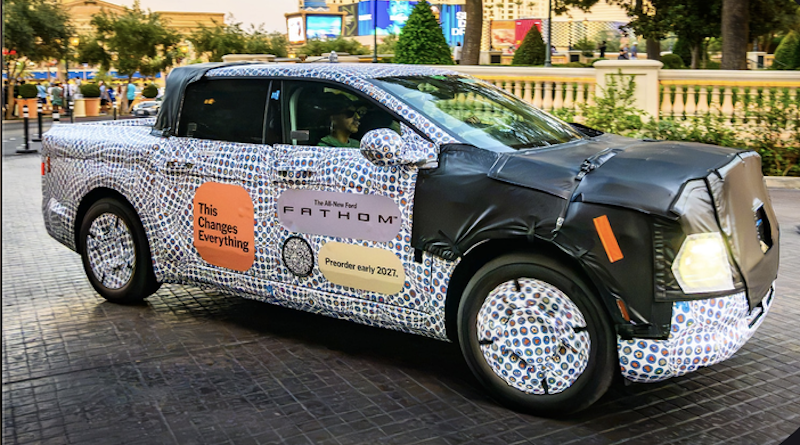
Photo: Ford’s new Fathom electric pickup truck — which is still under wraps — comes with a new bidirectional EV charging system that eliminates the cost of an external inverter (cropped, courtesy of Ford).
Sign up for CleanTechnica’s Weekly Substack for Zach and Scott’s in-depth analyses and high level summaries, sign up for our daily newsletter, and follow us on Google News!
Have a tip for CleanTechnica? Want to advertise? Want to suggest a guest for our CleanTech Talk podcast? Contact us here.
Sign up for our daily newsletter for 10–15 new cleantech stories a day. Or sign up for our weekly one on top stories of the week if daily is too frequent.

CleanTechnica uses affiliate links. See our policy here.
CleanTechnica’s Comment Policy