

Support CleanTechnica’s work through a Substack subscription, on Patreon, or on Stripe. Help us produce all of the high-quality, original content we publish week after week despite the challenges of content-scraping AI, antisocial media, inflation, and other hurdles.
In-road wireless EV charging systems are the kiss of death for gas and diesel fuel. They enable EV drivers to recharge without stopping or exiting their vehicle, saving time and improving personal security, too. That’s a next-level convenience no gas-powered vehicle can top. While much of the activity around in-road charging is still in the R&D stage, the leading global automaker Honda is among the electrification stakeholders ready to take it to the next level.
Wireless EV Charging Is Coming For Your Fossil Fuels
The public EV charging station network has made significant progress in the US over the past several years. The early days were plagued by long stretches of road with few or no charging stations in sight, lack of connectivity, and unplanned down times. Now the gaps are filling and reliability has improved to the point where more EV-curious drivers are confident about switching to an EV.
Still, the next big thing would be a system that enables drivers to charge up seamlessly while in motion. That may seem somewhat futuristic, and it is. However, the technology pieces are in place. Emedded, wireless charging systems offer aesthetic benefits and are potentially more tamper-proof and durable than conventional charging stations.
Stationary wireless systems began to surface in the early 2000’s, and now in-road charging systems have begun to emerge at the demonstration stage. Back in 2023, CleanTechnica recapped the state of affairs at the demonstration phase, with Germany and Sweden in the running alongside the Pennsylvania Turnpike, Detroit, Michigan, and the state of Indiana here in the US.
In 2024 the field advanced another degree when the US-based wireless EV charging startup InductEV hooked up with ENRX of Norway in a Memorandum of Understanding aimed at establishing higher-level global standards for wireless charging.
“The motivation for the MOU appears to be noise from the robotaxi field, which is fixing on a lower-level charge,” CleanTechnica reported. At the time, Tesla’s Robotaxi division was lobbying for a lower-level charge for its Cybercabs. In contrast, InductEV and ENRX are among the wireless stakeholders pushing for a higher-level standard, needed to eliminate range anxiety over longer distances than a typical robotaxi service would cover.
Who Will Win The Wireless Charging Standard Race?
Readers, if you have any updates on the Cybercab wireless charging situation, drop a note in the comment thread. In the meantime, the US Department of Energy has already weighed in on the topic.
“High-power, in-road, dynamic wireless charging could increase the cost effectiveness and utility of EVs by increasing their range while enabling the use of smaller, cheaper batteries and reducing the charging demand at the fleet’s central facility,” the Energy Department observes in an undated web page.
“This could reduce the cost of charging hardware and distribution system upgrades as well as the cost of operations and increase vehicle utilization and return on investment,” the agency emphasizes.
More Dynamic Charging For The US…
High-level or not, Florida has also joined the ranks of wireless-forward stakeholders. In 2024 the state announced plans to integrate a wireless in-road charging system with the construction of a new highway.
The announcement is significant because it marks the first time a new highway has been designed with wireless EV charging. Previous efforts have involved retrofitting stretches of roadway. “Operational rather than experimental, the in-road charging section of the 125 mile long SR 516 will encompass just over 4 miles,” CleanTechnica reported in 2024.
The project is also significant because Florida has become one of the strongest markets for EV adoption in the US, and the new wireless system indicates that state transportation planners are planning on more to come. The new 125-mile highway will link busy Lake and Orange counties, providing EV drivers with a new option for charging up along four miles of the roadway.
…And Now Comes Honda
Evidently we ain’t seen nothing yet, because now Honda has jumped into the wireless EV charging pool. The news is of particular interest considering that Honda is among the leading automakers that still considers hydrogen fuel cell EVs a viable path to zero emission transportation.
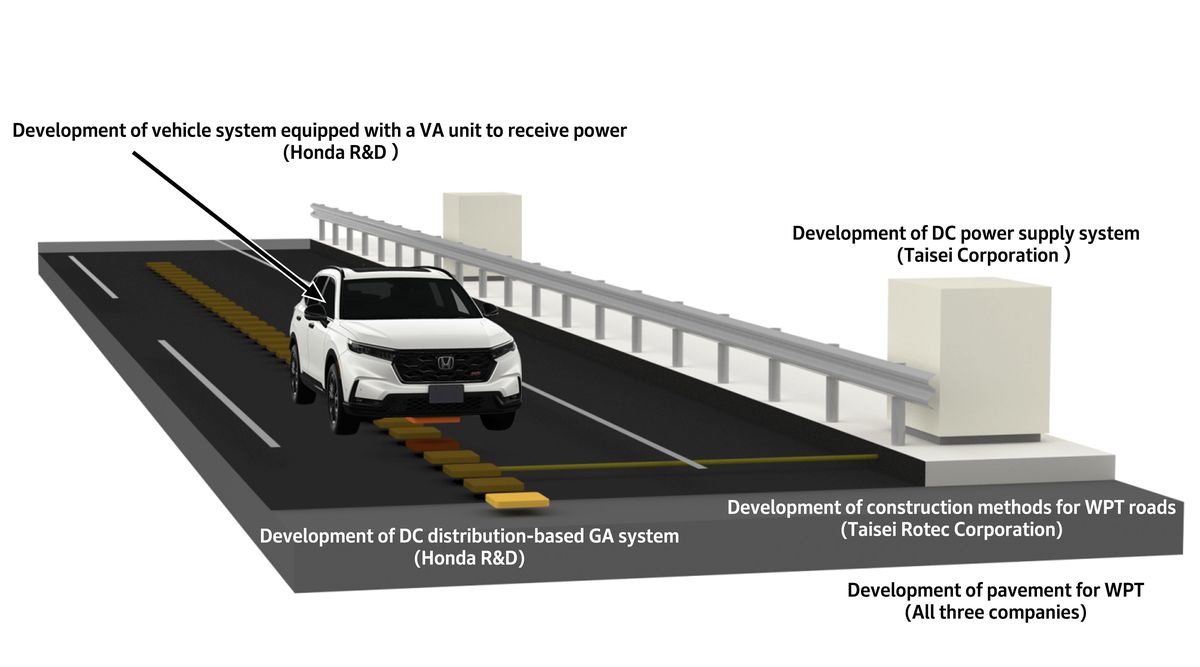
The latest news from Honda doesn’t necessarily mean that the automaker has thrown in the fuel cell towel, but it does signify a shift in attention towards battery-powered EVs. On October 5, Honda recapped its wireless charging plans, which the company has been developing under its Honda R&D Co. subsidiary in collaboration with Taisei Corporation and Taisei Rotec Corporation. In a long form press statement, Honda described the foundational technology for a “magnetic coupling wireless power transfer road system,” enabling EVs to recharge while in motion.
“The system combines proprietary technology of each company: a Honda high-power-density power receiver/transmitter units compatible with DC power distribution; a Taisei high-response DC power supply system; and Taisei Rotec technology for embedding equipment in roads,” Honda explained.
“With these technologies, the system achieves high-power wireless power transfer (WPT) and excellent ease of installation in road pavement, envisioning applications for a wide range of mobility products, from passenger EVs to large commercial EVs,” the automaker added for emphasis.
Don’t get too excited just yet. So far the collaboration has reached the validation testing stage, and the three partners have set the period beginning April 1 of 2027 for an initial demonstration of the new system on public roads. With a focus on trucks and other large commercial vehicles, the in-ground system will be designed for durability under heavy loads.
Wait, Where’s Honda?
Honda further emphasizes that the initial focus will be on logistics and transportation, where it anticipates higher highest returns, so don’t expect to find a wireless-equipped electric sedan or SUV at your local Honda dealer any time soon.
For that matter, over the summer Honda announced that its only 100% battery EV in the North America market, the Prologue, will sail into the black hole of automotive history once inventories are exhausted in 2027.
Still, the wireless EV charging venture indicates that Honda has battery EVs in its sights, at least elsewhere around the globe if not here in the US. In May, for example, Honda reaffirmed its long term electrification plans. Among other developments, the automaker announced that its Xcelerator Ventures branch has put up stakes in the UK battery startup Nexeon, which itself is a stragic partner with the Korean firm SKC.
And of course, there’s always the hybrid EV strategy, which US automakers have adopted hand over fist. Last week Honda joined the scramble, announcing plans to introduce 15 hybrid EV models in the North American market within the next three years.
Image: Honda has joined the race to develop wireless EV charging systems that enable drivers to recharge their batteries while on the road, adding a new layer of convenience to the EV experience (courtesy of Honda).
Sign up for CleanTechnica’s Weekly Substack for Zach and Scott’s in-depth analyses and high level summaries, sign up for our daily newsletter, and follow us on Google News!
Have a tip for CleanTechnica? Want to advertise? Want to suggest a guest for our CleanTech Talk podcast? Contact us here.
Sign up for our daily newsletter for 10–15 new cleantech stories a day. Or sign up for our weekly one on top stories of the week if daily is too frequent.

CleanTechnica uses affiliate links. See our policy here.
CleanTechnica’s Comment Policy