

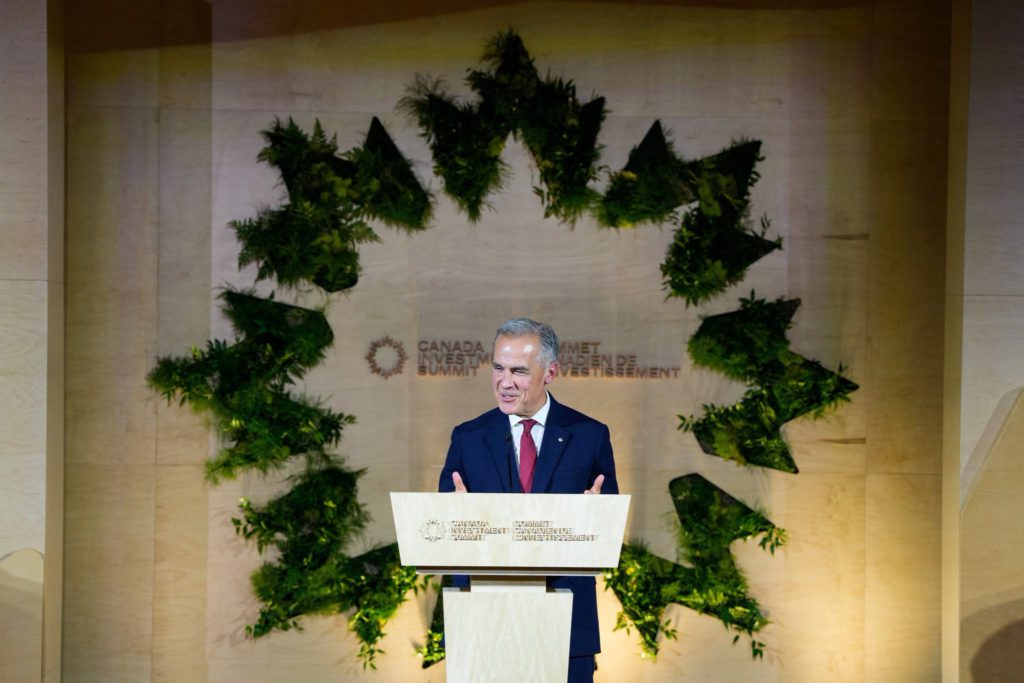
Toronto, September 17, 2026: Canada’s first Investment Summit has generated nearly C$500 billion in new investment commitments, but the headline figure also highlights a challenge for the country’s mining and critical-minerals sector: many individual projects remain too small or fragmented to attract the large-scale institutional capital now being targeted by Canada.
The September 14–15 summit in Toronto brought together investors from nearly 30 countries managing more than C$100 trillion in assets. Ottawa showcased 167 investment opportunities requiring more than C$1 trillion over five years, with 63 projects involving minerals and metals.
Nearly C$500 Billion in Commitments
The nearly C$500-billion figure combines several forms of investment and financing rather than representing C$500 billion in cash immediately flowing into projects.
Canada said pension funds, insurers and institutional investors committed almost C$100 billion in new capital. Canadian banks announced nearly C$325 billion in financing commitments, while investment funds pledged to mobilise more than C$14 billion.
Among the major announcements was a C$50 billion Maple Fund launched by CPP Investments and Brookfield Asset Management, targeting critical infrastructure and strategic industries. PSP Investments also plans to increase its Canadian investments by approximately C$25 billion.
Mining Struggles to Reach Institutional Scale
Despite mining being one of the central themes of the summit, direct project-specific funding for the sector was comparatively limited. The Canada Growth Fund committed about C$140 million to Generation Mining’s Marathon copper-palladium project in northwestern Ontario.
The issue is partly one of scale. Large pension funds and institutional investors often need opportunities capable of absorbing billions of dollars in capital. A collection of smaller mining projects can be strategically important but may not individually meet those investment requirements.
Analysts also point to the need to develop entire supply chains. Critical-mineral projects can require mines, processing plants, electricity, transportation infrastructure and long-term customers to be developed on compatible timelines.
Government Pushes Faster Approvals
Prime Minister Mark Carney has argued that faster project approvals will be essential to attracting investment. His government has promoted a “one project, one review, one year” approach for major projects and supply chains.
Ottawa has also announced a Productivity Mega Deduction, expanding immediate tax deductions to assets including mining property, pipelines, rail infrastructure, roads and other productive investments. The government says the measure will reduce Canada’s marginal effective tax rate on new business investment from roughly 13% to 6.4%.
Critical Minerals at the Centre
Canada is positioning its mineral resources as part of a broader strategy to strengthen domestic and international supply chains for critical materials.
However, the summit has shown that attracting capital is only one part of the challenge. Canadian mining companies must also overcome permitting timelines, infrastructure requirements, processing capacity and uncertainty over future markets.
The country’s lithium industry illustrates the issue. Some Canadian developers can produce spodumene concentrate, but limited domestic processing capacity means additional investment is needed to turn raw materials into battery-grade chemicals.
From Capital Commitments to Mining Projects
The Canada Investment Summit has demonstrated the large pool of capital available for Canadian businesses and infrastructure. The next test for the mining industry will be converting that interest into large, financeable and integrated mineral supply chains.
For Canada’s critical-minerals ambitions, the challenge is therefore not simply attracting more money—it is creating projects and infrastructure large enough, coordinated enough and sufficiently advanced to absorb that capital.