
California Legislature Approves Bill Easing Access to Clean, Affordable “Balcony Solar”

Support CleanTechnica’s work through a Substack subscription, on Patreon, or on Stripe. Help us produce all of the high-quality, original content we publish week after week despite the challenges of content-scraping AI, antisocial media, inflation, and other hurdles.
SB 868 would end red tape blocking millions from utility bill savings
SACRAMENTO — The Environmental Working Group today applauds the California Legislature for passing a bill that will help Californians invest in clean energy while also tackling sky-high energy bills by making it easier to install small, affordable “balcony solar” systems.
Senate Bill 868, known as the Plug and Play Solar Act, would eliminate red tape that has kept these systems from being placed in apartments, condos and single-family homes. The legislation would also ensure the systems comply with strict safety standards.
The bill is authored by Sen. Scott Wiener (D-San Francisco) and sponsored by EWG and the Abundance Network. SB 868 heads to Gov. Gavin Newsom for his signature upon concurrence by the Senate.
“This is the most exciting clean energy idea around,” said Bernadette Del Chiaro, EWG’s senior vice president for California. “With this bill, California is poised to fling its doors wide open to a real, tangible affordability solution for everyday consumers.
“Solar energy is a no-brainer for California and we applaud Sen. Wiener and his legislative colleagues for their hard work to put this critical clean energy solution on the governor’s desk,” she added.
Balcony solar is thriving in Europe — in Germany more than 4 million systems have been installed. Efforts to ease their deployment are gathering steam in other countries.
But in the U.S., regulatory barriers keep this technology out of reach for many. If enacted, SB 868 would remove those barriers while ensuring the systems meet safety standards.
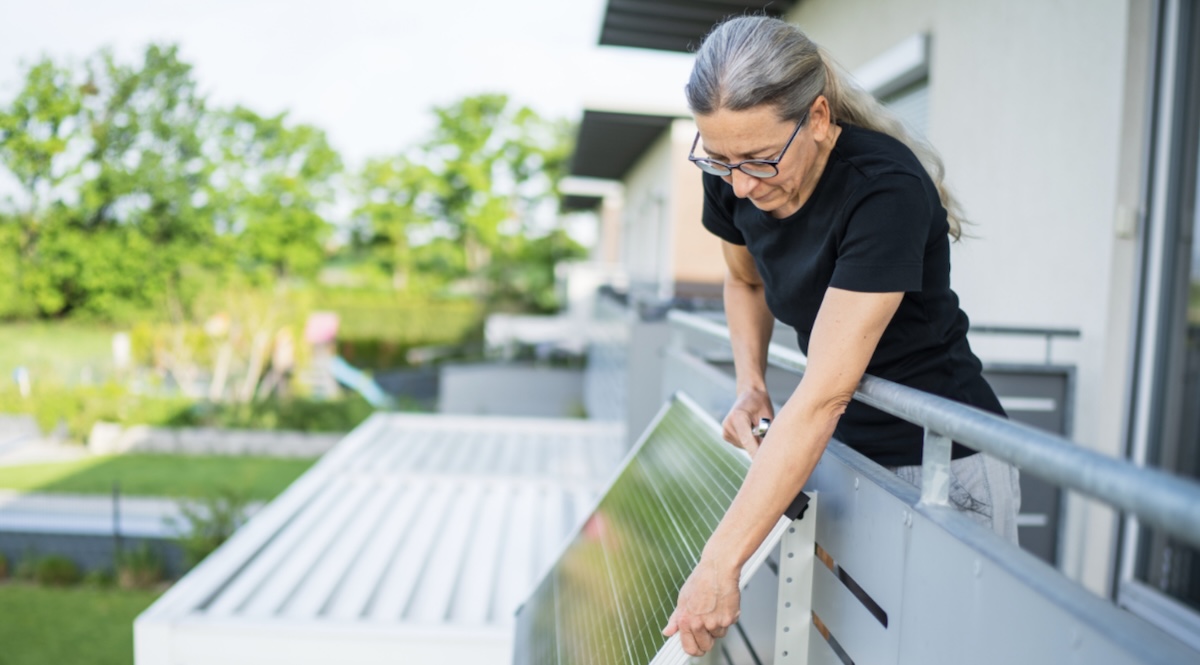
Homeowners and renters could then buy portable balcony solar panels from retailers and plug them in without first having to get an interconnection agreement from their utility. The cost and time involved with getting that agreement has been a barrier to greater deployment of these systems.
The Assembly amended the bill with a provision sunsetting the interconnection exemption on Jan. 1, 2030 — language sought by the utilities — but SB 868 gives the market four years to take off and the Legislature has the opportunity to remove the sunset in the future.
Solving an urgent public health problem
EWG this month released a report showing that California is experiencing more frequent and dangerous heat days, with extreme heat events up 55% statewide threatening public health and safety without access to cooling. But soaring utility bills mean millions of people can’t afford the air conditioning that could keep them safe.
Balcony solar is one solution, helping lower electricity costs and making it cheaper to run vital cooling. With 2027 shaping up to be the hottest year on record, it can’t come soon enough.
That’s why EWG is calling on policy makers to prioritize solutions like customer-sited solar energy that can drastically lower or eliminate annual utility costs for air conditioning. If it becomes law, SB 868 would help millions of families tackle air conditioning costs.
A single 400-watt balcony solar system can cover roughly 14% of the average apartment’s electricity usage, providing savings of about $250 per year. While the cost of balcony solar starts around $500 today, with broader adoption enabled by SB 868, EWG expects costs to fall, making solar even more accessible to renters and low-income households.
California electricity rates have nearly doubled over the past decade, leaving the state with the nation’s second-highest energy prices. SB 868 provides consumers with a straightforward way to take control of their energy bills.
And the systems are easy to use. “Installing balcony solar is as simple as plugging an appliance like a toaster into a standard wall outlet,” said Del Chiaro.
“At a time when many struggle to pay their energy bills, balcony solar is a powerful cost-cutting tool that also helps the state meet its clean energy goals,” she added.
SB 868 would also ensure these plug-and-play systems meet strict safety standards. All systems must be certified by UL, or Underwriters Laboratories, the global independent safety science company, or an equivalent national testing lab. To protect utility workers and prevent electrical hazards, systems must automatically shut off within seconds if the grid goes down.
System size is capped at 1,200 watts, enough to power everyday appliances such as fridges, lights, Wi-Fi routers and AC units.
California is not the first state to remove barriers to balcony solar. Utah became the first in 2025, and so far, eight other states have enacted laws to do the same.
With today’s vote, California joins New York as another state with a balcony solar bill sitting on the governor’s desk. Newsom has 30 days to take action on SB 868.
“California may not be the first out of the gates but we are the biggest prize,” said Del Chiaro. “If Gov. Newsom signs this bill into law, the size of our market will radically transform and accelerate the adoption of this brilliant new way to tackle both climate change and energy affordability.”
The Environmental Working Group is a nonprofit, non-partisan organization that empowers people to live healthier lives in a healthier environment. Through research, advocacy and unique education tools, EWG drives consumer choice and civic action.
Article from EWG.
Sign up for CleanTechnica’s Weekly Substack for Zach and Scott’s in-depth analyses and high level summaries, sign up for our daily newsletter, and follow us on Google News!
Have a tip for CleanTechnica? Want to advertise? Want to suggest a guest for our CleanTech Talk podcast? Contact us here.
Sign up for our daily newsletter for 15 new cleantech stories a day. Or sign up for our weekly one on top stories of the week if daily is too frequent.

CleanTechnica uses affiliate links. See our policy here.
CleanTechnica’s Comment Policy