


Support CleanTechnica’s work through a Substack subscription, on Patreon, or on Stripe. Help us produce all of the high-quality, original content we publish week after week despite the challenges of content-scraping AI, antisocial media, inflation, and other hurdles.
Like many people today, I am able to work remotely. My primary home is on the Atlantic coast of Florida, but, for ten or twelve weeks in the summer, I move to Connecticut. I own a modular home in a rural seasonal community that was established in the 1960s. It’s shaded by enormous eastern white pines and cooled by a bubbling brook. I do ask a lot more of this summer space than most of its previous inhabitants ever did, though — I want it to be an all-electric home.
If wishes were horses…
Ah, the home’s mere 30 amp service can’t begin to satisfy my vision. What’s a summer homeowner with a sustainability mission to do?
Seasonal residents like me are increasingly motivated to increase electrical capacity to electrify our homes. This momentum is driven by environmental and health concerns and also the wish to upgrade to a more contemporary interior environment. With limited electrical capacity, space constraints, and aging infrastructure, though, modular home upgrades can seem impractical or prohibitively expensive. Overcoming the barriers is one piece of the puzzle to achieve a clean energy future.
I don’t want to rely on propane fuel to power my appliances or to offer heat or cooling. These two primary two target areas have become my focus this summer, hoping I could switch them to electricity.
Eliminate the Fossil Fuels!
Modular homes in my community are equipped with a propane hookup. Propane typically supports a variety of amenities when we’re glamping/ hanging out at the cabin/ livin’ at the uninsulated beach cottage.
- Heating and cooling: Propane-powered furnaces keep people warm on cold nights and offer relief in heat waves.
- Indoor cooking appliances: Indoor stoves and ovens replicate home cooking routines.
- Hot water heaters: Washing hands or dishes and taking showers require hot water as basic needs.
Reliance on propane and other fossil fuels isn’t limited to my seasonal community. Over one-third of Connecticut households use heating oil or other petroleum products for home heating, the fourth-largest share of any state.
The first item on my “It’s got to go” list was the propane heater in the Florida room. Last generation, smelly, and polluting, it was a non-negotiable for me. I researched several electric heaters and heat pumps. The first picture is the heater that had to go. The second is the electric heater replacement and its friend, the fan.
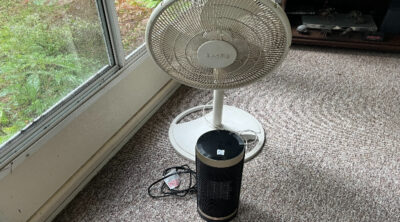
Would I have liked to opt for a bigger, most robust electric heat pump? Of course. But here’s why I chose as I did — necessity. I really had no other choice.
Amps, Volts, and Watts
So let’s start with the basics.
A 30 amp RV provides up to 3,600 watts (120V × 30A). Amps measure the current flowing through a structure’s wiring. Volts represent the pressure pushing that current. Watts tell the total power being consumed. The formula connecting them is: watts = volts × amps. Staying under total watt capacity is critical. Exceeding it trips the circuit breaker and cuts the power. Repeatedly pushing limits — especially on older models built before 2010 like mine– can cause heat buildup, voltage drop, and premature failure of compressors and electronic devices.
I didn’t know any of this before I purchased my summer place in 2019. I wanted to have a getaway that was relatively affordable and comfortable. I still love the convenience of having my own summer bungalow in the woods, but I do understand more now about the limitations of 30-amp service.
Experience informs me that my 30-amp modular home can run the refrigerator, television, and lights at the same time without problems. I can even methodically add in a small kitchen appliance like a toaster oven or microwave here or there. But, if I turn on the coffee pot at the same time that the portable electric heat is on in the Florida room — smack! The modular home goes dark.
Yes, strategies to stagger appliance usage help — shutting one off, turning on another. Good communication makes it possible. “I’m going to turn on the hot water heater,” I call out to the other room. “Is the Bolt still plugged in?”

Specific Workarounds for my Someday All-Electric Summer Digs
Here are some of my all-electric dreams and the subsequent electric realities.
Hot water: I won’t succumb to using propane for water heating instead of electric. But I did inherit an electric hot water heater option. I am also conscious that Connecticut has the third-highest average electricity price among the US states, after Hawaii and California. So I make adjustments. I consider heating water to be on-demand — if you want a shower, think at least a half hour prior. Turn it on, turn it off. Plan accordingly.
All-electric cooking? Not going to happen. The 30-amp service doesn’t begin to have enough juice for a 4-burner electric stove or its companion oven. But, not to be deterred, I studied up on induction stove tops over the previous winter. I chose a relatively affordable but well-recommended single burner, an induction-ready saucepan with lid, and a medium frying pan.
I’m very pleased with the induction stovetop’s fast and thorough heating. I’m not alone. Nearly all – 98% – say they are satisfied or very satisfied with their electric induction stove, compared with only 41% who feel that way about their gas stove.

Air conditioning: Connecticut in the summertime generally offers only a few hot days and refreshing breezes at night. Like many other summer homeowners here, central air is more rare than common. The 2026 summer patterns of extreme heat, however, have taxed even the most pragmatic persons. I open every window overnight to promote lighter air flow. I draw the blinds early in the day to moderate solar heating and turn on the oscillating fan. Most often, I sit outside next to the brook whenever possible, luxuriating in its cooling effect and breathing in the calm.
Plug-in Solar: I wish I could run out and buy what the state of CT is calling “portable solar.” However, the portable solar provision of the expected law isn’t scheduled to take effect until October 1, 2026. Not familiar with this option? What’s generally termed “plug-in solar” consists of modular, portable solar panels designed to be hung from a railing, such as a balcony or fence. They plug into an ordinary household electrical socket (though an assessment by a licensed electrician may be advised). Once plugged in, the solar panels integrate with household wiring to offset electricity demand from the grid. Next year, for sure! In the meantime, I’ve made progress toward all-electric summer living. It feels good.
References
“30 Amp vs 50 Amp RV: What you really need to know.” March 16, 2026.
“An elegant study shows how bad gas stoves are for your kids’ health.” Lloyd Alter. Substack. July 27, 2026.
“Electrifying mobile and manufactured homes: Challenges and emerging solutions.” Katey Beaton and Keith Cronin. Civic Well. November 6, 2025.
Sign up for CleanTechnica’s Weekly Substack for Zach and Scott’s in-depth analyses and high level summaries, sign up for our daily newsletter, and follow us on Google News!
Have a tip for CleanTechnica? Want to advertise? Want to suggest a guest for our CleanTech Talk podcast? Contact us here.
Sign up for our daily newsletter for 15 new cleantech stories a day. Or sign up for our weekly one on top stories of the week if daily is too frequent.


CleanTechnica uses affiliate links. See our policy here.
CleanTechnica’s Comment Policy