

Support CleanTechnica’s work through a Substack subscription, on Patreon, or on Stripe. Help us produce all of the high-quality, original content we publish week after week despite the challenges of content-scraping AI, antisocial media, inflation, and other hurdles.
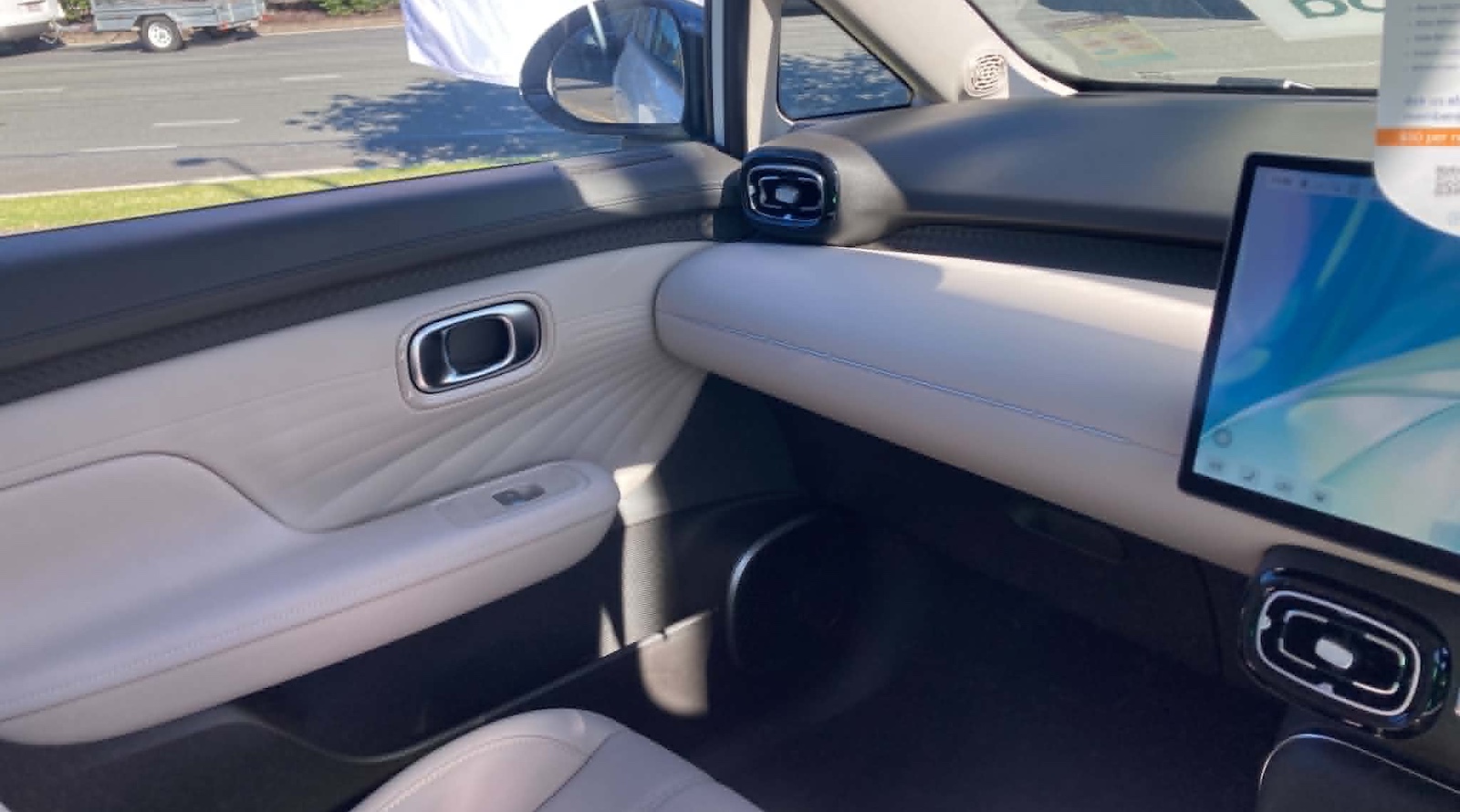
On our last adventure day to check out the Geely EX2 we managed to find a field of new GAC Aion compact electric cars. What a surprise! We couldn’t resist sitting in the one available, and Majella, of course, took lots of photos. Australia has gone from a dearth of affordable “small” EVs to a plethora. GAC has two cars in the Australian market — the GAC Aion UT (electric city hatch) and the GAC Aion V (midsize SUV). We were, unfortunately, unable to take a test drive.
GAC (Guangzhou Automobile Group) started life as Tongsheng Machining Plant in 1948. It is one of China’s largest state-owned automakers — selling over 2 million cars in 2021. GAC was the fourth largest Chinese carmaker at that time. It earned the nickname the “Chinese Toyota.” GAC currently has joint ventures with Honda and Toyota. Previously, GAC’s partners included Peugeot, Fiat, Chrysler, and Mitsubishi. GAC even partnered with BYD to make buses.
So, could GAC become a BYD killer. Possible, but not likely. Although GAC has the manufacturing capacity and scale to theoretically outsell BYD, GAC is behind BYD in the transition to electric vehicles. In China, the Aion V is called a Tyrannosaurus Rex. In 2025, GAC sold 0ver 310,000 vehicles in China alone. In Australia, GAC is ambitious and wants to be in the top ten brands for sales. GAC still has a long way to go.

But, the competition is heating up and seems to have moved from emphasis on acceleration and range to gimmicks and value for price! Do you remember all those Tesla vs [name any petrol muscle car] videos?
The media is framing the competition between similar EVs. The GAC Aion will compete for sales with the BYD Atto 2 and the MG4 Urban. GAC Aion sells for AU$32,000; same as the Atto 2 and the MG4 Urban. The Atto 1 still wins the prize for cheapest battery electric car at AU$24,000. But we are not so concerned about trying get EVs to compete with each other. What about a petrol equivalent?
According to CarExpert, EVs still have a little way to go before they can undercut the cheapest ICE vehicle on purchase price. I know, I know, total cost of ownership! In their April listing of the ten cheapest cars to buy in Australia, the petrol 1.2 L Kia Picanto wins, priced below AU$20,000. Though, the tech specs would certainly not stack up to the GAC Aion UT.
A quick google search reveals that the GAC Aion UT has a 60 kWh LFP battery providing a range of 430 km. Whereas the BYD Atto 2 offers 345 km and the MG Urban gives a range of 316 km. Well done, GAC. Though, as always, you have to take these range estimates with a grain of salt. GAC is being coy about its sales in Australia. The company is not yet reporting its sales numbers through the normal channel of the Federal Chamber of Automotive Industries (FCAI) for publication in the VFACTS database. Xpeng followed the same policy until recently.
Since the launch of the GAC Aion UT (electric city hatch) and the GAC Aion V (midsize SUV), GAC has expanded its dealerships to 30 locations across Australia. This indicates GAC’s Australian ambitions, and in the current fuel uncertainty, they will prove extremely popular.
In our brief visit to the GAC and Geely dealership, we were impressed with the design, the level of tech, and the quality of the build of the Aion. Although the field of cars (if you import them, they will sell) seemed mainly in boring colours, I have discovered that for a measly AU$600, you can get a “Classic Crimson vibrant magenta-leaning red.” For another AU$400, you can add a contrasting Rococo White roof. My kind of palette! And it has a five-star safety rating!

Of course, new owners have started a Facebook page and are comparing notes and helping each other navigate the transition from ICE. Everyone is sharing tips about navigating the on-screen menu and how to manage their charging needs. One comment: “Ok, day one of UT driving and I’m loving it! Gosh it’s a powerful little thing, it thinks nothing of accelerating up a hill like it’s not even there.”
Overall, the engineering gets praised, and the software comes in for some criticism. It appears that the Aion is a little too protective and tends to nag the driver for inconsequential breaches. The passenger crosses their legs, and a command comes to get your feet off the dashboard! And seatbelt warnings even when no one is sitting in the seat. Unusually, there appeared to be no complaints about connectivity. This has been a big issue in the past with other new models launched in Australia.
Majella and I were impressed by the fit and finish when we got to look at one in the metal.

The Facebook group was asked what they liked about the car, and the following responses were received: “I’ve almost forgotten how long it used to take my ICE car to heat up. No heat until the engine was warmed up and by then my hands lost all sensation.” And of course, the opposite from those living in the warmer parts of Australia:
- “The quick cool, or cooling before we even get in the car, will get a lot of use up here.”
- “Love the takeoff at the lights.”
- “No more going to the petrol station.”
- “I love driving it. It’s like a bubble on the road.”
- “It is cute and it’s such an easy car to drive (and handles well).”
- “Love saving so much money on fuel.”
- “Everything really! Love driving it, how quiet it is, the heated seats and steering wheel, the comfort, learning and using voice commands, there is so much. And after having it for 3 weeks, I’m still learning more about it.”
- “Love the moon roof.”
- “The soft ride, speed bumps no longer annoy me.”

Like any new brand coming to Australia (and we have seen this countless times), it takes time for the support ecosystem to be put in place. I am sure these deficits will be remedied as time progresses. New drivers are looking forward to a promised September software update.
Laura Berry of CarsGuide had the car for a week and put it through her normal driving experiences, covering about 250 km. Overall, she was impressed by the price, comparing it to the petrol Honda HR-V. Clever storage provision and plenty of cabin space led to a verdict of “more practical than many larger vehicles.” She was keen on the lack of physical buttons for climate control and media. (This is pretty much most cars these days. I’d hate to watch her try and drive my Tesla.) She found that the battery range estimate of 430 km was accurate.
Like the posters on Facebook, she found the frequent safety alerts a tad annoying. She also felt vulnerable driving on the highway surrounded by large trucks and SUVs. (My thoughts are that this would be true of anything midsize or smaller.) “There were times I wished we were in something larger and higher up,” she comments. Perhaps Laura would prefer the much larger GAC M8 people mover? (See below.) She thought that the Aion UT was not as good looking as Zeekr or some BYD models.

An interesting reaction by an Aion UT owner to Laura’s comments: “Cars twice the size as this are still every bit as vulnerable among trucks. Adding a metre of length and a tonne of mass won’t make a difference to your outcome if you and 20-tonne truck play bumper cars with each other.” And, on Australian highways, 20 tons is a small truck. Trucks travelling Australian highways generally weigh between 40 and 60 tons. (Thanks, Google.) Like Majella, this poster loves the design of the GAC Aion UT. We have plenty of choice now in Australia, and people can buy whatever appeals to them. Beauty is in the eye of the beholder.
More and more Chinese brands are entering the Australian market. No doubt they will all go through teething issues and yet do well. Facebook is doing a great job linking new owners with questions and those who have answers to give. Japanese brands with little to offer in the electric space are suffering, as are Stellantis brands (Fiat, for example). But, for the consumer, the future looks bright and electric!
Sign up for CleanTechnica’s Weekly Substack for Zach and Scott’s in-depth analyses and high level summaries, sign up for our daily newsletter, and follow us on Google News!
Have a tip for CleanTechnica? Want to advertise? Want to suggest a guest for our CleanTech Talk podcast? Contact us here.
Sign up for our daily newsletter for 15 new cleantech stories a day. Or sign up for our weekly one on top stories of the week if daily is too frequent.


CleanTechnica uses affiliate links. See our policy here.
CleanTechnica’s Comment Policy