

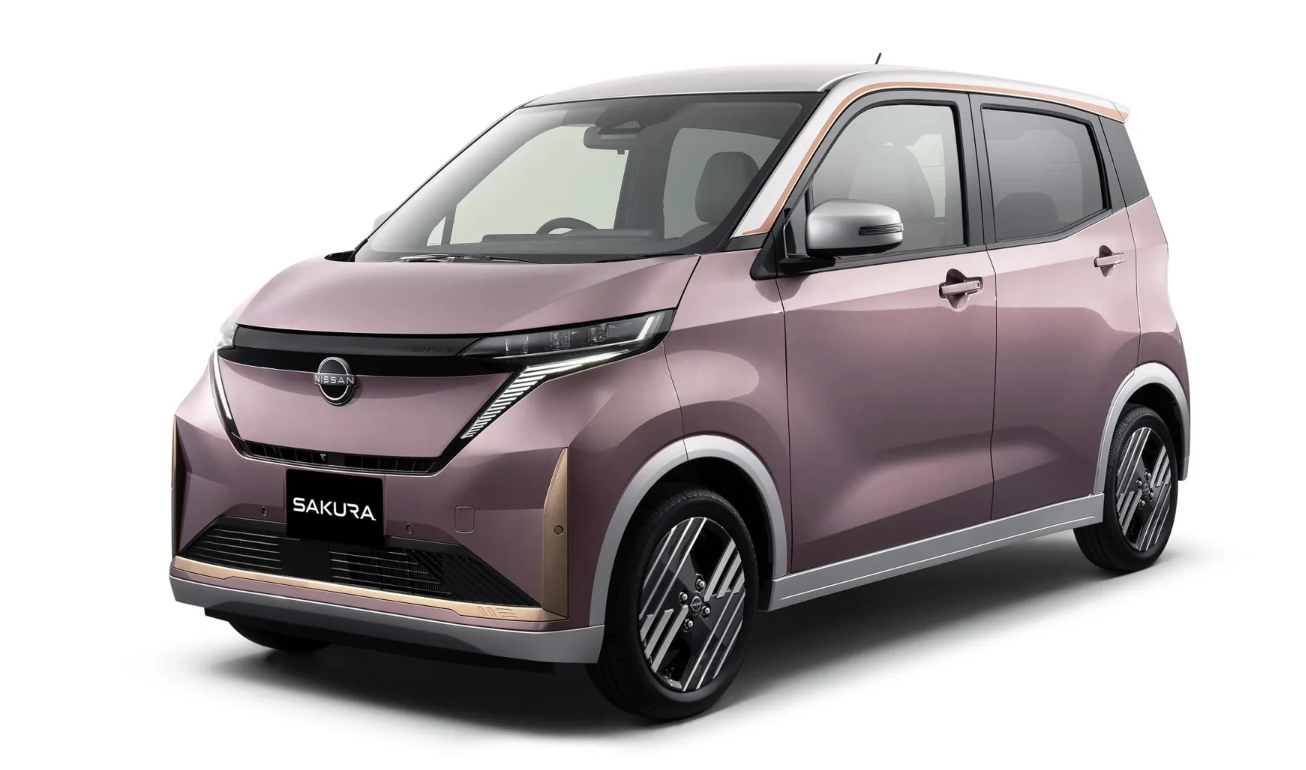
Four years into its run as the undisputed champion of the Japanese electric vehicle market, the Nissan Sakura is getting a mid-cycle refresh. The tiny kei car has single-handedly carried Nissan to the top of Japan’s EV sales charts since its 2022 debut, often accounting for nearly half of the entire battery-electric market in the country. Now, facing an inevitable wave of low-cost competition from Chinese manufacturers like BYD, Nissan is leaning into refinement to keep its crown.
The 2026 update focuses primarily on aesthetic updates and ergonomic fixes rather than mechanical overhauls. Up front, the Sakura drops its older textured dark grille panel in favor of a body-colored fascia that aligns its design language with the upcoming next-generation Nissan LEAF. Sharp vertical design elements on the revised lower bumper give the urban commuter a slightly wider, more assertive stance. Nissan is also introducing a flagship paint scheme called Minamono Sakura, which pairs a soft cherry blossom pink with a silver roof and copper accents.

Inside the cabin, Nissan addressed a few everyday usability complaints. The drive mode selector has been relocated to a more natural position, and an additional passenger-side cup holder has been added to the dashboard layout. For the mid-tier X trim, features that were previously locked behind options packages are now standard equipment. This includes the Intelligent Around View Monitor, heated front seats, and a heated steering wheel. Nissan also integrated an auto-lock and unlock function alongside a dedicated physical lock for the charging port.
Underneath the new bodywork, the mechanical footprint of the Sakura remains completely unchanged. Built strictly to Japan’s legal keijidōsha tax-saving bracket, the vehicle maximizes interior volume within a tiny footprint of 3,395 millimeters in length, 1,475 millimeters in width, and 1,655 millimeters in height. Curb weight stays between 1,070 and 1,090 kilograms depending on the trim level. Despite the diminutive exterior, the skateboard EV chassis allows for a roomy four-passenger cabin with a flat floor and 107 liters of cargo trunk space.

It continues to utilize a single MM48 front-wheel-drive electric motor assembly delivering 47 kilowatts, which translates to 63 horsepower, capping out exactly at the maximum legal limit for the kei class. Crucially, it provides 195 newton-meters of torque, ensuring immediate off-the-line acceleration that outpaces internal combustion equivalents. Power is pulled from a 20 kilowatt-hour laminated lithium-ion battery pack, delivering a range of up to 180 kilometers on the Japan WLTC cycle. While that figure appears low by Western standards, it perfectly aligns with the short daily commutes typical of Japanese urban centers. Equipped with standard AC charging for overnight home top-ups in approximately eight hours, it also supports CHAdeMO DC fast charging capable of raising the battery to 80 percent in roughly 40 minutes. It also features standard Vehicle-to-Load capability, allowing the vehicle to serve as a backup generator for Japanese homes during grid emergencies.
The Sakura is marketed in three primary tiers: the fleet-oriented S, the mainstream X, and the premium G. Higher-tier trims feature Nissan’s ProPILOT advanced driver-assistance systems, automated parking, a 7-inch digital gauge cluster paired with a 9-inch infotainment touchscreen, and premium interior fabrics utilizing copper accent detailing inspired by traditional Japanese craftsmanship.
The real strength of the Sakura remains its post-subsidy affordability. Base models start at 2,448,600 yen, which translates to roughly $15,400. Once national clean energy subsidies are applied, that price drops closer to 1.8 million yen, or roughly $11,800. This low barrier to entry is why the Sakura has managed to keep Japanese buyers loyal to domestic options, even as foreign alternatives begin to trickle into the market.
The historical sales data underscores this absolute dominance. In its launch year of 2022, despite only being on the market since May, the Sakura moved 21,887 units and instantly became the top-selling EV in Japan. The vehicle hit its peak sales volume in 2023 with 37,140 units, a year in which it also claimed the Japan Car of the Year award. While overall EV demand stabilized in 2024, the Sakura maintained market leadership with 22,926 units. Even with a broader contraction in the domestic battery-electric passenger car market in 2025, the Sakura recorded 14,093 sales for the year, securing its dominant lead over both domestic rivals, like the Mitsubishi eK X EV production twin and foreign entrants. Current year-to-date data for 2026 shows the model is firmly on track to hold the number one spot for a fourth consecutive year, bolstered by the arrival of the mid-cycle design refresh.
While the vehicle remains strictly a product for Japan and select right-hand-drive grey markets, its broader industry influence is growing. European regulators and automakers are increasingly studying the vehicle as a benchmark for small, ultra-efficient commuter platforms as they draft new guidelines meant to encourage lightweight, affordable, urban EVs.
