

Support CleanTechnica’s work through a Substack subscription, on Patreon, or on Stripe. Help us produce all of the high-quality, original content we publish week after week despite the challenges of content-scraping AI, antisocial media, inflation, and other hurdles.
Energy independence was an understandable slogan in Europe after Russia’s invasion of Ukraine sent gas and electricity prices through the roof. But it was also the wrong lesson. European countries had not erred by depending on one another. They had allowed too much of a critical energy supply to depend on one increasingly unreliable counterparty. The better objective is strategic energy interdependence: more trusted partners, more routes, more generation diversity and enough redundancy that losing one supplier or corridor is disruptive rather than destabilizing.
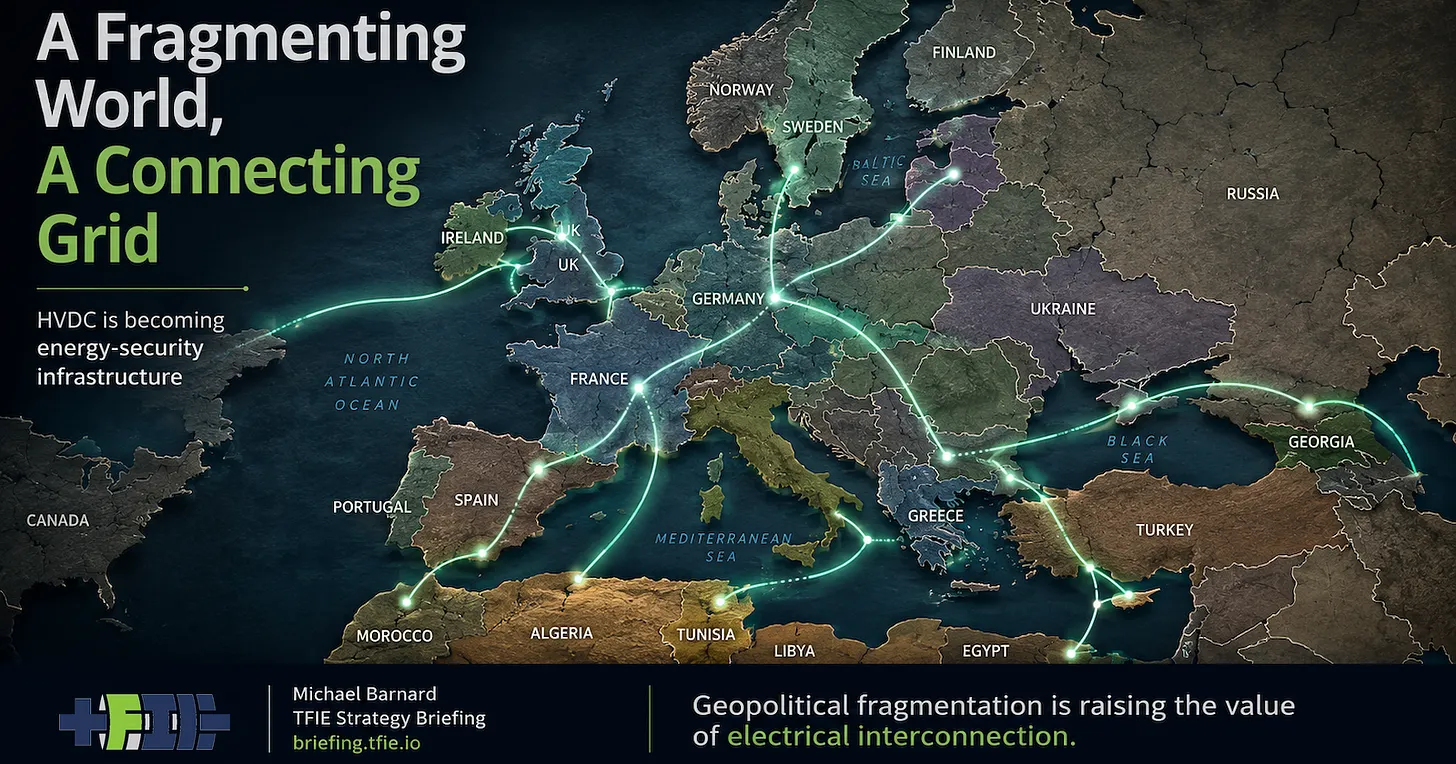
Four years later, the international HVDC pipeline provides a useful test. RTE International’s July 2026 inventory contains a substantial population of future voltage-source-converter projects, and filtering it for cross-national schemes produces about 60 prospective international links. Europe and its immediate neighbourhood dominate. If worsening geopolitics were pushing countries toward electrical autarky, cross-border transmission should be retreating. Instead, it remains a significant infrastructure category in the region where energy security has become most politically salient.
The Baltic-German PowerLink illustrates the point. Lithuania, Latvia and Germany are still advancing the project toward EU Project of Common Interest status after the Baltic states separated their electricity systems from the Russian sphere and while infrastructure security has become a major regional concern. The strategic context changed sharply, but the response has included more western electrical connection rather than retreat from it.
The project pipeline is much less uniform than the headline count suggests. The full TFIE Strategy Briefing follows which links are mature, which remain speculative, what is actually killing projects, and whether conflict exposure is changing development decisions.
An electrical interconnector creates a different dependency from a fuel pipeline. A gas pipeline or LNG terminal delivers value only as long as fuel keeps arriving, leaving the importer continuously exposed to commodity prices, supplier behaviour and the fuel market. An interconnector joins power systems that already contain generation, storage, demand and other connections. Electricity can generally move in either direction. Multiple links can expose a country to hydro, wind, solar, nuclear, storage and dispatchable generation across different jurisdictions and weather systems without removing domestic resources from the portfolio.
That distinction is increasingly showing up in policy. ACER now argues for stronger interconnection to support cross-border renewable use, reduce fossil-fuel dependence and improve flexibility and security. Britain’s Clean Flexibility Roadmap places international links inside a wider security-of-supply portfolio with storage and demand flexibility. Interconnection is no longer being described only as a way to arbitrage wholesale electricity prices.
Geopolitics is an additional source of value, not the sole explanation for the pipeline. Russia’s invasion did not cause every interconnector now expected in the 2030s. Offshore wind, renewable balancing, congestion, price differences, resource adequacy and market integration can justify HVDC links without geopolitical tension. Most large interconnectors also take many years to develop. The evidence supports a narrower conclusion: geopolitical shocks have added security and resilience value to infrastructure that often already made economic and decarbonization sense.
That does not mean every cable improves security. A single enormous interconnector can itself become a concentration risk. Subsea cables can fail or be attacked. Neighbouring countries can experience correlated weather. Domestic grid bottlenecks can prevent imported electricity from reaching demand. Strategic interdependence works when it is diversified: several counterparties, multiple routes, domestic generation, storage, flexible demand and enough internal transmission that losing one asset remains a contingency.
This portfolio logic is increasingly explicit. Britain describes interconnectors as one of several forms of clean electricity flexibility, while European analysis treats enhanced interconnection as a way to share flexibility across borders. The useful comparison is therefore not one cable versus one domestic generator. It is the cost and resilience of the wider system that would be required without the connection.
The important shift is not from dependence to independence. It is from concentrated, continuously replenished fuel dependence toward a broader and more reciprocal electricity portfolio.
The deeper analysis tests that argument against the 2026 cross-border HVDC inventory, project maturity and attrition, conflict-exposed cases, technology choices and the evidence that would prove the thesis wrong. Subscribe and read.
Sign up for CleanTechnica’s Weekly Substack for Zach and Scott’s in-depth analyses and high level summaries, sign up for our daily newsletter, and follow us on Google News!
Have a tip for CleanTechnica? Want to advertise? Want to suggest a guest for our CleanTech Talk podcast? Contact us here.
Sign up for our daily newsletter for 15 new cleantech stories a day. Or sign up for our weekly one on top stories of the week if daily is too frequent.

CleanTechnica uses affiliate links. See our policy here.
CleanTechnica’s Comment Policy