

Support CleanTechnica’s work through a Substack subscription, on Patreon, or on Stripe. Help us produce all of the high-quality, original content we publish week after week despite the challenges of content-scraping AI, antisocial media, inflation, and other hurdles.
Germany’s hydrogen industry finally has a demand number it can put in a headline: nearly 6 GW of paid reservations on the country’s emerging hydrogen core network. FNB Gas presented the reservations and customers’ willingness to pay as a strong indication that the hydrogen economy is gathering momentum. Six gigawatts certainly sounds like momentum. It sounds considerably less impressive once the number is unpacked.
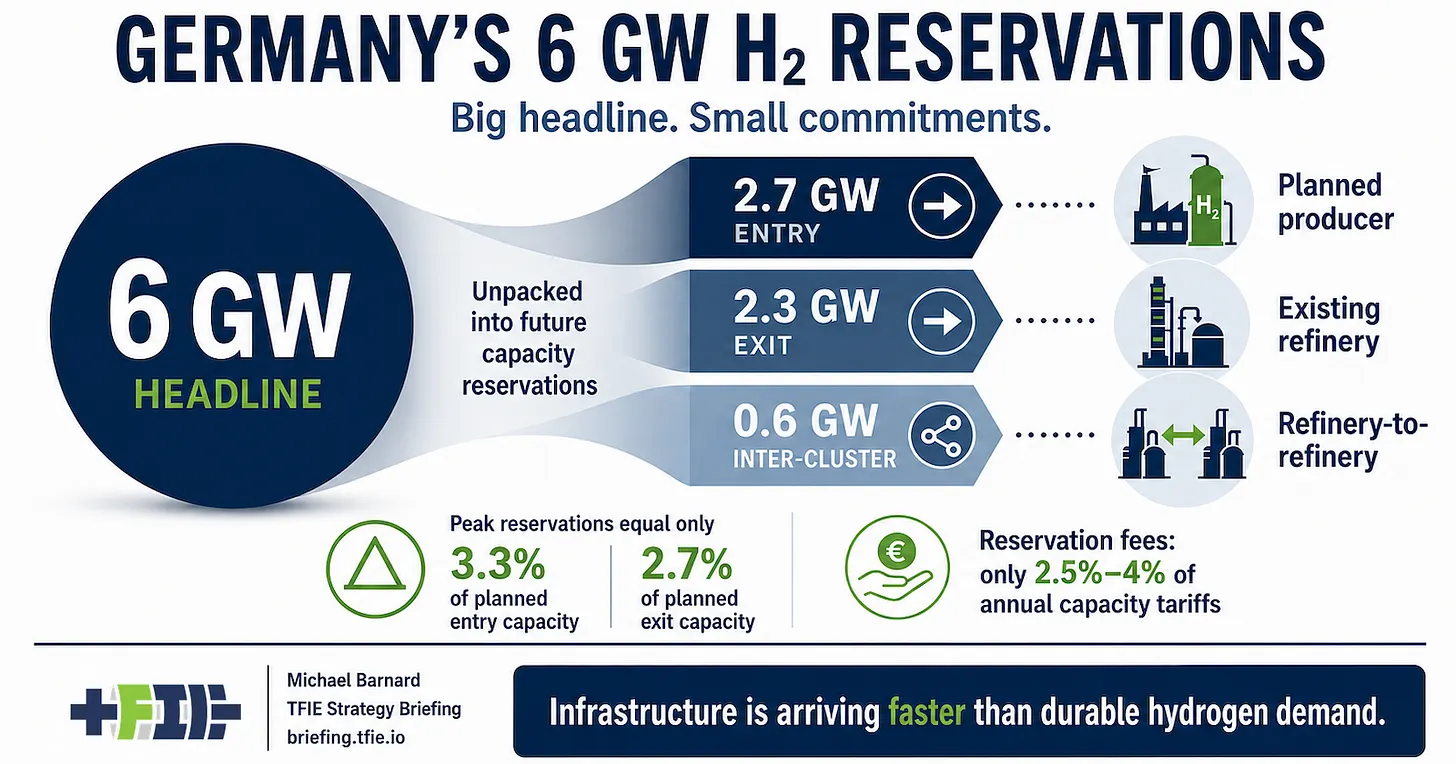
The headline combines roughly 2.7 GW of hydrogen entry reservations with about 2.3 GW of exit reservations, plus roughly 0.5–0.6 GW of inter-cluster transport capacity. Entry and exit are perfectly sensible categories for a pipeline operator, but adding them together does not measure hydrogen demand. Hydrogen injected into the network at one location and withdrawn at another can appear once as entry capacity and again as exit capacity.
That means the widely repeated nearly 6 GW figure does not represent 6 GW of hydrogen that German companies have committed to produce, buy or consume. It is a network-capacity accounting number being presented in a way that makes the underlying commercial commitment look much larger than it is.
The denominator makes the promotion harder to defend. Germany’s approved Hydrogen Core Network is planned to extend about 9,040 km, cost an estimated €18.9 billion and provide approximately 101 GW of entry capacity and 87 GW of exit capacity by the early 2030s. Against those design figures, peak reservations amount to roughly 3.3% of planned entry capacity and 2.6% of planned exit capacity.
Nobody should expect a new infrastructure network to be fully subscribed years before completion. Germany is deliberately building hydrogen pipelines ahead of demand to solve the familiar problem that customers will not commit without infrastructure while infrastructure cannot wait for mature customers before construction starts. Unfortunately, it’s building the infrastructure for a volume which will never materialize based on faulty premises.
The reservations themselves are also much weaker commitments than the headline suggests. They are not normal long-term pipeline-capacity contracts. ONTRAS allows customers to preserve access to future hydrogen capacity before the infrastructure is ready and decide later whether to convert the reservation into an actual booking.
The price for maintaining that option is correspondingly small. ONTRAS charges 2.5% of the applicable annual capacity tariff, while GASCADE charges 4%. Under some conditions the ONTRAS payments can later be credited against an actual booking.
TotalEnergies provides a useful example. It has reserved up to 500 MW of hydrogen withdrawal capacity for its existing Leuna refinery beginning around 2030. At the current regulated hydrogen ramp-up tariff, actually booking 500 MW for a year would cost roughly €12.5 million in capacity charges. Reserving the option costs about €312,500 a year.
For a major oil company trying to preserve strategic options around future hydrogen policy, supply and pricing, that is sensible corporate risk management. It is not remotely equivalent to TotalEnergies signing a long-term agreement to consume 500 MW continuously.
The single Leuna reservation also accounts for roughly 22% of Germany’s approximately 2.3 GW of exit capacity reserved around 2030. One existing refinery can therefore generate a remarkable amount of the apparent national hydrogen-demand story. As a reminder, refining fossil fuels is the largest demand sector for hydrogen today, about 40% of total global volumes.
And the identity of the customers is perhaps more revealing than the headline capacity. The publicly identifiable withdrawal reservations are concentrated in refineries and existing industrial hydrogen applications. These are places where pipelines can genuinely make sense: instead of producing hydrogen independently at every industrial plant, a network could connect producers and consumers, replace some captive fossil hydrogen production and make the remaining industrial hydrogen market more competitive.
That is a credible use of hydrogen infrastructure. It is also much narrower than the hydrogen economy used to justify infrastructure extending across Germany. And Germany already has appropriately scaled hydrogen pipelines for its core industrial sector covering hundreds of kilometers.
The industry has spent years promoting hydrogen for trucking, building heat, electricity storage, power generation and broad industrial combustion. The customers showing up with effectively pocket change today are the hydrogen market Germany already has: refineries and other industrial users that need hydrogen as a feedstock or process input.
That distinction is obscured when entry, exit and transport reservations are rolled into a 6 GW headline and described as evidence of hydrogen-economy momentum. The reservations are a useful signal, but what they signal so far is a comparatively small industrial market taking inexpensive options on a very large publicly enabled network.
Germany is building the oversized hydrogen backbone to create new demand in a non-existent hydrogen economy. The evidence available today does not demonstrate that. What it demonstrates is that hydrogen-network operators have found some credible industrial customers while the vast majority of the planned network capacity remains unreserved.
The full TFIE Strategy Briefing analysis examines the reservation economics, the identifiable customers, the infrastructure already available for hydrogen, and what Germany’s experience says about the much larger projected hydrogen market.
Read Germany’s 6 GW Hydrogen Reservations Are Options, Not Demand at TFIE Strategy Briefing.
Sign up for CleanTechnica’s Weekly Substack for Zach and Scott’s in-depth analyses and high level summaries, sign up for our daily newsletter, and follow us on Google News!
Have a tip for CleanTechnica? Want to advertise? Want to suggest a guest for our CleanTech Talk podcast? Contact us here.
Sign up for our daily newsletter for 15 new cleantech stories a day. Or sign up for our weekly one on top stories of the week if daily is too frequent.

CleanTechnica uses affiliate links. See our policy here.
CleanTechnica’s Comment Policy