
Domestic EV Policy Decides the Global Car Hierarchy: Why China & Thailand Are Pulling Ahead
Support CleanTechnica’s work through a Substack subscription, on Patreon, or on Stripe. Help us produce all of the high-quality, original content we publish week after week despite the challenges of content-scraping AI, antisocial media, inflation, and other hurdles.
By Ray Wills, Peter Newman AO, and Raphael Wellmann
China’s latest NEV plan makes one thing clear: the future global car hierarchy is being decided at home, not in export markets. Less expected is the rapid rise of Thailand, which is following China’s playbook with striking success.
Beijing’s new carbon‑peaking action plan requires new energy vehicles (NEVs) to reach 30% of the entire national fleet by 2030 — not just 30% of sales. That implies well over 100 million NEVs on Chinese roads, more than double today’s level. And the direction of travel is only hardening: China’s new 15th Five‑Year Plan explicitly calls for expanding the supply of NEVs, and Hainan has just become the first Chinese province to finalise a 2030 ban on new fossil‑fuel car sales, targeting 45% NEV fleet share. The point isn’t just climate: it locks in domestic scale, learning, and supplier depth that are already driving China’s rise as the world’s biggest car exporter, with EVs now accounting for a rapidly growing share of those exports.
Thailand, while a minnow in comparison, is following the same script. Its EV market has been transformed by Chinese manufacturers, especially BYD, which now dominates local EV sales and is building significant capacity in Rayong. Faced with domestic oversupply, Thailand has shifted its incentive scheme to explicitly reward exports, turning itself into an EV export base for ASEAN and beyond.
In both countries, domestic EV policy is not a side issue — it’s the foundation of industrial strategy – in this way, Thailand is moving into an elite club.
Two clubs of carmakers
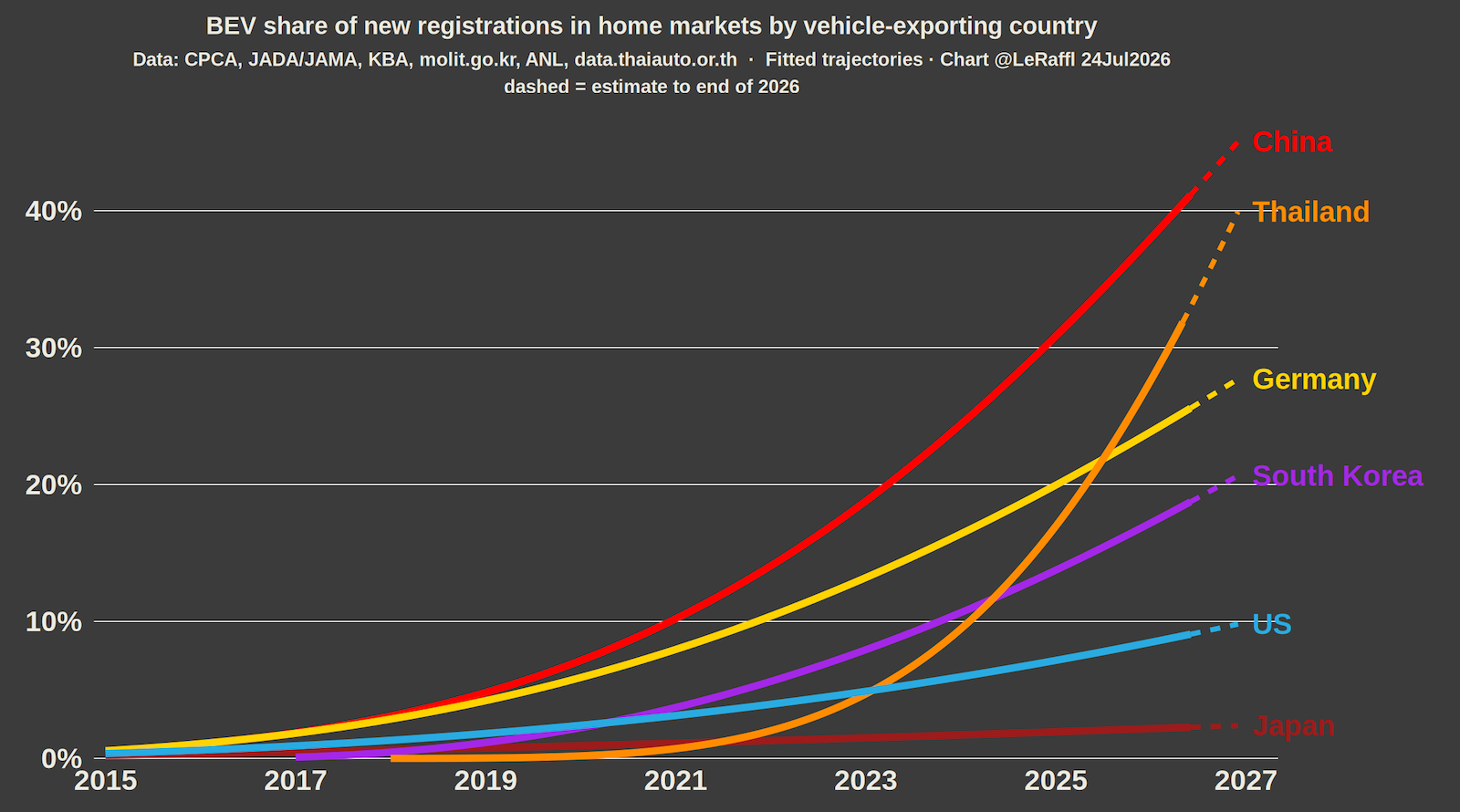
If you line up the major vehicle‑exporting countries and plot their share of new registrations that are battery‑electric at home, two distinct clubs emerge (Figure 1).
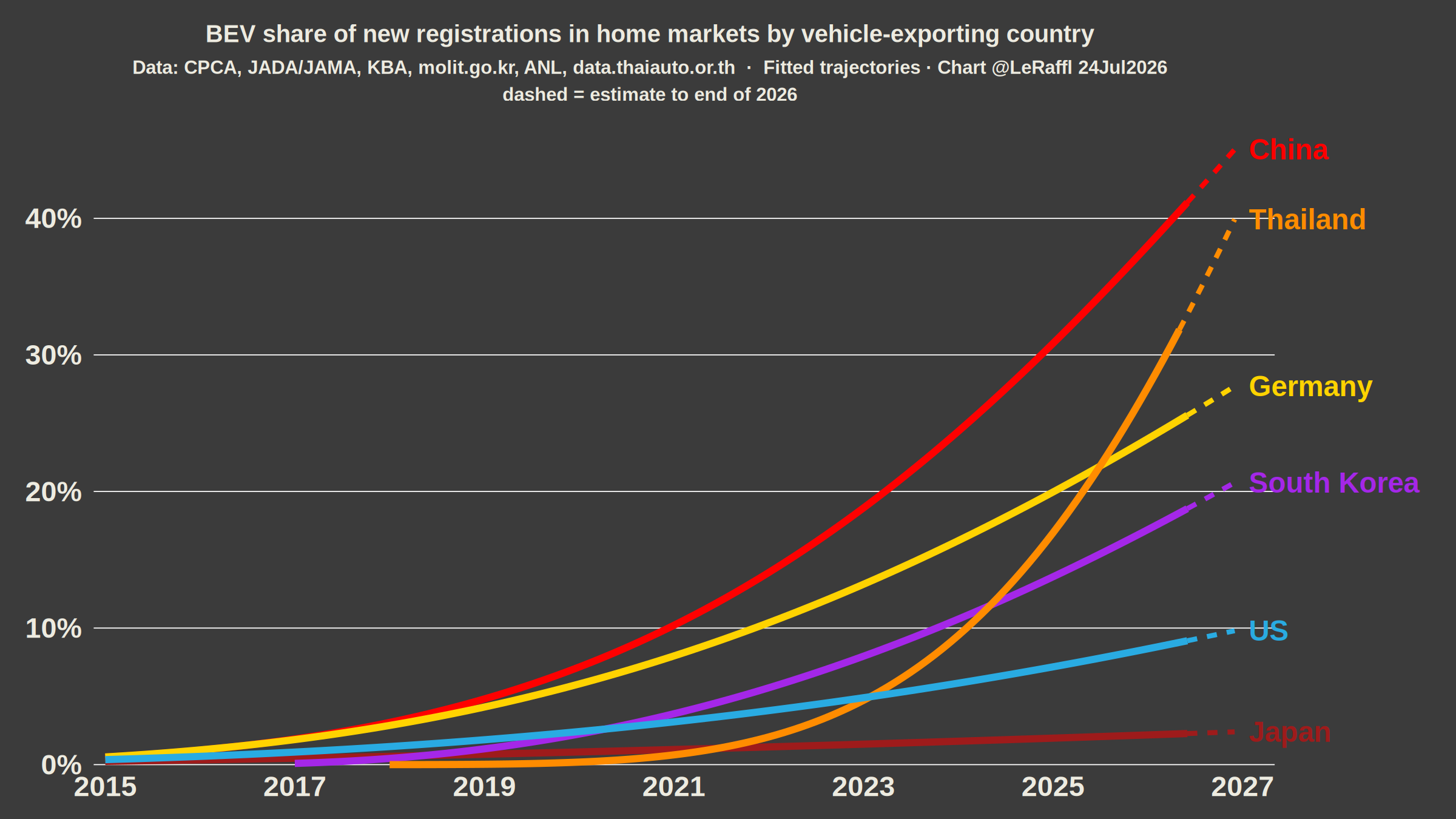
In the first club are the fast domestic EV adopters: China and Thailand — their charts show high and rising BEV shares of new registrations at home. These shares aren’t just numbers, they represent production runs, charging rollouts, component standardisation, and workforce retraining happening domestically. That domestic activity is what makes it possible to ship hundreds of thousands of EVs abroad.
In the second club are the incumbents who are slow or reluctant EV adopters: Japan and the US — with Germany and South Korea somewhere in the middle but improving — their domestic charts show much lower BEV shares and a long tail of hybrids and ICE sales. These countries still export vehicles, but the share of those exports that are pure EVs is modest, and the industrial learning curve is flatter because the domestic factory floor and showroom remain anchored in combustion.
The chart makes this divide brutally obvious. China and Thailand sit high on the chart; Japan and the US are stuck near the bottom; Germany and France hover mid‑range, slowly climbing.
Trajectories beyond 2030: who sails West to Valinor?
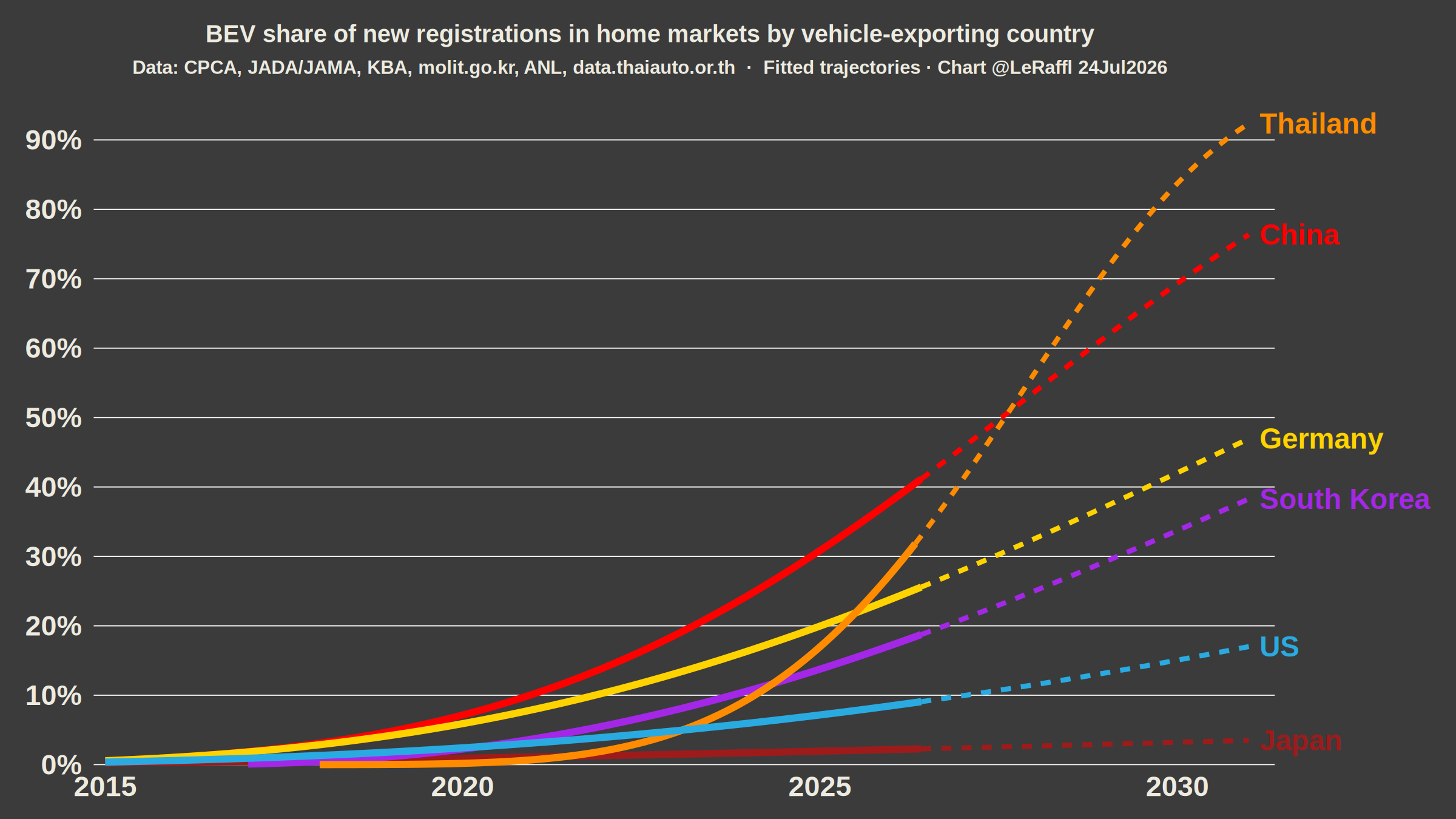
Project these trends forward five years to 2031 and the divergence becomes a chasm (Figure 2).
China and Thailand’s lines keep climbing aggressively toward near-total electrification of new registrations.
Meanwhile, Japan and the US rise only gradually, weighed down by a stubborn tail of ICE vehicles and a slow crawl from hybrids to full BEVs.
The lines for Japan and the US rise only gradually, weighed down by a long tail of ICE and a slow transition from hybrids to full BEV. Channelling Tolkien, incumbent car companies seem to have decided to “sail West to Valinor.”
It’s tempting to shrug this off because vehicle fleets turn over slowly. But they don’t turn over that slowly. Norway replaces roughly 5–7% of its fleet each year and went from ~30% EV sales share to near-total dominance within little more than a decade — with EVs now accounting for a disproportionate share of kilometres driven. When policy, infrastructure, and consumer behaviour align, transformation happens faster than sceptics expect — especially when oil vulnerability adds extra urgency.
Carmakers in China and Thailand are operating on what feels like a wartime footing. Their domestic environment forces rapid pivots in factories, R&D, supply chains, and workforce skills. Incumbents who keep delaying that shift at home are quietly surrendering their export competitiveness for the 2030s.
In Japan and the US, the domestic environment still allows incumbents to extend ICE’s lifespan and lean on hybrids, but the 2030s tell a different story: every year of delay is another year in which Chinese and Thai factories, software teams, and battery suppliers deepen their advantage.
Is domestic share the leading EV indicator?
China is already the largest car exporter, with EVs making up a rapidly rising share of those exports, and Thailand is repositioning itself from a Japanese‑centric ICE base to a Chinese‑led EV hub.
The scale of that export pivot has just become impossible to ignore.
In June 2026, China exported more than one million vehicles in a single month for the first time, and its new‑energy exports edged past its combustion exports — 523,000 NEVs against 514,000 conventional ICE vehicles.
For the first half of 2026, EV and plug‑in exports rose about 120% to 2.36 million units, a record 46% of all car exports. China’s widely reported 21% fall in car sales in the first half was a domestic figure only — registrations inside China — and it coincided with a 65% surge in exports. That is the signature of a maturing, planned, increasingly export‑oriented industry, not a collapsing one.
High and rising home-market uptake and export competitiveness evidently move together. Both are the result of new factories with robots, charging networks, supplier depth and consumer familiarity being built at scale. Incumbents, still dominated by ICE and hybrids, are deferring all those investments.
In households that own both an EV and an ICE car, people preferentially drive the EV, so electric vehicles capture a larger slice of kilometres travelled than of the fleet itself. In Norway, EVs make up around 32% of the fleet but closer to 38% of distance driven. Fuel displacement, and the demand signal that reshapes refuelling and servicing networks, therefore runs ahead of the headline registration numbers — which makes domestic BEV share an even stronger leading indicator than it first appears.
How has this EV dominance happened?
The pattern is not accidental, it’s the result of policy choices.
China has layered NEV mandates, city‑level restrictions on ICE, enormous charging investment, and now a fleet‑wide NEV target — reinforced by the 15th Five‑Year Plan and Hainan’s 2030 combustion‑car ban. Thailand has used its EV3.0 and EV3.5 schemes to attract Chinese investment and then explicitly shifted incentives toward exports. In contrast, the US and Japan have relied heavily on voluntary targets and consumer incentives, allowing hybrids and ICE to remain dominant domestically. The EU has moved further, with CO₂ standards and a clear phase‑out timetable, but its registration data still show heavy reliance on hybrids and plug‑in hybrids rather than a decisive BEV pivot.
The latest European figures make the point. In the first half of 2026, battery‑electric cars reached 21% of EU registrations, up from 16% a year earlier, but hybrids remained the largest single group at 37% and plug‑in hybrids added another 10%. That is genuine progress wrapped around continued hybrid dependence. Meanwhile Chinese brands captured a record 11% of the European market in June, roughly double their share a year earlier — a preview of what happens when domestic hesitation meets competitors who electrified at home first.
From a climate perspective, the message is straightforward: fast domestic electrification is the only credible path to cutting transport emissions at the pace required.
From an industrial perspective, the message is harsher: countries that drag their feet at home will find their car makers outcompeted abroad, even if those makers are household names today.
Future national vehicle hierarchy?
The future global car production hierarchy will be predictable based on the share of new registrations that are fully electric in the home markets of exporting countries.
China and Thailand are already on the path to dominance by this measure. Europe is caught in the middle, progressing but not yet moving at the speed its industry claims. Japan and the US are still hoping that incremental change and hybrids will be enough.
The future global car production hierarchy will be decided by who electrifies their home market fastest.
China and Thailand have chosen the winning path.
The question for Japan, the US, and Europe is whether they will adapt in time — or watch their industrial legacies erode.
Professor Ray Wills is Managing Director of Future Smart Strategies and an adjunct professor at The University of Western Australia, working at the intersection of electrification, regional energy sovereignty and industrial transformation.
Professor Peter Newman AO is Professor of Sustainability at Curtin University and a former Coordinating Lead Author for transport with the IPCC, recognised for coining the term “automobile dependence” and for his contributions to sustainable transport and urban design.
Raphael Wellmann is a data analyst specialising in global electric‑vehicle markets, maintaining a multi‑country database of BEV registrations and trajectories across Europe, North America, China and emerging regions.
Sign up for CleanTechnica’s Weekly Substack for Zach and Scott’s in-depth analyses and high level summaries, sign up for our daily newsletter, and follow us on Google News!
Have a tip for CleanTechnica? Want to advertise? Want to suggest a guest for our CleanTech Talk podcast? Contact us here.
Sign up for our daily newsletter for 15 new cleantech stories a day. Or sign up for our weekly one on top stories of the week if daily is too frequent.


CleanTechnica uses affiliate links. See our policy here.
CleanTechnica’s Comment Policy