

Support CleanTechnica’s work through a Substack subscription, on Patreon, or on Stripe. Help us produce all of the high-quality, original content we publish week after week despite the challenges of content-scraping AI, antisocial media, inflation, and other hurdles.
Swaptopus is easy to misread as a quirky name for another electric-truck infrastructure project. It is a newly formed joint venture between Octopus Energy and CATL, created to develop automated battery-swapping hubs for heavy trucks across Europe. Octopus is a UK-founded energy and technology group whose activities span electricity retail, renewable generation, energy trading and the Kraken software platform used to manage customers and flexible energy assets. CATL is the world’s largest electric-vehicle battery manufacturer, with a 39.2% global power-battery market share in 2025 and large businesses in stationary storage and battery swapping.
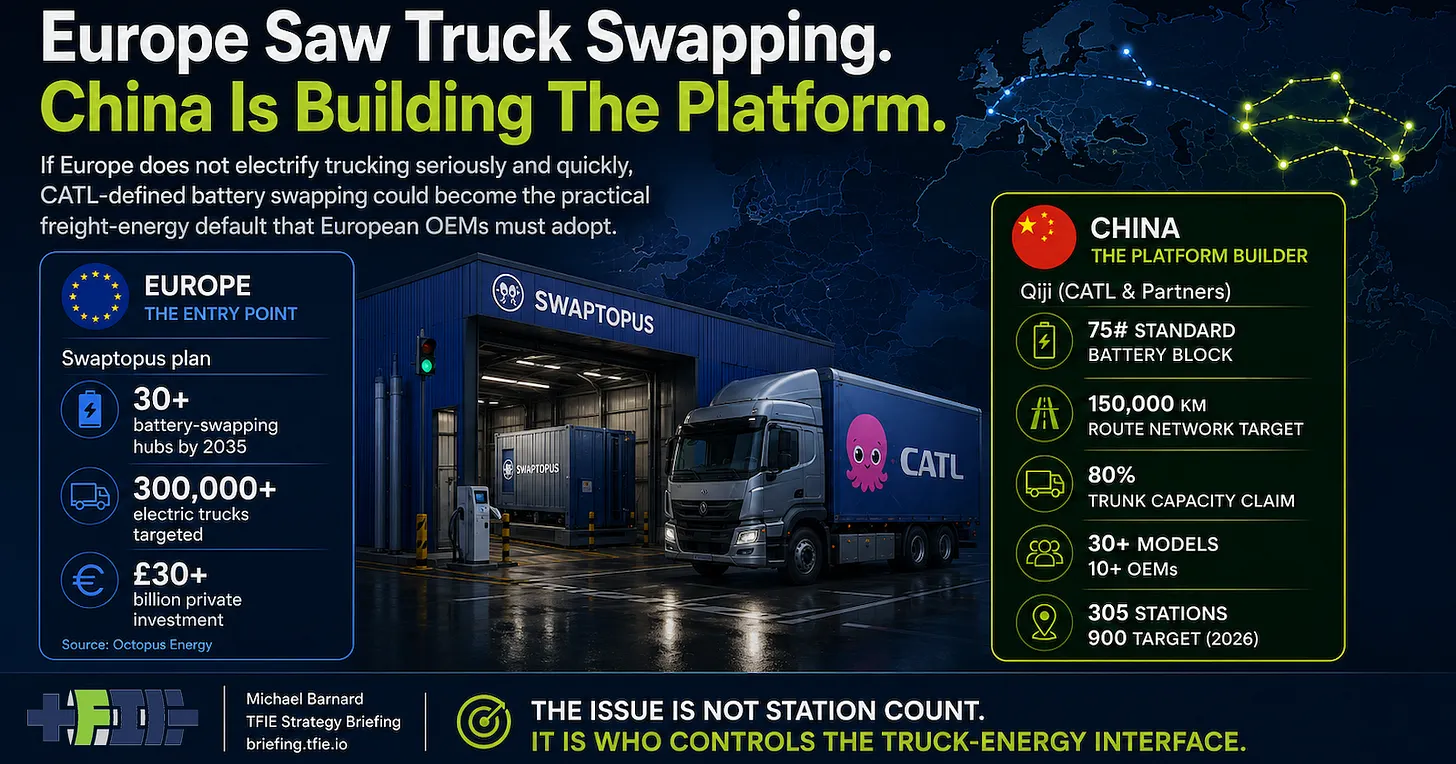
The combination is more consequential than either company announcing a pilot on its own. CATL brings batteries, standardized swapping equipment and operating experience from China. Octopus brings European electricity supply, trading, flexibility management, customer relationships and software. The joint venture says its first UK hubs will open in 2027, with more than 30 planned across Europe by 2035. It claims the eventual network could support more than 300,000 trucks and attract over £30 billion in private investment, although “support” should be read as an ecosystem-reach ambition rather than a claim that 30 sites will exchange the batteries of 300,000 trucks every day.
The relevant Chinese precedent is Qiji, CATL’s heavy-truck battery-swapping platform. Qiji combines standardized battery blocks, swap machinery and a cloud control layer. CATL is trying to make the battery block the common object around which truck chassis, stations, battery inventories and operating systems are designed. Its European joint venture gives that model an entry point into a market where charging regulation is advancing faster than truck-energy platform design.
Sinopec is part of the Chinese story, although it is not part of the Swaptopus joint venture. The state-owned energy and petrochemical group is China’s largest supplier of refined petroleum products and operates more than 30,000 service stations. It has been adding charging and battery-swapping facilities to that estate and has a strategic agreement with CATL covering energy storage, passenger-vehicle swapping and possible commercial-vehicle swapping at integrated energy stations. In China, Sinopec contributes sites, infrastructure operations and the logic of a national refuelling network. In Europe, Octopus brings a different but complementary set of capabilities around electricity procurement, flexibility, trading and software.
China’s policy environment also gives Qiji a more favourable starting point than a stand-alone corporate experiment would have. Its 2030 implementation plan calls for new-energy heavy trucks to reach 40% of sales, a stock of more than 1.6 million vehicles, roughly 3,000 heavy-truck charging and swapping stations and 30,000 kilometres of zero-carbon freight corridors. As I examined in China Just Made Electric Trucks A Freight System, Not A Vehicle Category, the policy connects vehicles to corridors, depots, service areas, grids and freight use cases instead of treating sales targets as sufficient.
That matters because battery swapping has a narrow but credible operating fit. Freight operators often run repeated routes between ports, factories, distribution centres and logistics hubs. Those patterns provide known traffic, known stopping points and relatively predictable electricity demand. A swap hub can be placed around an existing freight flow instead of hoping that enough unrelated trucks eventually pass through.
The battery standard is central to the strategy. CATL calls its heavy-truck format the 75# block, but the designation is not a public statement of its energy capacity. CATL has not disclosed the block’s dimensions, weight or usable kWh in the cited release. Octopus refers separately to swapping a roughly 500 kWh truck battery. One source suggested three 171 kWh blocks. The strategic claim is that a repeatable block can shape the chassis connection, station mechanics, battery inventory, state-of-health records, maintenance procedures, leasing and dispatch software.
This extends an argument Rish Ghatikar and I made in The New Logistics: Electrifying Freight With Microgrids. Electric trucks are becoming technically straightforward; supplying large amounts of electricity at the sites and times freight operators require is the harder problem. Our report favoured modular, grid-aware infrastructure that could be repeated and expanded in increments rather than bespoke charging projects at every depot. Qiji applies that logic below the site level. The candidate modular unit is the battery block, with the station, inventory and software organized around it.
CATL says Qiji supports more than 30 chassis-swap models from over ten truck manufacturers. It reported 305 commercial or truck swap stations built by the end of 2025, is targeting 900 during 2026 and describes a route network reaching 150,000 kilometres by 2030. Those figures show industrial coordination, investment and ambition. The operating evidence that would make the commercial case persuasive—swaps per day, battery stocks, uptime, queues, grid use and station-level economics—has not yet been published at comparable scale.
A swap station does not avoid charging. It moves charging away from the truck’s dwell period and into a managed inventory of batteries. That can improve vehicle utilization, but it requires more battery capital at the station, enough grid capacity to recharge the inventory and software that schedules charging around truck arrivals, electricity prices and battery condition.
This can be commercially attractive where trucks are highly utilized and delays are expensive. A carrier may also be able to buy or lease the truck separately from the battery, lowering the initial vehicle price and moving battery degradation and residual-value risk to a specialist owner. The same separation can create contractual complexity around warranty coverage, insurance, access rights, state-of-health calculations and what happens when a carrier changes routes or truck brands.
The practical comparator is well-designed depot and corridor charging, not a truck waiting beside an undersized charger for several hours. Megawatt charging, larger batteries, managed depot loads and scheduled driver breaks will serve much of the long-haul market without requiring the vehicle and battery to be separated. Charging avoids maintaining interchangeable battery inventories, while swapping can preserve truck uptime on routes where the additional equipment and battery capital are used frequently enough.
Europe already has serious foundations for that charging pathway. Its heavy-duty vehicle CO₂ regulations, Alternative Fuels Infrastructure Regulation, battery rules, battery-passport requirements and megawatt-charging work are pushing manufacturers and infrastructure providers toward electric freight. The risk is that regulators focus on the plug and vehicle while the commercial centre of gravity moves into the battery and operating platform.
Battery swapping does not have to replace charging across the European truck market for that to matter. It only has to become attractive on enough high-volume, defined routes that large fleet operators begin requiring compatibility. European truck manufacturers could then find themselves adapting their chassis to a battery block, station interface and data architecture established by CATL and Swaptopus.
That is a different competitive problem from importing a battery cell. An OEM can source cells from several suppliers while retaining control of the vehicle architecture, customer relationship and service model. A platform that combines the battery, lease, health data, station access and route-energy software reaches further into the truck manufacturer’s role.
European regulators should therefore decide which interfaces need to remain open before fleets build operations around long-lived commercial arrangements. Battery-health records should be portable. Station access rules should prevent unreasonable discrimination. Battery leases and warranties should survive changes in fleet operator or vehicle brand. Insurance and residual-value methods should be transparent enough that customers understand which risks they are transferring and which they retain.
The system may also become an electricity-market asset. Octopus says the battery inventory at Swaptopus hubs could charge and discharge in response to grid conditions, using its Kraken software to operate the sites as virtual power plants. That is plausible in principle, but freight operations must remain the first design constraint. A battery needed for the morning truck peak cannot simultaneously be promised as dependable evening grid capacity unless inventory, contracts and dispatch rules account for both obligations.
The same infrastructure-first pattern is visible in other Chinese freight sectors. On the Yangtze, electric vessels, containerized batteries, port charging and grid connections are beginning to form an operating corridor rather than a series of isolated vessel demonstrations, as discussed in The Yangtze Is Turning Battery Freight Into Infrastructure. China’s advantage is not that every announced project succeeds. It is that repeated hardware, large manufacturers, infrastructure owners and policy direction are increasingly being assembled into deployment systems.
Qiji and Swaptopus still have material questions to answer. High station utilization could expose grid constraints. Low utilization would leave expensive batteries sitting idle. Degradation, maintenance, lease pricing, insurance and residual-value assumptions could weaken the economics. Proprietary control might accelerate early deployment while limiting later competition and customer choice.
The evidence supports taking the platform seriously without assuming that its business case is settled. CATL has the battery scale, Qiji has a coherent technical architecture, Sinopec provides unusually strong infrastructure conditions in China and Octopus gives the European joint venture credible energy and software capabilities. The remaining proof is operational: whether trucks use the hubs heavily, the batteries cycle economically and the commercial terms remain attractive once the early deployment phase is over.
Europe does not need to copy Qiji or make swapping its preferred freight technology. It does need to recognize what Swaptopus is. This is not simply another place to put energy into an electric truck. It is an attempt to define the relationship among the truck, battery, station, fleet operator and electricity system.
The full TFIE Strategy Briefing pathway review, Europe Saw Truck Swapping. China Is Building The Freight-Energy Platform, separates official policy evidence, CATL claims and TFIE inference. It also examines the Qiji architecture, battery-inventory economics, market-control risks and the operating evidence that would change the assessment.
Sign up for CleanTechnica’s Weekly Substack for Zach and Scott’s in-depth analyses and high level summaries, sign up for our daily newsletter, and follow us on Google News!
Have a tip for CleanTechnica? Want to advertise? Want to suggest a guest for our CleanTech Talk podcast? Contact us here.
Sign up for our daily newsletter for 15 new cleantech stories a day. Or sign up for our weekly one on top stories of the week if daily is too frequent.

CleanTechnica uses affiliate links. See our policy here.
CleanTechnica’s Comment Policy