

Support CleanTechnica’s work through a Substack subscription, on Patreon, or on Stripe. Help us produce all of the high-quality, original content we publish week after week despite the challenges of content-scraping AI, antisocial media, inflation, and other hurdles.
Just a few years ago, the US Department of Energy projected that offshore wind farms will soon beat coal and natural gas on the cost of power generation. Too bad US President Donald Trump bullied the US offshore wind industry into a state of near-morbidity. Still, he can’t do anything to stop activity on a global scale. That includes shipyards around the world, which have mobilized to build a new fleet of offshore construction vessels aimed at driving costs down while speeding up deployment.
Offshore Wind And The Service Vessel Difference
When the global offshore wind industry first emerged in the early 2000’s, it relied on construction vessels and equipment commonly used in the oil and gas industry. The practice layered expense and complexity onto wind projects, but that’s all they had at the time. When shipyards began to build specialized vessels designed around the specific needs of offshore wind farms, costs began to come down.
Now that the size of offshore turbines and foundations has increased, a new generation of SOVs (service operation vessels) is needed, to ferry the supersized loads out to the site,and fix them in position as quickly and efficiently as possible (see more SOV background here).
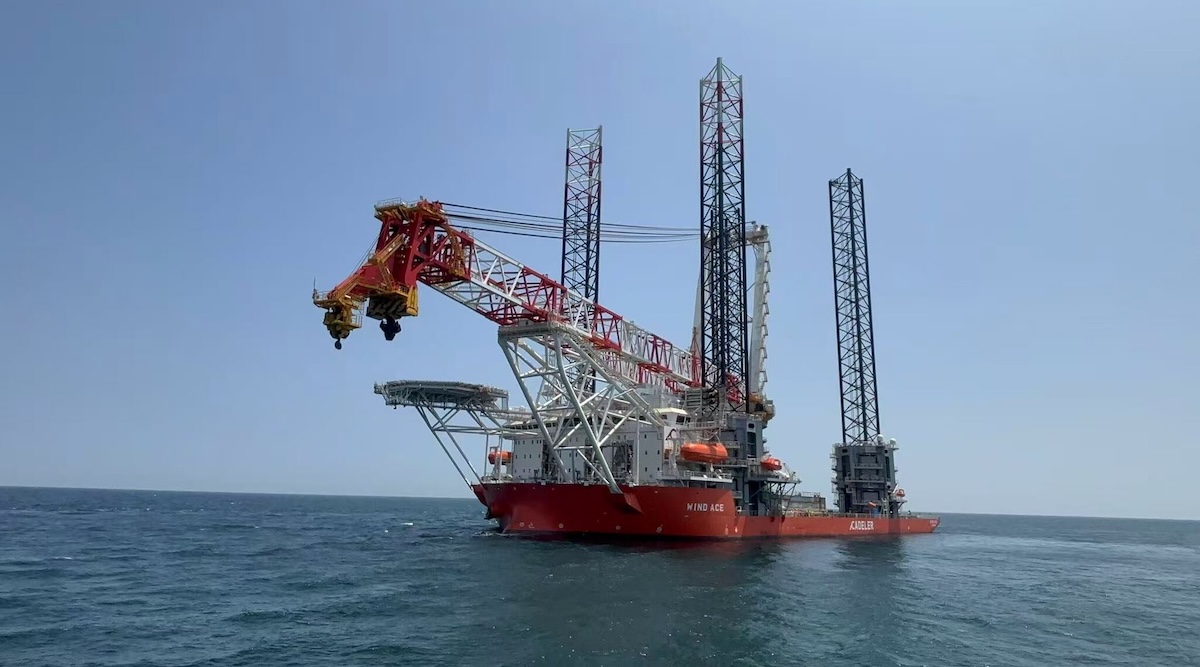
The latest news in that space comes from the Chinese shipyard COSCO in Qidong, which has just put the finishing touches on the new Wind Ace wind installation vessel, commissioned by the Danish offshore wind specialist Cadeler.
Cadeler describes itself as the owner and operator of the largest fleet of jack-up offshore wind vessels in the world, with jack-up referring to the heavy-duty cranes used to install offshore wind turbines. In a press announcement dated July 17, Cadeler also notes that Wind Ace is the second new A-class vessel in its fleet, purpose-built for installing XXL wind turbines as quickly as possible. “As turbines and foundations grow larger and projects become more complex, our clients need full-scope installation partners with the capabilities to deliver safely and reliably,” explains Cadeler CEO Mikkel Gleerup.
“The vessel’s hybrid design provides the flexibility to efficiently perform both foundation and wind turbine installation scopes, supporting the increasing scale and complexity of offshore wind developments,” the firm elaborates.
Cadeler does not intend for grass to grow under the feet of Wind Ace. After all, the global wind industry is very busy. “Following mobilisation, Wind Ace will prepare for deployment on ScottishPower Renewables’ East Anglia TWO offshore wind farm in the UK,” Cadeler affirms, adding that the job demonstrates it ability to both transport and install the 64 wind turbines and their foundations that make up East Anglia TWO.
Including Wind Ace, Cadeler counts 11 vessels in its fleet, and a 12th is already on its way. The company expects delivery of its third A-Class vessel, Apex Wind, next year.
Offshore Wind Is Coming For Your Fossil Fuels
Globally, the cost of offshore wind is already pushing up against new coal and natural gas power plants, based on a LCOE (levelized cost of energy) calculation designed to compare costs among widely disparate energy resources.
“Offshore wind just crossed a critical threshold: in 2026, new projects are achieving $40-50/MWh LCOE-competitive with natural gas and cheaper than new coal,” declared the data analytics firm Energy Solutions Intelligence last December, based on an analysis of 247 projects in 18 different countries. ESI also took note of the emergence of supersized, 18-megawatt wind turbines. That’s a great leap forward from just 10 years ago, when the first five commercial-level offshore turbines were commissioned in the US at only 6 megawatts each.
The ESI report tracks with the “FORCE” open-source wind project cost forecaster launched by the US Department of Energy in 2023. “The FORCE model estimates that the average levelized cost of energy, or the lifetime cost of a power plant divided by its overall energy production, could decrease from $75/megawatt-hours (MWh) in 2021 to $53/MWh in 2035 for fixed-bottom offshore wind energy,” DOE reported, with fixed-bottom referring to the monopiles used to construct wind farms in relatively shallow waters.
DOE also anticipated an even more dramatic reduction in the cost of new floating wind turbines, which enable projects to extend into deeper waters where sinking a monopile into the sea floor is impractical if not impossible. According to the FORCE model, floating turbine project costs would decline from $207/MWh to $64/MWh in 2035.
What Else Is Pushing Down Costs?
In addition to cost-shaving with bigger turbines and more efficient construction vessels, wind stakeholders have also focused attention on operations and maintenance costs. According to one estimate, O&M accounts for almost 33% of the per-kWh cost of offshore wind.
Cutting the cost of O&M was the focus of the UK’s “HOME” (Holistic Operation and Maintenance for Energy from Offshore Wind Farms) consortium, launched in 2020 with the aim of improving cross-industry collaboration. The areas of concentration included advanced sensors and machine learning to predict potential trouble spots before they cause trouble.
Robotics also played a large part in the effort. As calculated by the consortium, the cost of labor — including worker transportation at sea — accounts for up to 80-90% of offshore O&M costs, making a strong case for robotics. “In addition to investigating robots beneath the waves (to assess subsea structures such as cables), aerial robots (to assess the state of turbines), and robots within the electrical structures (such as offshore substations), the project explored communication, robot design, sensor, and structural problems,” the consortium leader, University of Manchester, summarizes.
UM notes that the HOME project pioneered new subsea cable sensing technology, drone-based turbine maintenance systems, and substation inspection data retrieved by mobile robots in real time.
Another collaborative project, called FLOW for Far and Large Offshore Wind, features an online maritime weather dashboard developed by the Dutch firm Deltares. The dashboard deploys on-site buoys alongside other sensors to give wind farm operators a precise two-day planning window for each individual turbine visit, including wind speed, wave height, and current.
Of particular interest is a 2024 report by the firm DNV, which concluded that early investments in the offshore wind supply chain and infrastructure could support a decrease in costs of up to 14% for future projects.
Too bad Trump flushed that all down the toilet. Upon taking office last year he suspended the federal offshore lease program and attempted — ultimately, with no success — to stop leased offshore projects that were already at or near the construction phase, upending the entire domestic offshore wind supply chain in the process. Last year the Trump administration also clawed back funding for 12 seaport improvement projects in support of the offshore industry.
More recently, Trump has also bought out (some say bribed) other offshore lease holders. That, too, may ultimately prove fruitless as a coalition of coastal states has taken the matter to court.
Trump Vs. China
Circling back around to China, President Trump suddenly evoked China in his 2020 election conspiracy theory during a prime time speech to the nation on July 16. Why? Who knows! Perhaps he was somewhat peeved by China’s leadership role in the global wind industry. Regardless of the reason, nobody was fooled. ABC and NBC declined to air the speech live, having been forewarned that the topic would turn once again to false allegations of election fraud, about which Trump has been bleating incessantly for going on six years now.
Trump’s latest pet media project, CBS, wasn’t buying it either. CBS aired only part of the show live, following a disclaimer that the President is, in effect, lying. As of July 18 CBS was still enthusiastically debunking, in lavish detail, Trump’s claims of voter fraud.
When you’ve lost CBS…
Image: The global offshore wind industry is taking advantage of new cost-cutting technologies and a new generation of offshore construction vessels that can handle today’s supersized turbines (courtesy of Cadeler via LinkedIn).
Sign up for CleanTechnica’s Weekly Substack for Zach and Scott’s in-depth analyses and high level summaries, sign up for our daily newsletter, and follow us on Google News!
Have a tip for CleanTechnica? Want to advertise? Want to suggest a guest for our CleanTech Talk podcast? Contact us here.
Sign up for our daily newsletter for 15 new cleantech stories a day. Or sign up for our weekly one on top stories of the week if daily is too frequent.

CleanTechnica uses affiliate links. See our policy here.
CleanTechnica’s Comment Policy