

Support CleanTechnica’s work through a Substack subscription, on Patreon, or on Stripe. Help us produce all of the high-quality, original content we publish week after week despite the challenges of content-scraping AI, antisocial media, inflation, and other hurdles.
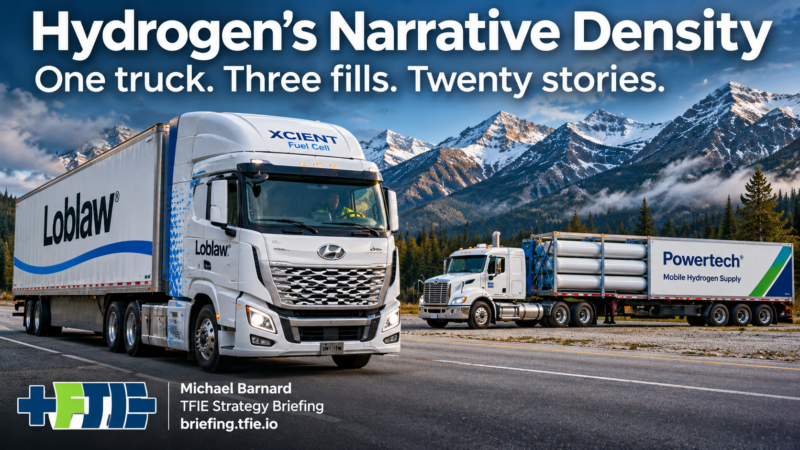
Loblaw’s Hyundai XCIENT hydrogen fuel-cell truck crossed the Canadian Rockies from Vancouver to Calgary on November 18. The 1,046 km journey attracted enthusiastic coverage as a Canadian heavy-freight milestone. It also illustrated an infrastructure problem that gets much less attention than a successful crossing: the hydrogen had to be brought to the truck.
The Edmonton Region Hydrogen Hub announcement describes three fuelling occasions. The truck started with a fill at HTEC’s Vancouver hydrogen station, then refuelled at Sicamous and Golden from a mobile tube trailer supplied by Powertech. Other project partners arranged the trailer’s transportation and logistics. The tractor hauling the mobile fuel was almost certainly diesel-powered. The public account did not include that support truck’s fuel consumption, emissions or cost.
The hydrogen truck completed the trip, and the project partners demonstrated that a mobile hydrogen supply operation could support a freight vehicle across the mountains. Those are achievements, albeit not novel ones. A fleet operator considering hydrogen needs a more demanding result: dependable places to refuel on repeated journeys, delivered hydrogen prices, vehicle availability, maintenance requirements and the complete cost of the support system. Moving a fuel trailer between planned stops is not the same thing as operating a commercial refuelling corridor.
The three fills also complicate the familiar argument that hydrogen offers heavy trucks a decisive range advantage. Hyundai’s fuel-cell truck has marketed range specifications, but the crossing did not establish that range advantage against battery-electric heavy trucks. Battery trucks had completed demanding Alpine journeys years earlier, and commercial electric freight operations have progressed since then. The comparative distances, energy stops and subsequent operating evidence are important when evaluating what this latest event contributed.
There is a second question about what happened after the official announcement. In the TFIE Strategy Briefing assessment, I reviewed a bounded sample of news reports and social posts from the week after the journey. The press generally included the mobile refills. The promotional accounts circulating on social media were much more likely to celebrate the distance and mountains while leaving out the operation that supplied the fuel.
That difference matters. A photograph of a truck crossing a mountain pass makes an effective announcement. Refuelling arrangements, energy costs and repeatability are harder to compress into a congratulatory post. As the story travels, a demonstration can start to resemble a commercially proven transport system even when the fundamental business questions remain unanswered.
Loblaw also operates battery-electric freight vehicles. Those trucks are making commercial deliveries and accumulating service kilometres rather than appearing in a single supported trial. Comparing the deployment record within the same company with the attention lavished on its hydrogen journey is a useful way to test how publicity can distort perceptions of technological maturity.
The earlier TFIE analysis, Hydrogen Has Narrative Density. Electrification Has Deployment Density, identified that mismatch across several energy and transport markets. The Loblaw event shows the mechanism: an attractive milestone generates attention while the surrounding operating system receives less attention, and routine electric deployment barely enters the story.
The project partners have said operational results will follow. The decisive questions concern delivered fuel, support logistics and recurring freight service, rather than whether a fuel-cell truck can make one successful trip with dedicated logistical support. Fleet investment requires operating evidence, not publicity counts.
The full TFIE Strategy Briefing quantifies the media-versus-social disclosure gap, compares the driving legs with an earlier battery-electric mountain crossing, and sets the demonstration against Loblaw’s existing electric-fleet deployment. A free subscription opens the complete assessment and its two analytical graphics.
The broader narrative-density assessment traces the same gap between announcements and deployments across energy sectors.
Sign up for CleanTechnica’s Weekly Substack for Zach and Scott’s in-depth analyses and high level summaries, sign up for our daily newsletter, and follow us on Google News!
Have a tip for CleanTechnica? Want to advertise? Want to suggest a guest for our CleanTech Talk podcast? Contact us here.
Sign up for our daily newsletter for 10–15 new cleantech stories a day. Or sign up for our weekly one on top stories of the week if daily is too frequent.

CleanTechnica uses affiliate links. See our policy here.
CleanTechnica’s Comment Policy