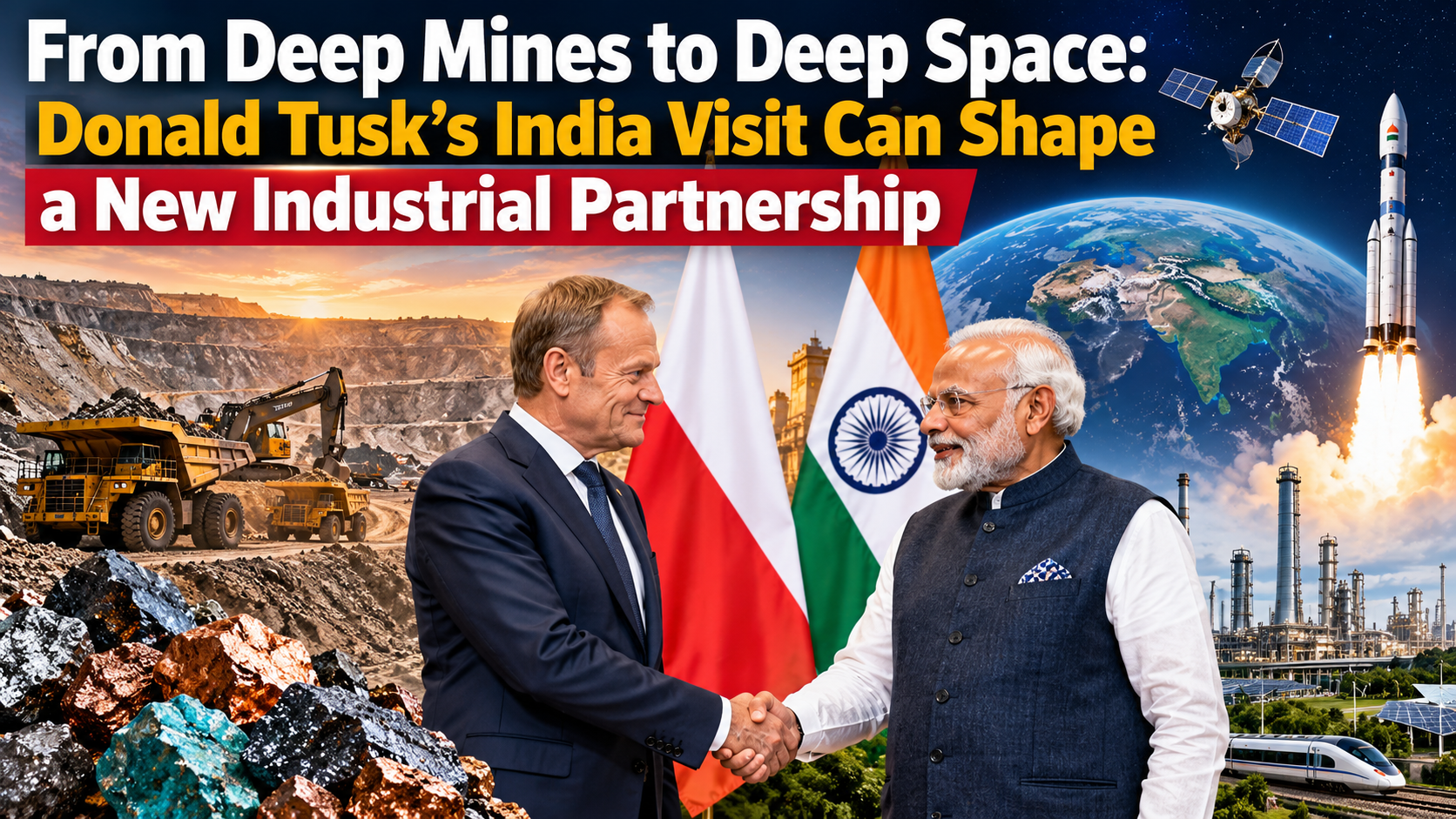
From Deep Mines to Deep Space: Donald Tusk’s India Visit Can Shape a New Industrial Partnership
As the Polish Prime Minister visits India, defence, space, mining technology and advanced manufacturing offer an opportunity to turn strategic goodwill into shared industrial capability.
The next chapter of India–Poland relations could be written underground, on factory floors and in orbit.
Polish Prime Minister Donald Tusk’s official visit to India from 21–23 October 2026 comes at an important moment for the partnership. With bilateral talks with Prime Minister Narendra Modi scheduled for 22 October, followed by business engagements in New Delhi and Bengaluru, the visit offers an opportunity to connect diplomatic ambition with investment, technology and industrial execution. Poland’s published programme includes a business forum in Delhi and an ICT and aerospace business seminar in Bengaluru.
For India’s metals, minerals and engineering industries, the significance extends well beyond another high-level exchange. The central question is whether the two countries can build a partnership that delivers safer mines, stronger manufacturing, skilled employment and greater control over strategically important technologies.
The opportunity is substantial: combine Polish industrial experience with Indian scale, engineering talent and enterprise to create capabilities that both countries can use—and jointly offer to the world.
A strategic partnership ready for execution
The political foundation already exists. During Prime Minister Modi’s August 2024 visit to Poland, the two countries elevated their relationship to a Strategic Partnership and adopted an implementation plan for 2024–2028. Its priorities explicitly include defence industry engagement, advanced mining systems, high-tech machinery, mining safety, critical minerals and commercial space cooperation.
Institutional engagement has continued. The seventh India–Poland Joint Commission for Economic Cooperation met in New Delhi in July 2026, accompanied by business meetings and engagements involving ISRO, NASSCOM and India’s Ministry of Micro, Small and Medium Enterprises. These exchanges provide a practical foundation for the prime ministerial visit.
Tusk’s visit should now help move that process towards identifiable projects, responsible partners, financing arrangements and delivery schedules.
Strategic partnerships acquire economic meaning when businesses can build around them.
Mining technology: an opportunity beneath the surface
Poland brings operational experience in underground coal mining alongside a substantial mining research and engineering base. LW Bogdanka’s operating record illustrates its longwall mining experience, while the KOMAG Institute of Mining Technology works across underground mechanisation, mineral processing, automation and monitoring technologies.
India, meanwhile, is pursuing greater mechanisation in underground coal production. The Ministry of Coal has identified continuous miners, longwall systems and highwall mining among the mass production technologies being adopted by Coal India.
These capabilities create a credible basis for cooperation. However, importing an advanced machine is only the beginning.
A successful underground mining project requires geological assessment, suitable mine design, reliable power, ventilation, evacuation capacity, maintenance systems and trained personnel. A highly productive mining face cannot compensate for bottlenecks elsewhere in the operation.
The strongest partnership would therefore combine equipment with mine planning, commissioning, operator development, maintenance support and clearly defined performance responsibilities.
Technology must also be adapted to Indian conditions. Seam characteristics, roof behaviour, faults, groundwater and gas conditions require project-specific assessment. International experience should strengthen that assessment and inform engineering choices.
For prospective Indian and Polish partners, the commercial objective should be dependable production over the operating life of the mine.
Sustainability must be demonstrated in the mine
Mining cooperation will carry greater credibility if sustainability is embedded in project design and measured during operation.
Underground mining can reduce some forms of surface disturbance compared with opencast development, but it brings its own environmental and safety challenges. Methane, subsidence, water management, ventilation demand and worker exposure all require attention.
Polish research offers relevant areas for exchange. KOMAG participates in work on methane monitoring at abandoned coal mines and has developed dust suppression equipment for underground workings. Such capabilities suggest practical opportunities for joint trials, training and adaptation.
Future cooperation should assess outcomes through indicators such as energy consumed per tonne, methane emissions, water use, dust exposure, equipment reliability and rehabilitation performance.
Higher output alone cannot establish environmental improvement. The stronger proposition is safer production, better resource recovery and a measurable reduction in environmental impact.
Technology transfer must create Indian capability
The lasting value of the partnership will depend on how much knowledge becomes embedded in Indian institutions, factories and workforces.
A meaningful technology transfer arrangement should define the engineering knowledge, manufacturing processes, maintenance competencies and intellectual property rights that partners are prepared to share. It should establish how Indian suppliers qualify, how personnel are trained and how technical support continues after commissioning.
A phased approach could begin with joint project engineering and local assembly, followed by component manufacturing, repair capability and collaborative product development.
Training deserves equal standing with machinery. Joint programmes could cover mine planning, electro-hydraulic systems, automation, fault diagnosis, safety and supervisory competence. Exchanges between operating mines, research institutions and training centres would help turn transferred knowledge into repeatable performance.
The essential test is straightforward: can the Indian partner operate, maintain and progressively improve the technology with increasing domestic competence?
Critical minerals connect mining with national security
The partnership should also extend beyond coal.
India’s National Critical Mineral Mission provides a wider policy context. Approved in January 2025, it envisages ₹16,300 crore in expenditure and an expected ₹18,000 crore in investment by public sector enterprises and other stakeholders. Its scope spans exploration, mining, beneficiation, processing and recovery from end-of-life products.
Poland’s industrial experience includes integrated mining and metallurgy. KGHM, a major copper and silver producer, operates across extraction, smelting and refining, offering an example of capabilities relevant to a broader minerals partnership.
The editorial case for cooperation is therefore wider than securing access to ore. India and Poland should examine opportunities in mineral processing, metal recovery, recycling, specialist equipment and downstream manufacturing.
Defence systems, satellites, power networks and advanced electronics depend on reliable materials and processing capabilities. Mineral security and technological security increasingly belong in the same conversation.
Defence: build an industrial relationship
Defence cooperation offers another avenue for deeper industrial engagement.
Polish defence manufacturer WB Group already maintains an Indian presence and states that its activities support indigenisation and technological self-reliance under Make in India and Aatmanirbhar Bharat. This provides a concrete example of commercial engagement on which wider cooperation could build.
The next stage should examine joint engineering, qualified component supply chains, maintenance support and opportunities for production in India. These arrangements require clarity on intellectual property, export permissions, certification and long-term access to spares.
For Indian industry, the gains could extend across precision manufacturing, electronics, software, testing and specialist materials.
For Poland, Indian partnerships could offer engineering capacity, manufacturing scale and opportunities to develop products for additional markets.
The strategic value will grow when both sides have a sustained industrial stake in the relationship.
Space: a bridge between security and resource management
Space cooperation makes the partnership particularly relevant to a changing industrial economy.
A tangible commercial foundation is already emerging. In June 2026, Dhruva Space and ICEYE announced an MoU to explore collaboration in satellite manufacturing, space systems, Earth observation, disaster management and ground infrastructure. ICEYE subsequently announced the establishment of an Indian entity in August, including plans to develop manufacturing capability locally. ICEYE is Finnish-founded and has substantial Polish operations, illustrating the wider European industrial networks that bilateral cooperation can connect with India.
For mining, satellite applications deserve particular attention. Radar interferometry can support monitoring of surface deformation associated with underground extraction, creating opportunities to combine space data with mine surveying and ground instruments. Published research has examined this application in longwall mining environments.
A useful future pilot could bring together Indian mine operators, space companies and research institutions to evaluate monitoring performance under local conditions.
This would connect a high-profile technology sector with a practical industrial need: better information for managing mining risk.
Trade growth needs projects that can be financed
The wider economic relationship provides room for expansion.
According to Poland’s Foreign Ministry, bilateral trade reached approximately €5.6 billion in 2025, with machinery and equipment accounting for 28.5% and chemical products for 18.6%. Separately, former Polish Ambassador to India Adam Burakowski has articulated an ambition to raise annual trade to US$10 billion. That figure represents an aspiration rather than a concluded outcome of this visit.
Growth should draw on a broad base: engineering, pharmaceuticals, digital services, food processing, transport equipment, environmental technologies and advanced manufacturing.
For capital-intensive mining projects, financing will be decisive. Buyers and suppliers need to assess interest costs, currency exposure, guarantees, insurance, spare parts, maintenance and operating performance together.
Leasing, phased investment and contracts linked to equipment availability or production merit examination where project conditions support them. Such structures need a clear allocation of geological, operational and financial responsibilities.
The lowest purchase price may deliver poor value if downtime and maintenance costs are high. The relevant measure is the cost of reliable performance over the project’s life.
The measure of success
As Tusk and Modi meet, the opportunity is to establish a focused implementation programme: a small portfolio of viable mining projects, manufacturing partnerships, research collaborations and training initiatives, each with accountable institutions and measurable milestones.
These are proposed priorities. Their value lies in giving industry a practical route from diplomatic engagement to investment.
India and Poland have already identified the sectors. The task now is to organise the engineering, capital and human capability needed to deliver.
The legacy of this visit should be visible in safer mines, stronger factories, skilled workforces and technologies developed together. From deep mines to deep space, India and Poland have an opportunity to build a partnership whose impact reaches far beyond the negotiating table