
Verdox Captured CO₂ From An Aluminum Smelter. Commercial Scale Is A Much Bigger System.

Support CleanTechnica’s work through a Substack subscription, on Patreon, or on Stripe. Help us produce all of the high-quality, original content we publish week after week despite the challenges of content-scraping AI, antisocial media, inflation, and other hurdles.
Verdox has completed a useful industrial demonstration at Hydro’s Sunndal aluminum smelter in Norway. During a two-month test, its electrochemical process captured carbon dioxide from exhaust containing only about 1% CO₂ and operated in the presence of contaminants found in real smelter gas. Hydro’s investment and continued work with Verdox give the trial more weight than a laboratory demonstration or a technology-company test carried out on a prepared gas stream.
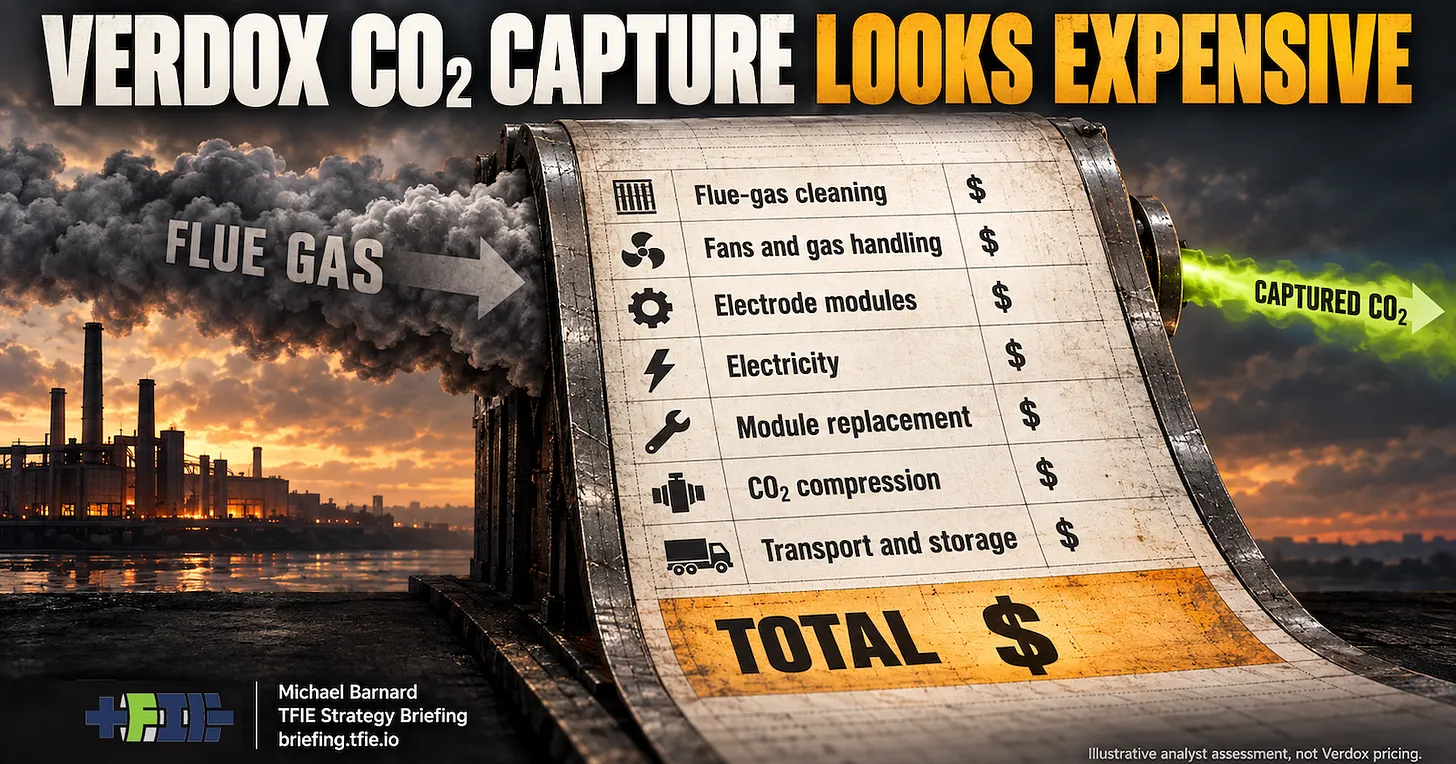
The demonstration establishes that the capture chemistry can operate in a relevant industrial environment. It does not establish what a commercial installation would cost, how much electricity the complete plant would use, how long finished capture modules would last, or what equipment would be required to move and condition the enormous volume of dilute exhaust. Those are the issues that determine whether the technology becomes an industrial business rather than an interesting capture process.
I worked through those questions in a TFIE Strategy Briefing assessment of Verdox at Hydro’s Sunndal smelter, separating the published technology evidence from the additional engineering needed to get captured CO₂ all the way to permanent storage.
Concentration drives much of the problem. When carbon dioxide is only about 1% of the incoming stream, almost all of the gas being handled is nitrogen, oxygen, water vapour and other constituents rather than the molecule being captured. Commercial equipment has to move that gas through cleaning systems and capture modules while controlling pressure losses, contaminants and flow distribution. The size and power demand of fans, ducts and pretreatment equipment belong in the economics even when the electrochemical separation itself performs well.
Verdox publishes an energy figure of about 1.5 GJ, or 417 kWh, per tonne of CO₂ for its process. The figure is relevant, but an investor needs a precise equipment boundary around it. A complete facility can also require additional gas cleaning, switching and clearing steps, pumps or fans, cooling, product drying and compression, and the public material does not yet provide enough information to determine which of those loads are included in the company figure.
Continuous industrial operation introduces another layer. Verdox’s quinone-bearing material captures CO₂ in one electrical state and releases it in another, so a capture surface cannot perform both functions simultaneously. A steady smelter exhaust requires multiple banks operating at different stages of the cycle, or an equivalent arrangement that allows fresh flue gas to keep arriving while other modules clear residual gas and release concentrated CO₂.
The commercial scale of that equipment depends heavily on how much CO₂ each square metre of finished module can process over time and how long the material survives in service. Published laboratory cycling results are useful evidence about the underlying chemistry, but they are not a maintenance record for a commercial module exposed to smelter gas for years. Replacement frequency affects capital requirements, operating cost, downtime, materials supply and waste handling, so it deserves as much diligence as the electrical consumption of the capture reaction.
The captured gas also has to become a product that a pipeline or storage operator will accept. CO₂ released from the capture medium needs to be separated from residual feed gas, collected, dried and compressed to the required specification. From there it still needs transport and access to suitable geological storage, with the associated contracts, monitoring requirements and infrastructure. A technically successful capture unit beside a smelter represents only part of the carbon-management chain.
Aluminum complicates the investment decision because the industry is also working on eliminating the source of much of the direct CO₂. Conventional Hall-Héroult smelting consumes carbon anodes, and Hydro and Rio Tinto state that anode consumption accounts for roughly three quarters of a smelter’s direct carbon emissions. Capture is being investigated partly because those emissions are difficult to address at existing plants, while alternative smelting processes are being developed in parallel.
Rio Tinto and Alcoa’s ELYSIS venture started a 450 kA commercial-size inert-anode cell at the Alma smelter in 2025. Hydro’s HalZero programme follows a different route using aluminium chloride and remains at an earlier industrial-development stage. Neither technology provides a ready replacement for every existing potline, but both belong in the lifetime economics of a capture project expected to operate for decades.
An existing smelter with substantial remaining life can still have a sensible capture case if process conversion is difficult, clean electricity is available and storage is accessible at a tolerable cost. A plant approaching a major potline replacement faces a different decision because investment in capture has to compete with investment that could change the smelting process itself. The relevant comparison is specific to the asset, its remaining life and the alternatives available when the next large capital decision arrives.
The same screening logic applies across carbon capture more broadly. Some CO₂ streams begin much easier than aluminum-smelter exhaust. Fermentation, biogas upgrading and some other processes can produce relatively concentrated biogenic CO₂ that requires less separation work before compression and storage. Where the biomass is genuinely sustainable and geological storage is durable, storing such a stream can provide net carbon removal rather than avoiding a new process emission.
That does not eliminate the potential role for dilute industrial capture. Existing plants will remain in service for years, some process emissions will be difficult to remove, and not every site will have a commercially viable process-conversion option. It does suggest that carbon-capture investment should begin with the source, the available alternatives and the full chain to storage rather than ranking technologies primarily by the performance of the separation material.
Verdox has produced enough evidence at Sunndal to justify continued industrial diligence. The next useful evidence will be more operational: a complete gas and CO₂ mass balance, measured electricity across the whole plant, pressure losses, product purity, module-area productivity, availability, replacement rates and a storage route that exists on commercial terms. Those measurements would turn a promising industrial demonstration into the basis for a much firmer project assessment.
The paid TFIE Strategy Briefing includes the complete-system screening model, gas-flow calculations, capture and storage scenarios, module-lifetime sensitivities and the evidence I would want before using the economics in an investment decision.
Sign up for CleanTechnica’s Weekly Substack for Zach and Scott’s in-depth analyses and high level summaries, sign up for our daily newsletter, and follow us on Google News!
Have a tip for CleanTechnica? Want to advertise? Want to suggest a guest for our CleanTech Talk podcast? Contact us here.
Sign up for our daily newsletter for 10–15 new cleantech stories a day. Or sign up for our weekly one on top stories of the week if daily is too frequent.

CleanTechnica uses affiliate links. See our policy here.
CleanTechnica’s Comment Policy