

Support CleanTechnica’s work through a Substack subscription, on Patreon, or on Stripe. Help us produce all of the high-quality, original content we publish week after week despite the challenges of content-scraping AI, antisocial media, inflation, and other hurdles.
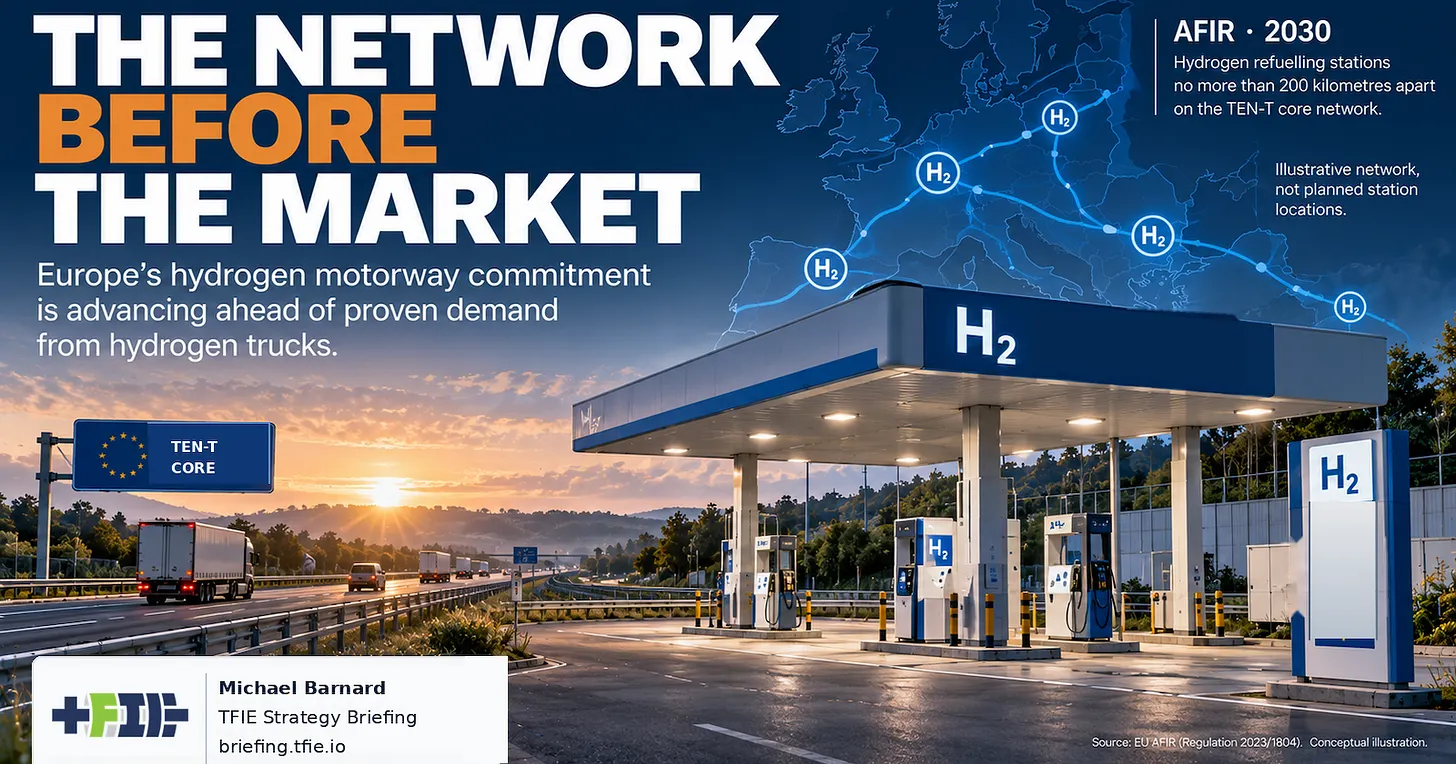
Europe is building a hydrogen-refuelling network before there is a large hydrogen-truck market to support it. Under the Alternative Fuels Infrastructure Regulation, hydrogen stations are supposed to be available along major motorway corridors at intervals of no more than 200 kilometres by 2030, with additional coverage at designated urban nodes. A European assessment estimates that an AFIR-compliant network could require roughly €2.1 billion of capital investment.
The policy logic is understandable. Truck operators are unlikely to buy hydrogen vehicles if they cannot refuel them reliably across borders, while station investors are reluctant to build without customers. The problem is that Europe is not the first jurisdiction to try solving that coordination problem by pushing infrastructure ahead of demand. South Korea has already run a much more mature version of the experiment, and its station economics should be treated as a warning.
I examine that comparison in Europe’s Hydrogen Highway Gamble. The deeper analysis looks at South Korea’s operating subsidies, the strongest break-even case, hydrogen supply economics and what Europe should require before committing further AFIR capital.
By August 2026, South Korea had installed 493 hydrogen refuelling units, reaching 74.7% of its target of at least 660 by 2030. Hydrogen vehicle registrations were much further behind at 49,220, only 16.4% of the government’s 300,000-vehicle target. Those figures are not utilization rates, but they show that the policy programme succeeded much more rapidly at constructing infrastructure than at creating the customer base intended to support it.
The financial evidence is more consequential. Of 258 commercially active stations assessed in the first half of 2026, 208 received government support toward operating losses, or 80.6%. Several relatively new stations had already stopped operating, with poor business prospects or financial losses among the reasons cited. The subsidy programme has eligibility limits, so the remaining stations cannot simply be classified as profitable, but the scale of continuing support is difficult to reconcile with the idea that early infrastructure automatically matures into a commercially self-sustaining network.
South Korea did not neglect the vehicle side of the market. Hydrogen vehicles received purchase incentives, station construction was subsidized, operating losses were supported and industrial policy promoted hydrogen production and infrastructure. The country offers a serious test of the theory that government can solve the chicken-and-egg problem by supporting supply and demand together. The result is a substantial network whose economics still depend heavily on public support after years of coordinated intervention.
Jeonju Pyeonghwa provides an apparent counterexample that is worth exploring. The station reported reaching operating break-even in 2024 while serving concentrated hydrogen-bus demand. However, refueling infrastructure was subsidized, it’s unclear if the breakeven included capex amortization and the hydrogen was fossil-derived. That result matters because it shows that hydrogen refuelling can somewhat work economically under favorable conditions, but those conditions are very different from a motorway station built because the next facility must be within a regulatory spacing limit. Buses return predictably, use large quantities of fuel and allow infrastructure to be designed around known demand.
Europe should make that distinction central to AFIR. A station linked to committed fleets or dense freight activity can be tested against identifiable customers and expected kilograms sold. A geographically mandated station may exist primarily because network coverage requires it, leaving utilization dependent on a truck market that has not materialized and is unlikely to.
Fuel cost adds another layer of risk. South Korea’s hydrogen-refuelling economics developed largely around relatively inexpensive fossil-derived and petrochemical by-product hydrogen. That helps station economics but weakens the climate case. Renewable hydrogen improves lifecycle emissions while raising fuel costs substantially, which means the economics become more difficult just as the fuel becomes more consistent with the policy objective.
Europe faces the same tension. Its hydrogen industry remains overwhelmingly conventional, while renewable hydrogen costs materially more before transport, compression and dispensing are included. A hydrogen station can therefore satisfy an infrastructure mandate without demonstrating either commercially attractive fuel prices or the lifecycle emissions reductions that justify the policy.
The competitive market is also moving. Battery-electric trucks are entering service in increasing numbers, while high-power freight charging is being deployed. Every truck that moves directly to batteries reduces the addressable demand available to recover the fixed costs of hydrogen stations. A network built today has to be evaluated against the technologies likely to compete with it over the lifetime of the assets, not against the freight market as it looked when the spacing requirement was written.
Europe does not need to close useful existing hydrogen stations or prevent projects with committed fleet demand from proceeding. What it should reconsider is the assumption that geographic coverage should continue expanding automatically. New stations should face explicit tests for expected throughput, full capital and operating costs, required public support, hydrogen price and provenance, and the climate value of the transport they actually enable.
South Korea’s experience shows the danger of treating infrastructure deployment as evidence that a market exists. It built much of its planned network, demand lagged badly and operating support remains widespread. Europe has the advantage of seeing that outcome before completing its own network, and the AFIR review should use it to distinguish strategically useful stations from potential white elephants that could require public support long after their construction grants are forgotten.
The full TFIE Strategy Briefing analysis goes further into Jeonju’s economics, Korean subsidy history, fossil-linked versus renewable hydrogen costs and a staged framework for testing Europe’s minimum network before expansion.
Sign up for CleanTechnica’s Weekly Substack for Zach and Scott’s in-depth analyses and high level summaries, sign up for our daily newsletter, and follow us on Google News!
Have a tip for CleanTechnica? Want to advertise? Want to suggest a guest for our CleanTech Talk podcast? Contact us here.
Sign up for our daily newsletter for 10–15 new cleantech stories a day. Or sign up for our weekly one on top stories of the week if daily is too frequent.

CleanTechnica uses affiliate links. See our policy here.
CleanTechnica’s Comment Policy