
Support CleanTechnica’s work through a Substack subscription, on Patreon, or on Stripe. Help us produce all of the high-quality, original content we publish week after week despite the challenges of content-scraping AI, antisocial media, inflation, and other hurdles.
In what world is it normal for a US President to attack an entire state and its residents? The answer is no world, of course, and yet such is the state of affairs in which we live today. Exhibit A is California, upon which President Donald Trump has been waging a ferocious battle to undercut state policy makers. That includes the state’s clean vehicle standards. Try as he might, though, California Governor Gavin Newsom gets the last laugh. EVs racked up a fairly good sales record in Q1 this year, and EV sales in the state continued to rise in Q2.
Trump Targets EV Sales In California
The highlight of President Trump’s war on EVs is his much-touted “One Big Beautiful Bill Act,” which passed by virtue of his Republican majority in Congress last July, with exactly zero votes from the Democratic side of the aisle. Among other provisions, OBBA called for the premature sunsetting of the $7,500 federal EV tax credit. EV sales predictably collapsed in the months following the expiration of the tax credit on September 30, 2025.
The OBBA was just the beginning of Trump’s war on EVs. In another step aimed at sending EV sales even further down the tubes, last month the US Environmental Protection Agency targeted California for yet another salvo.
By way of backstory, California is one of the single largest automotive markets in the world, and its industry-leading emissions standards predate the federal Clean Air Act. After the initial iteration of the Clean Air Act became law in 1970, Congress routinely enabled California to continue establishing stricter standards. Since then, EPA has provided California with upwards of 75 such preemptions. As waivers, not rules, the preemptions have not been considered subject to review by Congress — until suddenly they are.
California also happens to be a leader in EV sales in the US, so it’s no surprise to see the US Environmental Protection Agency attempt to undermine the state’s authority to exceed Clean Air Act standards. Last year EPA tried, and failed, to prevent California from enforcing its emissions standards. Now EPA is attacking from another angle, by summarily transforming four of California’s most recent waivers into rules.
In the form of rules, the waivers fall under the purview of Congress — the same Congress that passed the OBBA for Trump. Clearly, the plan was to send the “rules” to Congress where they would be most certainly be shot down, thereby putting an end to California’s waivers.
Of the four waivers, one provides for California to implement 2008 greenhouse gas standards for cars established by CARB (the California Air Resources Board), and another covers CARB’s 2012 emissions standards for cars. Trump tried to rescind the 2012 CARB standards during his first term in office, but the Joe Biden administration reinstated key parts of the waiver, and so it stands. The fourth waiver covers amendments to the 2022 Small Offroad Engine Rule amendments.
California To Trump: I’ll See You In Court!
On June 22, California Attorney General Rob Bonta, Governor Gavin Newsom, and CARB clapped back at Trump with a lawsuit challenging EPA’s authority to reclassify the four waivers.
“In over 50 years since the Clean Air Act was enacted, waivers have never been considered rules subject to Congressional disapproval,” AG Bonta’s office explained, adding that “EPA purported to reclassify these waivers as rules and submitted them to Congress in an unlawful attempt to end-run administrative procedure and tee up a Congressional attack on California’s vehicle emissions rules.”
“The Trump Administration is doubling down on its unlawful attack on California’s longstanding authority to address air pollution,” Bonta emphasized. “For fifty years, both Democratic and Republican administrations have agreed that EPA Clean Air Act waivers are not rules, and EPA’s unlawful attempt to reclassify them — years after the fact — is an illegal attempt to take down these important tools.”
EV Sales Are Up In California
The last laugh is on Trump, who shot himself in the foot by launching a misbegotten war against Iran on February 28, upsetting the Middle East applecart in a way that surprised nobody who has been paying attention to the delicate state of affairs in that region. Instead of knuckling under, Iran promptly closed the key Strait of Horumz fossil energy shipping lane and attacked US bases in neighboring countries at will.
So far the Trump administration has admitted to 16 US service members killed in the conflict, which also predictably caused the price of gasoline to spike in the US. So far it’s been difficult to tell which development has resulted in more outrage among members of the US electorate, though that may change.
Meanwhile, auto industry observers have cautioned that an increase in the price of gasoline will not necessarily lead to a significant upturn in EV sales, at least not over the short term. However, the longer the war drags on, the more time EV-curious drivers have time to calculate the savings to be gained by switching to electricity.
Now the California Energy Commission has run the numbers, and they concluded that Trump really has shot himself in the foot.
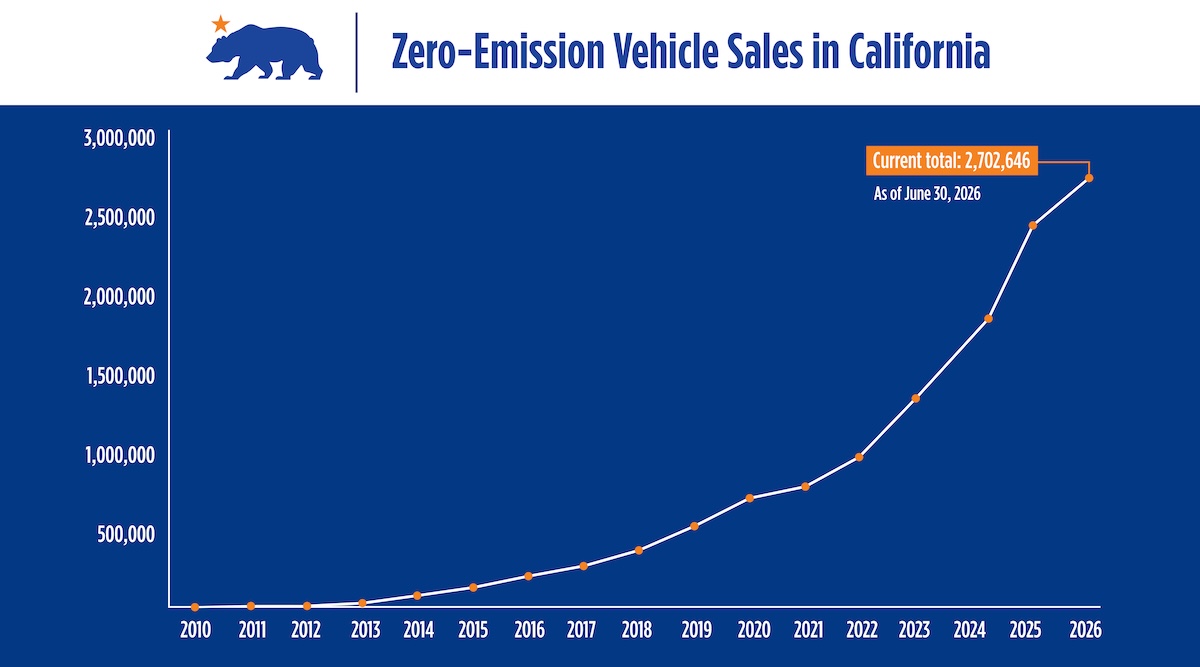
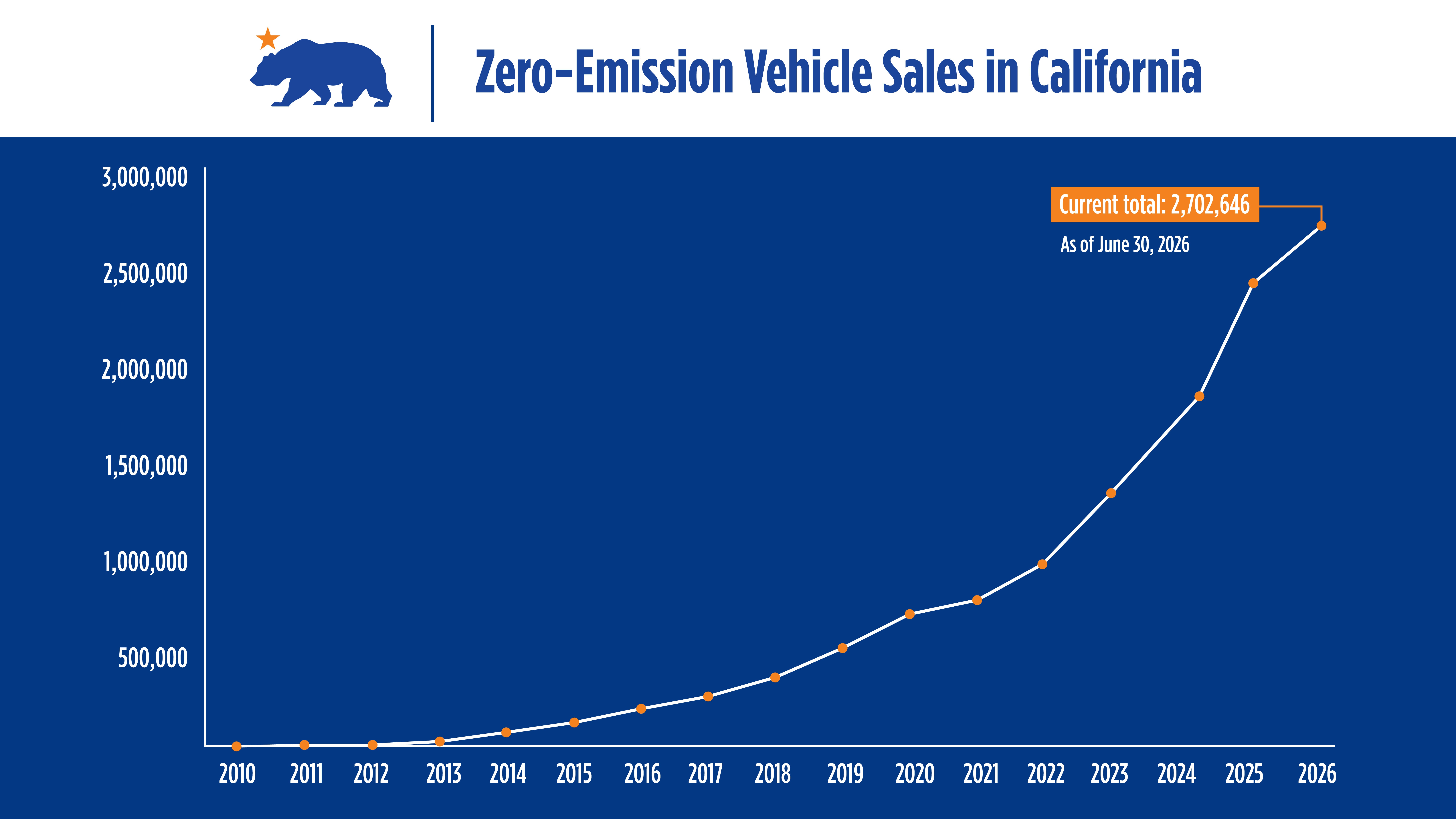
“As gasoline prices skyrocketed in the wake of Trump’s war in Iran, new zero-emission vehicle (ZEV) sales increased in the second quarter of 2026, representing 19.1% of new vehicle sales in California, a 3.3 percentage point increase quarter over quarter,” the California Energy Commission announced on July 20.
Before you get too excited, the numbers include plug-in hybrids as well as fuel cell EVs. Of the 86,857 new ZEVs counted by CEC, 75,597 were full battery-powered EVs, and 11,179 were plug-in hybrids. Fuel cell EVs brought up the rear at just 81 vehicles.
Still, the results are an impressive rebuke to Trump’s anti-EV crusade. “This recent quarter’s sales represent the highest share of new EV purchases recorded without federal tax credits and are only 2.5 percentage points below the same quarter last year, when the $7,500 federal incentive was still available,” CEC elaborated.
There’s plenty more where that came from. California’s new “MyFirstEV” incentive program will kick in next month, presumably helping to stimulate sales further. Administered by CARB, the program provides first-time EV buyers with a $3,500 rebate at the dealership, for vehicles with an MSRP up to $50,000. The program also shaves $1,750 from used EV sales of up to $25,000. Ford, General Motors, Honda, Hyundai, Kia, Lucid, Mitsubishi, Nissan, Rivian, Subaru, Tesla, Toyota and Volvo are all participating in the program. Check out the details here.
They say that revenge is a dish best served cold, but the Q2 sales figures were a dish too hard to resist, and California Governor Newsom could not resist taking a poke at Trump’s failure.
“While Donald Trump makes Americans pay the bill for his Iran war at the pump, California is giving families the freedom to choose a cheaper way forward by going electric,” Newsom said in a press statement.
“California’s MyFirstEV instant rebate program is going to put thousands more Californians behind the wheel of a car that can’t be held hostage by greedy oil companies or foreign wars,” he added for good measure.
“We built the largest electric car market in America, and we’re not stopping now,” he piled on again…so hold on to your hats!
Image: EV sales rebounded in California in Q2 2026, despite US President Donald Trump’s persistent attacks on EVs in general, and California in particular (courtesy of California CEC).
Sign up for CleanTechnica’s Weekly Substack for Zach and Scott’s in-depth analyses and high level summaries, sign up for our daily newsletter, and follow us on Google News!
Have a tip for CleanTechnica? Want to advertise? Want to suggest a guest for our CleanTech Talk podcast? Contact us here.
Sign up for our daily newsletter for 15 new cleantech stories a day. Or sign up for our weekly one on top stories of the week if daily is too frequent.

CleanTechnica uses affiliate links. See our policy here.
CleanTechnica’s Comment Policy