

Support CleanTechnica’s work through a Substack subscription or on Stripe.
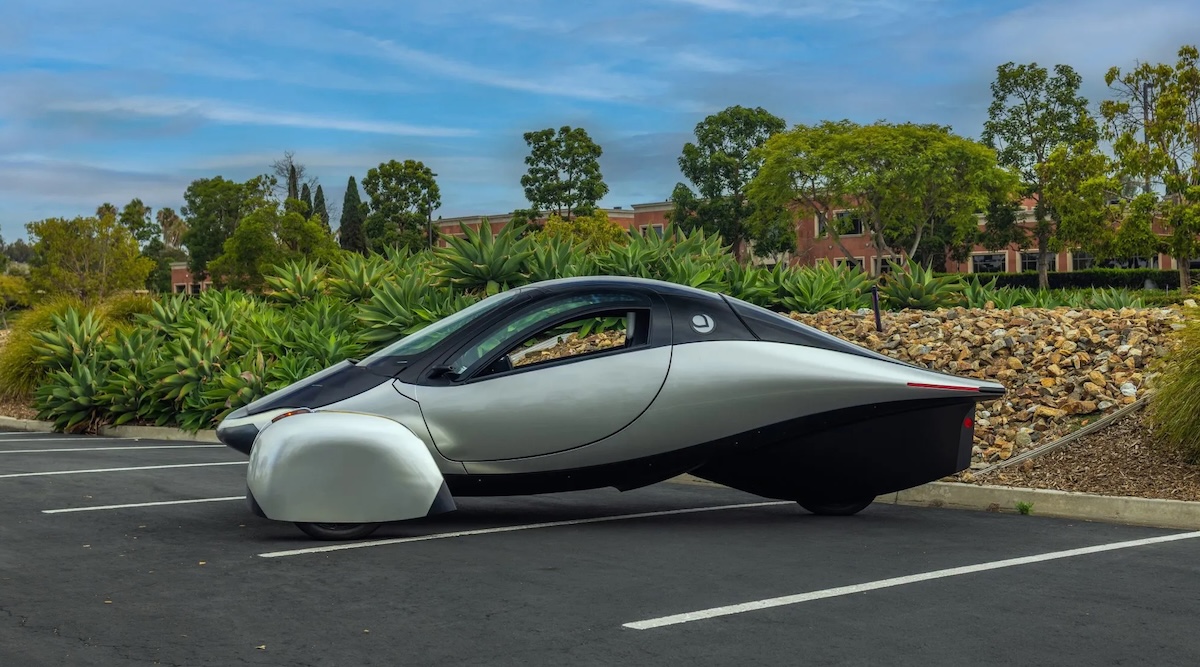
The US startup Aptera Motors Corp. has taken the long way around on its journey to produce an EV that runs on solar power from its own onboard solar cells. That has been a tough row to hoe, but the company is finally ready to prove its case with a series of real-world videos featuring its signature EV under the code name “Atlas.” Spoiler alert: repositioning pays off.
The Return Of The Autocycle, EV Edition
Autocycles are three-wheeled vehicles that are sometimes confused with three-wheeled motorcycles. However, they are a different sort of beast. In the US, autocycles are defined by regular front-facing car seats and a steering wheel, in contrast to the straddle seat and grips that characterize motorcycles.
That’s an important distinction for the EV market here in the US, because it relieves drivers from the hassle of acquiring a motorcycle license in addition to their car license. Nevertheless, although autocycles were relatively popular in other markets through the middle of the 20th century, they failed to catch fire here.
Well, that was then. In a case of everything old being new again, automotive enthusiasts have begun to tease autocycles into a comeback, in the form of souped-up, open-air versions, both gas and electric (here’s a forthcoming electric example).
Aptera has been aiming for a foothold in the autocycle market since 2006, which was 20 years ago for those of you keeping score at home. With many delays along the way, perhaps it’s just as well the the startup has finally found its footing at a time when autocycles are just beginning to attract interest from the EV-buying public.
Aptera Puts The EV Pedal To The Metal
Aptera has been picking up the pace over the past couple of years. Its first validation vehicle rolled off the assembly line in March, and the company has not let the grass grow under its feet since then.
On June 25, the company announced that the results of a series of real-world tests on its new EV, with results that support the company’s promise of enough solar power to get a typical driver through daily errands before needing to plug into a charging station.
The test car hit a peak of 4.42 kilowatt-hours of daily generation, enough to travel up to 44 miles, exceeding the company’s initial calculations.
Aptera attributes the achievement to its ground-up body design and a custom, soup-to-nuts charge controller that maximizes the energy produced from various parts of the car’s body. “That full-stack ownership is what made it possible to optimize every layer of the system simultaneously and validate it as a complete unit,” the company explains.
Atlas And The Repositioning Factor
Aptera plans to put Atlas through a third-party validation sequence sometime in July. Meanwhile, you can check out the data from their in-house tests on the Aptera blog and see the videos on their YouTube channel.
To summarize briefly, Aptera is satisfied that their autocycle can provide drivers with a full solar-powered EV experience for typical daily use on cloudy days as well as sunny days.
“Thanks to the large curvature of Aptera’s solar panels, parking with the front facing east or west (rather than north or south) is the best way to maximize energy capture throughout the day,” the company notes.
Aptera hit the high mark of 44 miles with a vehicle in a parking lot, rotating it just once at noon in order to catch more sun in the latter part of the day. The achievement is notable because the day started off with considerable cloud cover.
The company also tested the vehicle without moving it at all. On a sunny day, one position yielded 39 miles of added range. In another test, the EV also booked 40 miles in a fixed position, despite cloud cover at the beginning and end of the day.
The repositioning factor kicks in when cloudy conditions throughout the day interfere with solar collection. On one cloudy test day, the car was repositioned multiple times for optimal effect. All that hard work paid off, with the car racking up a respectable 36 miles of range by the end of the day.
Repositioning For Solar Powered EVs
As Aptera emphasizes, the Atlas test sequence shows that drivers don’t necessarily need to re-park their cars in order to collect a reasonable amount of solar energy for the day. However, hyper-milers may be attracted by the idea of tweaking the car’s solar capabilities beyond conventional driving habits. Aptera cites a peak of 4.6 kilowatt-hours (about 46 miles of range) under a repositioning schedule with multiple rotations, even on a test day when morning clouds interfered.
For that matter, re-positioning is not just a fun pursuit for hyper-milers. Many drivers park and re-park their cars at intervals throughout the day, when commuting or running errands.
For those parking in one location throughout the day, repositioning just once around lunchtime is enough to add substantial range. “The goal is not to ask Aptera owners to go out of their way. It is simply to show that a little awareness of where you park can meaningfully add to your daily solar range,” Aptera emphasizes.
“Repositioning the vehicle throughout the day might sound like extra effort, but it’s actually pretty natural when you think about how most people use their vehicles,” the company explains. “It’s easy to imagine moving your Aptera two to four times a day just going about your routine: driving to work, heading out for lunch, running errands, and coming home.”
The War Against EVs Is Winding Down
Interested? The company is targeting a price of $40,000 and you can reserve your spot for $100.
Meanwhile, Aptera is not the only US automaker with designs on the electric mobility market of the future. In the lastest signs of activity, Ford re-affirmed its plans to launch an affordable electric pickup truck into the market, the EV startup Rivian somehow managed to secure an Energy Department loan to support its plans for a new factory in Georgia, and the Bezos-backed startup Slate Auto has hooked up with the leading online auto retailer Carvana.
While EV sales in the US continue to disappoint, the writing is already on the wall. US President Donald Trump’s war on zero emission mobility is already fizzling out to a lame conclusion, just like his war on renewable energy, his war in Iran, and most recently, his war on algae.
Unfortunately the President’s war on the American public is still in force, native-born and non-native alike. However, that’s what elections are for. If you have any thoughts about that, drop a note in the discussion thread.
Photo: The US startup Aptera sets out to prove that an EV can rack up a significant amount of added range by deploying body-integrated solar cells in a futuristic, autocycle-based design (cropped, courtesy of Aptera).
Sign up for CleanTechnica’s Weekly Substack for Zach and Scott’s in-depth analyses and high level summaries, sign up for our daily newsletter, and follow us on Google News!
Have a tip for CleanTechnica? Want to advertise? Want to suggest a guest for our CleanTech Talk podcast? Contact us here.
Sign up for our daily newsletter for 15 new cleantech stories a day. Or sign up for our weekly one on top stories of the week if daily is too frequent.

CleanTechnica uses affiliate links. See our policy here.
CleanTechnica’s Comment Policy