

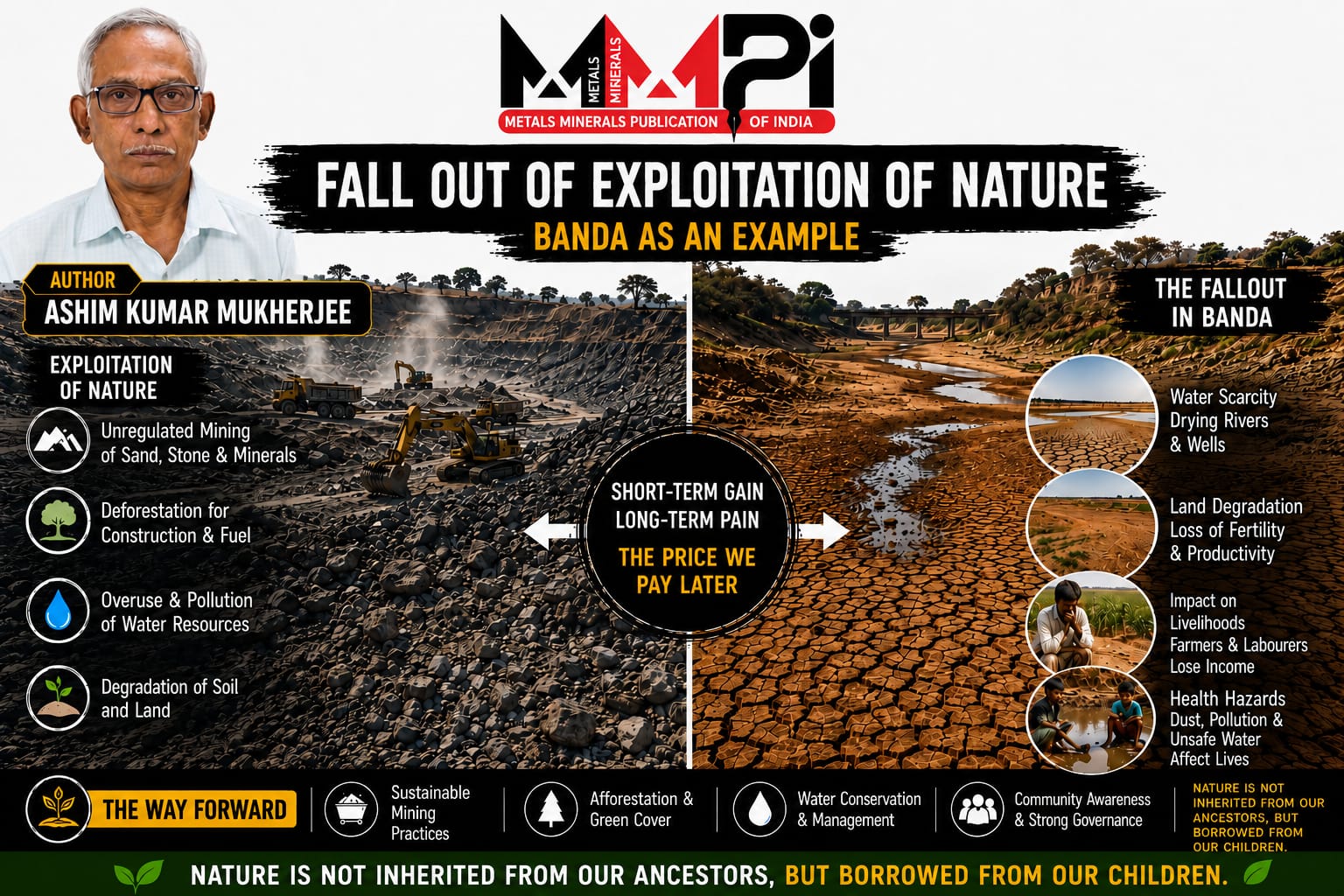
BY Ashim Kumar Mukherjee
Banda, a city in Uttar Pradesh has experienced ambient temperature of 48.2 deg C on 19-May-2026, highest in recorded weather history. People are going inside room at 10AM morning. Consequential effects are extremely detrimental.
- Electricity transmission and distribution require transformers of varying capacities and sizes. Such transformers are normally air cooled or oil-cooled, which in turn gets cooled by circulation of air only. These transformers are designed to work with maximum ambient temperature of 50 deg C and yearly weighted ambient temperature of 32 deg C. Prolonged high ambient temperature results in increase in weighted ambient temperature resulting in transformers operating in continued high temperature. In a nutshell, transformers become prone for malfunctioning in case ambient temperature going past 40 deg C. Sometimes electric department pours water to cool the transformers besides resorting to power cut. Transformers, switches and feeders are excessively strained with increased ambient temperature.
Water level has gone down – at some places around 36m deep, despite of the fact that almost 84km of Ken river runs across Banda district and this river meets Yamuna at Chilla village in the same district. Commercial activities were disrupted, earnings for daily wage labourers reduced, lifestyle changed because increased nighttime working including agricultural jobs.
This situation has come because of extreme exploitation of nature at and in near vicinity of Banda. Some are given below:
- Approximately 34,000 cum of river sand are extracted daily from the Ken river.
- Extraction of sand from small rivers from Ranj and Bagai (Baghein) is also going on for quite some time.
- Dense forest cover has fallen more than 17% as measured in 2025
- Total forest cover reduced from 120 sq km in 2005 to 95 sq km in 2025
- Increase in cement concrete road
- Mining activities involving rock blasting
River sand acts as water reservoir, increasing longer holding of water and having innumerable other ecological contributions. These contributions from river-sand are nullified by sand-mining.
Man made damages might have crossed the limits of reversibility, but still some hopes are there for restoration of normalcy. Followings are suggested:
- Sand mining must be stopped wherever mining depth exceeded 3m.
- Sand mining must be kept limited to a distance of 3m from any of the river bank or 10% of the total river width, whichever is lower.
- No sand or gravel should be allowed to be extracted within a 500m radius from any hydraulic structure like pumping station or bridge.
- Controlled blasting, muffler blasting to be resorted to limit dust clouds caused by blasting
- Appropriate safeguard measure must be taken to reduce dust from crushing operations.
- Deforestation caused by mining activities must be compensated by equivalent effective afforestation process.
In addition to above, National Green Tribunal Guidelines, Enforcement & Monitoring Guidelines for Sand Mining-2020, Sustainable Sand Mining Management Guideline-2016 must be implemented immediately without any deviation.
It is also suggested to constitute a Task Force to study and report remedial measures to be taken for arresting man-made environmental degradation in Banda district of Uttar Pradesh. Let this be taken as a challenge and a model to act upon for other areas affected by high ambient temperature in India.