

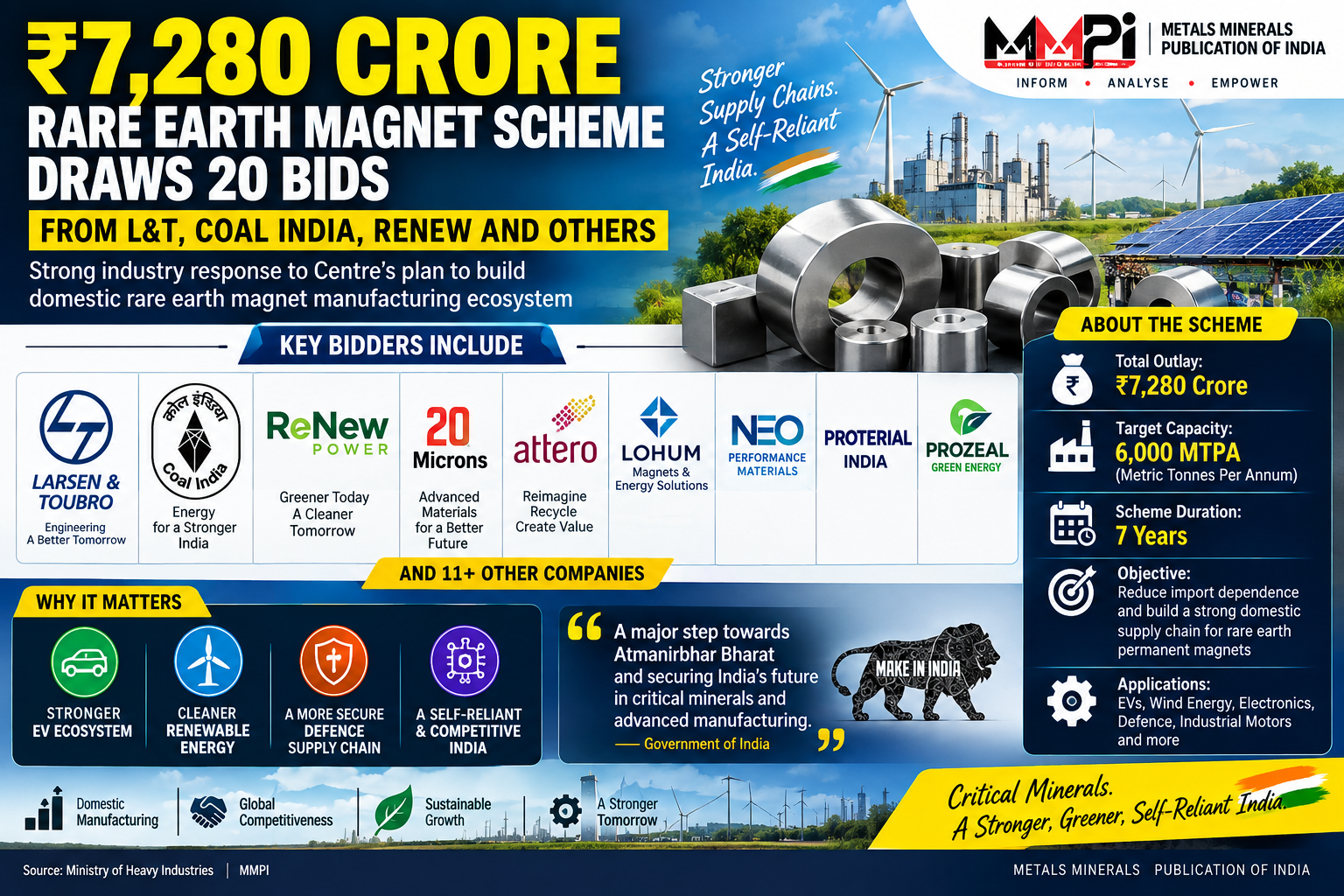
New Delhi: The Centre’s ambitious ₹7,280-crore scheme to promote domestic manufacturing of rare earth permanent magnets has attracted 20 bids from companies seeking to establish integrated manufacturing facilities in India. The Ministry of Heavy Industries said the bidders include major names such as Larsen & Toubro (L&T), Coal India and ReNew, highlighting strong industry interest in building a domestic rare-earth magnet supply chain.
The bids were submitted through a global tender on the Central Public Procurement (CPP) Portal under the Scheme to Promote Manufacturing of Sintered Rare Earth Permanent Magnets (REPM). The technical bids were opened on August 13, following the August 12 deadline for submissions.
Other bidders include 20 Microns, Attero Recycling, Lohum Magnets & Energy Solutions, NEO Performance Materials of Singapore, Proterial India and Prozeal Green Energy, among others. The diverse participation includes companies from sectors such as advanced materials, recycling, energy and industrial manufacturing.
6,000 MTPA Manufacturing Capacity Target
The scheme aims to establish 6,000 metric tonnes per annum (MTPA) of integrated rare earth permanent magnet manufacturing capacity in India. Five beneficiaries will ultimately be selected through global competitive bidding, with each beneficiary eligible for up to 1,200 MTPA of capacity.
The Union Cabinet approved the scheme in November 2025 with a total financial outlay of ₹7,280 crore. The programme includes a ₹750-crore capital subsidy and ₹6,450 crore in sales-linked incentives.
The government plans to build an integrated value chain covering the conversion of neodymium-praseodymium (NdPr) oxide into metals, alloys and finished sintered NdFeB magnets. This is aimed at reducing India’s dependence on imported rare earth magnets and strengthening domestic manufacturing capabilities.
Critical for EVs, Renewable Energy and Defence
Rare earth permanent magnets, particularly NdFeB magnets, are among the most powerful permanent magnets and are essential components in electric vehicles, wind turbines, advanced electronics, aerospace and defence systems. Developing domestic production is therefore viewed as strategically important for India’s clean-energy transition, advanced manufacturing and national supply-chain security.
The scheme is scheduled to run for seven years from the date of award, comprising a two-year period for establishing manufacturing facilities followed by five years of incentive disbursement linked to magnet sales.
The strong response to the tender marks an important step in India’s effort to develop an indigenous rare-earth magnet ecosystem. With 20 bidders competing for five beneficiary slots, the government now faces the task of evaluating technical and financial proposals before selecting companies capable of delivering commercially viable, integrated production capacity.