
US Advances Critical Minerals Talks with EU and Japan, Plans Price Floor to Stabilize Supply Chains

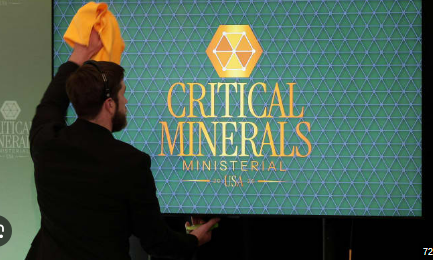
The United States is moving forward with discussions with the European Union and Japan to establish a coordinated framework for critical minerals trade, including the possibility of introducing a price floor aimed at stabilizing the market and securing supply chains.
Officials familiar with the negotiations said the proposed initiative could lay the groundwork for a broader trade agreement covering key minerals essential for advanced technologies, renewable energy systems, and defense industries. The talks are being led by the Office of the US Trade Representative in collaboration with counterparts in Brussels and Tokyo.
The proposed framework may include mechanisms such as coordinated tariffs and minimum price levels for certain minerals. These measures are intended to prevent market distortions and protect producers from price volatility, particularly in a sector heavily influenced by global supply dynamics.
Critical minerals such as lithium, cobalt, nickel, and rare earth elements play a vital role in the production of electric vehicles, semiconductors, renewable energy technologies, and defense equipment. Governments in the US, Europe, and Japan have become increasingly concerned about supply chain vulnerabilities and dependence on a limited number of suppliers.
One of the key motivations behind the initiative is to reduce reliance on China, which dominates global processing and supply of many rare earth elements. Policymakers believe coordinated policies among major industrial economies could encourage investment in mining and processing projects outside China while ensuring stable prices for producers.
Under the evolving plan, the US, EU, and Japan are also expected to explore joint investment in mining projects, coordinated stockpiling strategies, and improved information sharing on mineral supply chains. These efforts aim to strengthen resilience and prevent disruptions that could affect critical industries.
Analysts say the initiative could reshape the global minerals market by creating a new trade framework among allied economies. However, negotiations are still ongoing, and further discussions will determine how the proposed price floor and trade rules will be implemented in practice.
If finalized, the agreement could mark a significant step toward building a coordinated international strategy for securing the supply of minerals essential to the global energy transition and high-tech manufacturing.