
U.S. and Uzbekistan Sign Strategic Critical Minerals Pact to Secure Supply Chains and Boost Investment

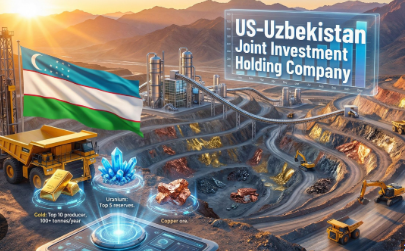
The United States and Uzbekistan have formally signed a critical minerals cooperation agreement aimed at strengthening bilateral partnerships in mining, exploration, and processing of strategic resources vital to modern technologies and supply chain security. The “Joint Investment Framework” was agreed upon during high-level talks in Washington, underscoring both countries’ mutual interest in expanding access to and development of minerals such as lithium, copper, rare earth elements, and other essential raw materials.
Led by the U.S. International Development Finance Corporation (DFC), the pact is designed to enhance collaboration across the full mineral value chain — from exploration and extraction to processing and infrastructure investment. As part of the deal, a U.S.–Uzbekistan Joint Investment Holding Company is proposed to coordinate future projects, attract finance, and encourage technology transfer to make Uzbekistan a more integral supplier of critical resources.
For Washington, the agreement fits into a broader strategy to diversify global critical minerals supply chains and reduce reliance on dominant processors and producers — particularly China — which currently hold significant influence over rare earths and other materials crucial for electric vehicles, renewable energy, and high-tech manufacturing.
Uzbekistan, long seeking to expand its role in global markets, holds substantial reserves of several strategic minerals. The pact reflects Tashkent’s drive to attract foreign investment, develop its mining sector, and integrate into global supply chains while balancing relationships with major regional powers.
Officials from both capitals have signaled that this cooperation could pave the way for further economic ties and infrastructure projects, although the pace of concrete developments will depend on regulatory clarity, investor confidence, and implementation of mining reforms.