
Anil Agarwal: When Personal Grief Transforms into National Purpose
By MMPI – Metals & Minerals Publication of India

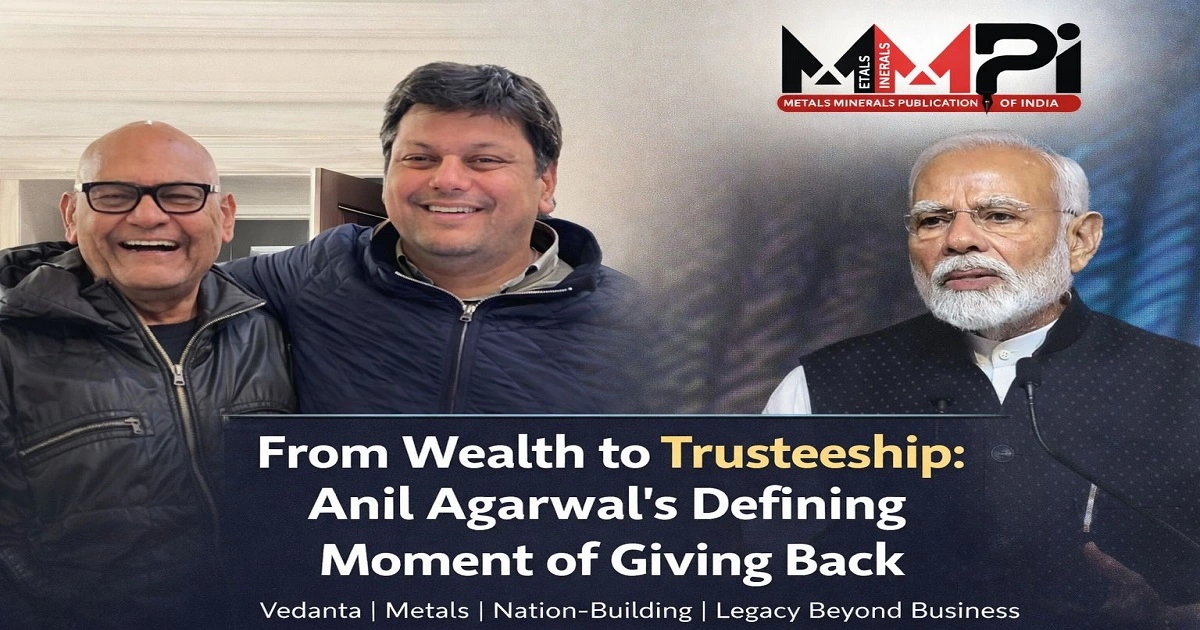
In an era where corporate success is often measured purely in balance sheets and market capitalisation, Anil Agarwal stands apart as a rare industrialist who has consistently framed wealth as a means to serve society, not an end in itself. His recent public reflection—shared after attending the Prime Minister’s Roundtable with Global Energy Leaders—reveals not just the mind of a business leader, but the soul of a trustee of national progress.
Coming soon after a deeply personal tragedy, Mr. Agarwal’s decision to return to public duty speaks volumes about resilience anchored in purpose. His acknowledgement of the empathy shown by Narendra Modi is significant—not merely as an interaction between a statesman and an industrialist, but as a moment that underscores the human dimension of leadership in India today.
From Promoter to Trustee: Redefining Wealth in Modern India
Perhaps the most defining statement made by Mr. Agarwal is his declaration that 75% of his wealth will be returned to society, and that he will step away from the role of a promoter to work as a trustee. In Indian industry, this is not a symbolic gesture—it is a structural and philosophical shift.
At a time when debates around ESG, responsible capitalism, and inclusive growth dominate boardrooms and policy forums, Mr. Agarwal’s decision elevates the conversation. It reframes wealth creation as a temporary custodianship, with society as the ultimate stakeholder. For sectors like mining, metals, and energy—industries that draw directly from natural and human capital—this approach sets a powerful precedent.
A Vision Anchored in Education and Healthcare
In keeping with the wishes of his late son, Mr. Agarwal has proposed deploying ₹10,000–15,000 crore towards a transformative initiative in education, healthcare, or other large-scale social impact domains. This is not charity in the conventional sense; it is nation-building at scale.
India today stands at a critical juncture:
•A young population that demands world-class education aligned with future industries
•A healthcare system that must bridge gaps in access, quality, and affordability
•Resource-rich regions that need sustainable development alongside industrial growth
A philanthropic intervention of this magnitude, guided by execution discipline and long-term vision, can redefine outcomes for generations—particularly in mineral-bearing and industrial regions that form the backbone of India’s growth story.
Empathy as Statecraft, Purpose as Leadership
Mr. Agarwal’s closing observation—that India is fortunate to have a Prime Minister who combines ground-level awareness with deep empathy—resonates strongly. Economic leadership, after all, does not operate in isolation from human experience. When empathy informs policy and purpose guides capital, societies move forward with balance.
For MMPI and the wider mining and metals ecosystem, this moment is instructive. It reminds industry leaders that scale brings responsibility, and that legacy is shaped not by extraction alone, but by restoration—of opportunity, dignity, and hope.
MMPI Perspective
Anil Agarwal’s journey—from entrepreneur to philanthropist, from promoter to trustee—marks a defining chapter in Indian industrial history. His response to personal grief by committing deeper service to society reflects a leadership ethos India needs more of: quiet strength, long-term thinking, and moral clarity.
In honoring his intent, Indian industry must ask itself a larger question—not how much value we create, but for whom, and for how long.
MMPI salutes a leader who reminds us that true wealth lies in what we give back.